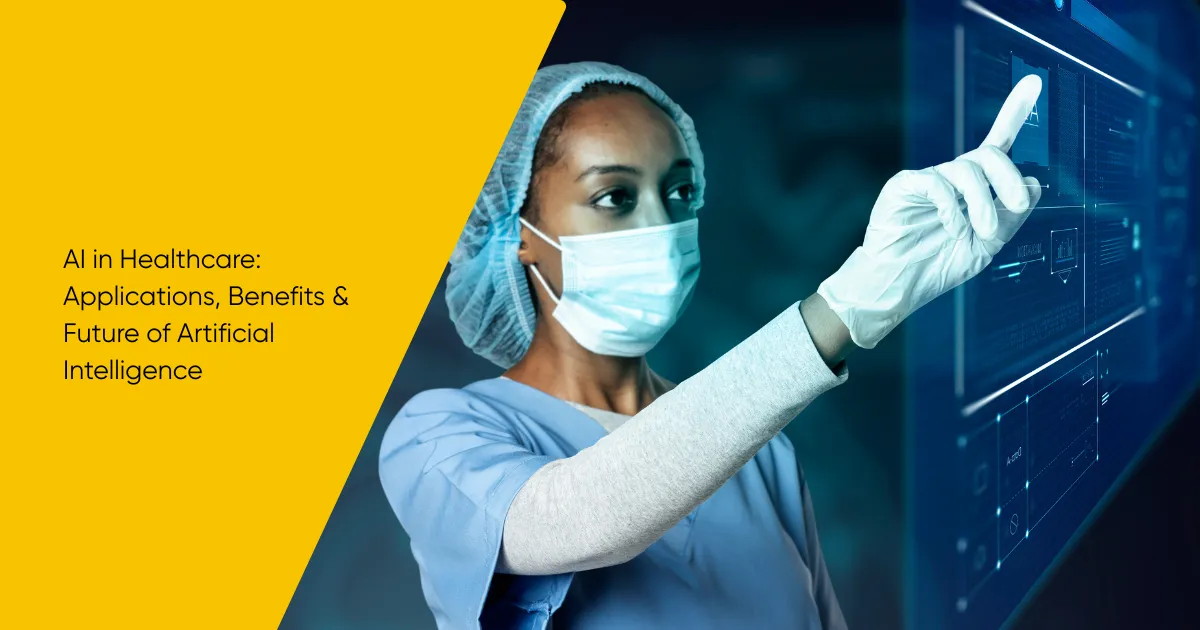
The integration of artificial intelligence (AI) into health care has transformed the industry in significant ways. Today, AI is being used for early detection, clinical documentation, discovering medications and generating personalized treatment plans. It also helps in robotic-assisted surgery, assisting surgeons in performing complex procedures. This comprehensive guide explores the usage of AI in healthcare, its current applications, key benefits and the future scope in the industry.
How is AI Used in Healthcare?
Artificial intelligence in healthcare uses various technologies to address specific issues and enhance patient care. The table below highlights how is AI used in healthcare, including examples of both clinical and administrative applications.
| AI Technology |
Usage in Healthcare |
| Machine Learning (ML) |
Machine learning technologies help analyze historical patient data to identify patterns that can inform risk prediction, diagnostic support, and personalized care recommendations. |
| Deep Learning |
Deep learning technology uses neural networks to process unstructured visual data like medical images and pathology slides. It can detect patterns, abnormalities, and provide interpretations that assist clinicians. |
| Natural Language Processing (NLP) |
NLP enables systems to understand and interpret human language. It helps extract insights from clinical notes, discharge summaries, and medical records to automate documentation. |
| Robotic Process Automation (RPA) |
RPA helps automate repetitive administrative tasks such as billing, claims processing, and appointment scheduling. The technology increases operational efficiency in hospitals and clinics. |
| Predictive Analytics |
Predictive analytics is used in healthcare to analyze patient outcomes and forecast future risks. It also helps in tailoring treatment decisions and optimising operational improvements that may lead to cost reductions and better care quality. |
| Conversational AI & Virtual Assistants |
Chatbots and voice assistants can support patient queries and appointment scheduling by handling routine requests and providing information. They can help improve patient engagement and reduce administrative burden for staff. |
The Role of Artificial Intelligence in Healthcare
The role of artificial intelligence in healthcare goes beyond simple automation. It helps healthcare professionals analyze medical images and support disease detections. AI in health care also enhances personalized treatment plans leading to better patient outcomes. Below are some of the major areas of AI applications in healthcare:
1. Diagnostic Imaging and Disease Detection
Machine learning models help to transform diagnostic imaging to analyze X-rays, MRIs and CT scans. AI-assisted interpretation of scans can highlight subtle abnormalities and patterns that may be overlooked during routine review. This can help speed up the disease detection process, improving the diagnostic accuracy and treatment planning.
2. Robotic-Assisted Surgery
AI-based robotic surgical equipment enables surgeons to conduct the procedures with more precision and control. This aids in reducing the tremors and gives real-time updates during the surgeries. These systems support minimally invasive procedures by enabling smaller incisions, greater precision, and faster recovery times for patients.
3. Predictive Analytics and Early Intervention
AI healthcare systems, when implemented in intensive care units, can analyze continuous vital signs, test results, and patient history. This helps detect early warning signs of clinical deterioration before symptoms appear and offers timely treatment. These systems identify subtle patterns that human observers might overlook, supporting proactive care in critical settings.
4. Drug Discovery and Development
AI for medical drug discovery increases the search for potential medical candidates. AI can search through huge libraries of chemical compounds to identify those with potential for treating specific diseases. This can contribute to the reduction of the cost and time of drug discovery. Predictive modelling algorithms can use the molecular structure and interactions to predict the efficacy and safety of new drugs.
5. Healthcare Analytics
AI helps accelerate the speed of processing and extracting vast amounts of data. This can lead to proactive care, better diagnoses and more efficient hospital operations. They help organizations identify trends and make data-driven decisions about patient care and facility management.
6. Precision Medicine
Today, AI healthcare technologies play an important role in precision medicine or individualized treatment strategies. It considers the genetic structure, medical history, environmental factors and lifestyle. This approach helps improve treatment effectiveness and helps reduce side effects by helping choose therapies that are most likely to benefit a specific patient.
7. Virtual Health Assistants and Patient Engagement
Virtual AI assistants are created to help with patient questions, patient care recommendations and appointment support. These solutions provide significant improvements in patient engagement and productivity by automating routine tasks and offering highly individualized health care interventions.
8. Administrative Automation
The role of artificial intelligence in healthcare includes streamlining administrative r tasks or procedures. This involves arranging appointments, billing, claims processing and electronic health records administration. They help reduce operational costs and also improve efficiency. AI healthcare tools can be used by physicians to record visit notes and upload them to patient files so they can spend more time caring for patients.
9. Remote Patient Monitoring
Remote Patient Monitoring (RPM) is one of the most popular AI applications in healthcare. It helps transform healthcare by continuously tracking patients outside clinical settings. These algorithms help analyse massive data streams in real time to predict early health deterioration, monitor conditions, and thus prevent serious conditions in advance.
Benefits of AI in Healthcare
The benefits of AI in healthcare are substantial and observable across clinical, operational, and patient experience dimensions.
Clinical Benefits
- Using AI in health care helps identify subtle patterns that help in early diagnosis.
- AI for medical diagnosis also assists physicians in developing effective treatment plans.
Operational Benefits
- AI helps streamline administrative tasks and automates workflows.
- AI algorithms helps analyze patient data to identify high-risk cases and prioritize patient care first.
Patient Experience Benefits
- AI in healthcare ensures improved accessibility and delivery through remote monitoring tools.
- It creates recommendations for improved patient care based on individual health data, patterns, and risk predictions.
- AI-powered tools help resolve patient queries, providing instant access to health information.
The Future of Artificial Intelligence in Healthcare
Hospitals, clinics and laboratories are rapidly adopting AI technologies to enhance patient care. This shift is streamlining and improving processes across India and the world, from diagnostics to data management. The future of artificial intelligence in healthcare envisions systems that handle both routine administrative tasks and complex clinical decision-making. AI in healthcare is expected to enhance the diagnostic accuracy, enable new medical cures and also expand patient care.
Expected Future Developments
1. Hyper-personalization & predictive medicine: AI helps analyze genetic profiles to provide individualized treatment approaches and identify potential disease risks earlier. This moves healthcare from a reactive to a proactive prevention paradigm.
2. Accelerated drug discovery and trials: AI can virtually simulate drug interactions and match diverse trial participants. This can help reduce research time and costs and make clinical studies more efficient.
3. Augmented clinical workflows & operations: Generative AI can help automate administrative tasks like updating EHRs and billing. Hospital staffing and patient flow can be improved by predictive analytics to reduce wait times.
4. Continuous care & telemedicine: AI-powered virtual assistants and wearable sensors will enable remote continuous monitoring, conducting symptom checks and alerting medical teams to sudden physiological changes.
5. Ethical AI and governance: The industry is working towards integrating strict mechanisms to detect and correct algorithmic biases. This can help build trust in AI-driven healthcare decisions.
Challenges and Ethical Considerations
Despite the many benefits of AI in healthcare, there are numerous challenges. Data privacy is a critical concern, as patient data must be protected when using AI systems. Bias in AI models is another significant issue, as they can skew results and exacerbate health disparities among different populations. This also creates ambiguity for doctors about how certain recommendations are reached. There is also a growing need for professionals who are skilled in both AI technology and healthcare practices to effectively deploy and operate these systems.
Regulatory barriers may also present another barrier to ensuring AI tools meet all legal and safety standards, as this is a complex and time-consuming process. Integration of AI may face challenges with the existing healthcare infrastructure, since they require careful planning and investment. Finally, determining legal responsibility in case of AI-assisted medical errors also remains highly contested and unsettled.
Conclusion
Artificial intelligence is actively reshaping today’s healthcare. AI in healthcare now includes improved diagnostics, drug discovery, robotic surgery, personalized treatment planning, and administrative automation. The usage of AI in healthcare helps enhance diagnostic accuracy, accelerate drug discovery, reduce operational costs, and improve accessibility. There is increased adoption of these technologies among medical professionals and consumers, increasing their demand. With the healthcare domain steadily adopting these innovations, there is potential to bring quality healthcare to all.
If you are interested in building a career in healthcare, explore the allied and health science programs at JAIN (Deemed-to-be University) and prepare for the evolving future of medicine.
FAQs
Q1. Why AI Works in Healthcare?
A1. AI in health care is beneficial because it processes vast medical data quickly, identifies patterns humans miss, and supports faster, more accurate clinical decisions.
Q2. What are the top uses of AI in healthcare?
A2. Top uses include medical imaging analysis, disease prediction, drug discovery, personalized treatment plans, robotic surgery, and administrative automation.
Q3. How does AI help doctors and hospitals?
A3. AI automates routine tasks, improves diagnostic accuracy, predicts patient outcomes, optimizes resources, and reduces administrative burdens for staff.
Q4. Is AI replacing jobs in healthcare?
A4. No, AI augments healthcare jobs by handling repetitive tasks, freeing professionals to focus more on direct patient care and complex decisions.
Q5. What are the benefits of AI in healthcare?
A5. Benefits include improved diagnostic accuracy, faster decisions, reduced costs, early disease detection, and better patient outcomes.
Q6. How is AI used in medical field?
A6. AI diagnoses diseases through imaging, predicts health risks, creates treatment plans, manages medical records, and accelerates drug development.