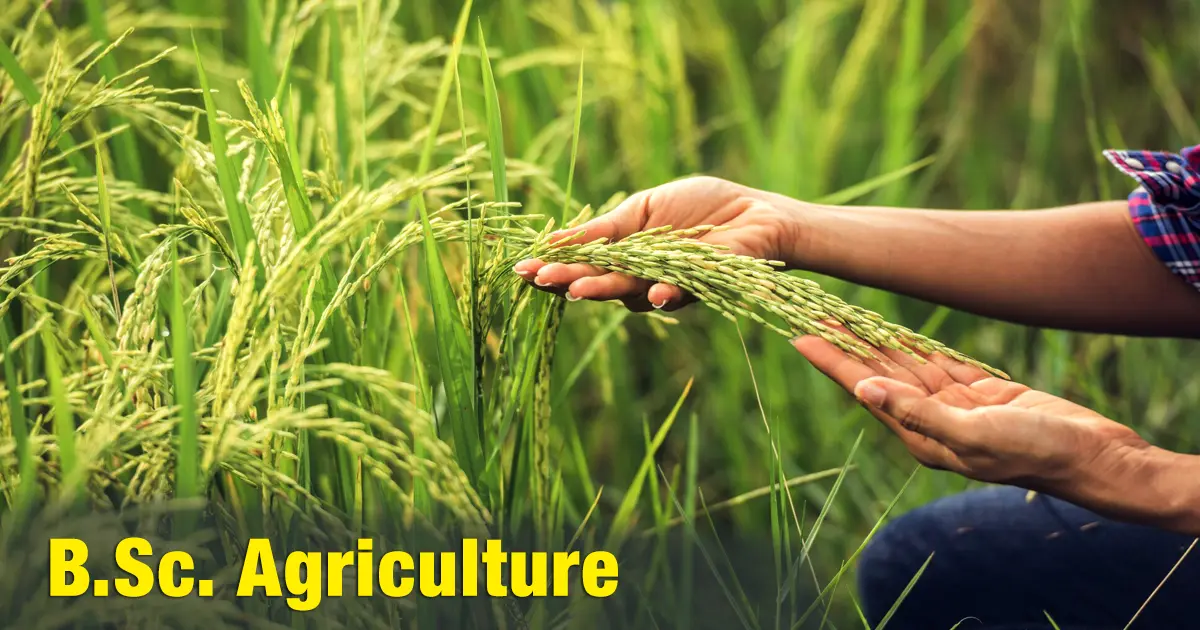
The Indian Agricultural industry has evolved from traditional practices into an advanced field that integrates science and technology. If you are a student aspiring to merge an interest in nature with scientific inquiry, then enrolling in a B.Sc. Agriculture degree will open doors to a critical global sector. This four-year undergraduate program covers diverse disciplines, including genetics, plant pathology, soil sciences, and Agricultural microbiology.
As part of our guide, you will find complete B.Sc. Agriculture course details to help you understand why this discipline is a cornerstone of modern Indian education.
Why Choose B.Sc. Agriculture?
India maintains an Agriculture-based economy at its core. Nevertheless, due to global shifts like climate change and rapid population growth, the 21st century requires a new generation of specialists in this field.
There is a common misconception among students regarding the professional scope of this discipline; specifically, many wonder whether it is limited to farming. However, this notion is inaccurate, as the B.Sc. Agriculture Degree involves the use of innovative scientific approaches and data-driven technology to enhance Agricultural efficiency and sustainability.
B.Sc. Agriculture Course Eligibility Criteria
To apply for admission at one of the leading institutions, it is important to understand the B.Sc. Agriculture Course Details and the corresponding B.Sc. Agriculture Course Eligibility Criteria. This is because most universities in India have established benchmarks based on which students must have a specific foundational background.
- Educational Qualification: Candidates must have completed their 10+2 or equivalent examination from a recognized board.
- Subject Requirements: It is mandatory to have studied Physics, Chemistry, and Biology (PCB) or Physics, Chemistry, and Mathematics (PCM). Some institutions also accept Agriculture as a vocational subject.
- Minimum Marks: Generally, a minimum aggregate of 50% marks in the qualifying examination is required, though this may vary slightly depending on the university and category reservations.
- Age Limit: Most colleges require the candidate to be at least 17 years of age at the time of admission.
B.Sc. Agriculture Admission Process in India
In India, enrollment in this program typically occurs through entrance exams or merit-based selection. The B.Sc. Agriculture admission process in India has evolved significantly in recent years; while the Indian Council of Agricultural Research (ICAR) previously conducted the AIEEA UG, admission to most premier Agricultural universities is now facilitated through the CUET (Common University Entrance Test). Additionally, various state-level Common Entrance Tests (CETs) remain a primary route for regional institutions.
Private universities, such as JAIN (Deemed-to-be University), often employ more holistic selection criteria. These institutions may require candidates to complete an internal entrance assessment followed by an interview to evaluate their aptitude for the Agricultural sciences. Prospective students should diligently monitor application deadlines, which typically fall between April and June.
B.Sc. Agriculture Syllabus and Subjects
The course design has been developed as a mixture of theoretical classroom lectures and intensive field practicals. The B.Sc. Agriculture syllabus and subjects have been divided into eight semesters, providing students with an all-around understanding of the field. This structure ensures that academic learning is consistently reinforced by hands-on experience, preparing graduates for the technical demands of the industry.
Foundational Subjects
In the initial years, the focus is on building a base in the sciences. You will study subjects such as:
- Agricultural Meteorology
- Fundamentals of Soil Science
- Introduction to Computer Applications
- Rural Sociology and Educational Psychology
Core Technical Subjects
As you progress, the subjects become more specialized. These include:
- Plant Breeding and Genetics
- Agricultural Entomology
- Plant Pathology
- Crop Production Technology
Practical Training and Rural Immersion
One of the most interesting aspects of the B.Sc. Agriculture syllabus and subjects is the RAWE (Rural Agricultural Work Experience) program. It usually occurs in the final year of studies when students stay in rural areas and interact directly with the farmers there. The importance of this aspect lies in the fact that it helps combine theoretical knowledge with real-world practice, ensuring that graduates are well-prepared for the practical challenges of the Agricultural sector.
Career Opportunities and Professional Scope
The B.Sc. Agriculture scope and salary are key concerns for students who intend to pursue a career in Agricultural Science. Fortunately, the field is remarkably broad; graduates are not limited to field or farm work. Their expertise is highly sought after by corporations specialising in fertiliser production, seed technology, and food processing, as well as various governmental departments.
Public sector roles are often pursued for their stability and competitive pay scales. Obtaining a B.Sc. Agriculture degree allows candidates to apply for positions such as Agricultural Officer (AO), Technical Assistant, and Research Associate. These coveted posts are typically secured through the Agricultural Field Officer (AFO) exams conducted by IBPS for the banking sector or through specialized State Public Service Commission examinations for administrative roles. Consequently, the potential for a stable and prestigious career after B.Sc. Agriculture is significant for those who successfully navigate these competitive assessments.
Beyond institutional employment, a bachelor's degree in this discipline can lead toward establishing private business ventures. The industry is currently seeing a surge in "Agri-tech" startups, driven by a new generation of entrepreneurs who are innovating within the Agricultural value chain.
Understanding the Salary Trends in India
Financial stability is a significant factor in career selection. When evaluating the B.Sc. Agriculture scope and salary, it is clear that the B.Sc. Agriculture salary in India varies based on the sector and the specific role. Professional opportunities range from research and development to agribusiness management, each offering different levels of remuneration and long-term growth.
- Entry-Level Roles: Fresh graduates usually start with an annual salary ranging from ₹3,00,000 to ₹5,00,000. These roles provide a foundational understanding of the Agricultural value chain.
- Government Sector: Public sector roles offer stability and structured pay scales. The salary for an Agricultural Field Officer or a State Technical Assistant often starts at ₹5,00,000 to ₹7,00,000 per annum, inclusive of various allowances.
- Private Sector: Companies in the FMCG or seed industry may offer higher starting packages for students from reputed universities, especially in specialized research and development roles.
- Career Progression: As you gain experience and perhaps pursue a postgraduate degree (MSc Agriculture or MBA in Agribusiness), the B.Sc. Agriculture salary in India can grow significantly, often reaching ₹10,00,000 to ₹15,00,000 per annum in senior management or senior scientist positions.
Sources: Data compiled from Glassdoor India (2026), IBPS Recruitment Pay Scales, and 6figr Agribusiness Salary Reports (2025-26).
The Evolving B.Sc. Agriculture Degree
As Artificial Intelligence (AI) and the Internet of Things (IoT) integrate into the primary sector, the scope of a B.Sc. in Agriculture is increasingly intersecting with advanced technology. Students now have the opportunity to specialise in fields such as Precision Farming and Global Positioning Systems (GPS), ensuring that professional compensation and career advancement remain competitive with other branches of engineering and the sciences.
Furthermore, as the global focus shifts toward sustainable practices, experts specialising in soil and water conservation have become essential to the industry. Choosing this path offers a high degree of stability, because global food demand is constant, Agriculture remains one of the most resilient industries in any economic climate.
Conclusion
A degree in Agriculture is a commitment to the future of the planet. It offers a unique combination of outdoor work, laboratory research, and business management. Take the first step toward becoming an Agricultural leader.
Explore our comprehensive curriculum and discover why we are considered one of the best agriculture courses after 12th in India. Your journey toward a resilient and impactful future starts here.
Apply now and lead the change in global food security.
FAQs
Q1. What is the best option after B.Sc. Agriculture?
A1. Graduates can pursue an MSc in specialized fields or an MBA in Agribusiness for corporate roles. Alternatively, you can appear for competitive government exams like UPSC or IBPS AO for stable public sector careers.
Q2. Is B.Sc. Agriculture easy or hard?
A2. It is a balanced program. While subjects like genetics require focused study, the practical field sessions and rural work experience make the curriculum engaging and manageable for science students.
Q3. Is B.Sc. Agriculture a good career?
A3. Yes. It is an excellent career choice. With the rise of agri-tech and the global need for food security, a career after B.Sc. Agriculture offers high job security across both corporate and government sectors.
Q4. How many years is B.Sc. Agriculture?
A4. The course is a four-year undergraduate program divided into eight semesters. It includes a mandatory period of rural Agricultural work experience in the final year.
Q5. What is B.Sc. Agriculture salary?
A5. The B.Sc. Agriculture salary in India for freshers typically ranges between 3,00,000 and 6,00,000 per year. With experience and higher education, this can increase to over 12,00,000 per year in senior or specialized roles.