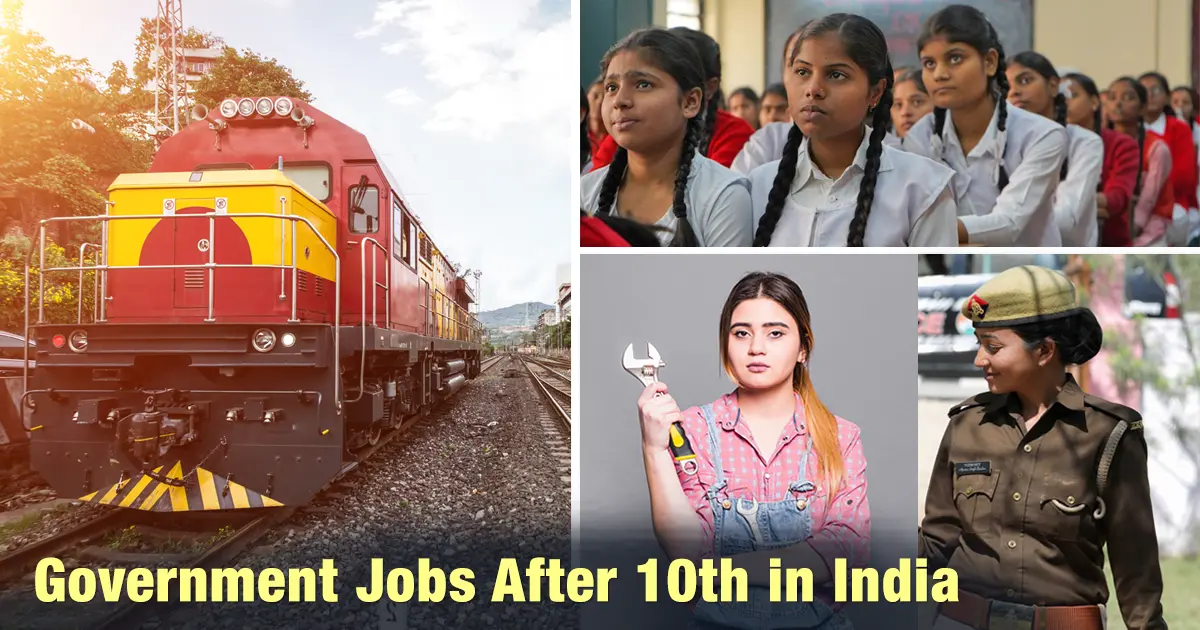
Many students assume that entering public service requires a university degree, completely overlooking the robust employment pathways available immediately after schooling. In reality, multiple public sectors offer stable career opportunities to candidates who have cleared their matriculation.
This path allows young aspirants to secure financial independence early by joining respected departments like the Indian Railways or the defense services.
This comprehensive guide outlines the best government jobs after 10th in India, detailing critical factors such as salary scales, eligibility criteria, and selection procedures to jumpstart your career.
Why Government Jobs Remain Popular After 10th
Securing a government jobs after 10th in India continues to be a highly sought-after career path due to unmatched job security, structured pay revisions under the Pay Commission, and transparent, merit-based recruitment tracking.
A primary driver of this popularity is the broad demographic reach of these entry-level examinations. Mass-recruitment drives routinely bridge the employment gap between rural and urban youth, eliminating complex professional filters. For instance, national-level assessments like the Staff Selection Commission Multi-Tasking Staff (SSC MTS) exam consistently see massive engagement, drawing over 36 lakh applications for approximately 7,948 active vacancies. Similarly, the India Post Gramin Dak Sevak (GDS) recruitment drive opens up over 28,600 merit-based positions annually, establishing a direct entry route based on metric scores. Furthermore, the accommodating nature of these roles provides financial stability while allowing selected candidates the flexibility to pursue higher education or parallel competitive exam preparations.
Government Jobs List After 10th Pass
The tables below show the top national and state-level exams for government jobs after 10th in India, divided by sector and job type.
1. Non-Technical and Administrative Exams
These roles focus on general administration, office support, and basic logistics.
| Exam Name |
Primary Job Roles |
Eligibility |
Age Range |
| SSC MTS Exam |
Staff, Peon, Chowkidar |
10th Pass |
18–25 years (up to 27 for some posts) |
| India Post GDS Recruitment |
Gramin Dak Sevak, Postmaster |
10th Pass (merit-based selection) |
18–40 years |
| RRB Non-Technical Level-1 Exam |
Assistant Pointsman, Hospital Assistant |
10th Pass |
18–33 years |
| DRDO CEAMTS Exam |
Multi-Tasking Staff (MTS), Support Staff |
10th Pass |
18–25 years |
2. Technical and Infrastructure Exams
These roles involve technical assistance, workshops, and equipment maintenance.
| Exam Name |
Primary Job Roles |
Eligibility |
Age Range |
| RRB Technical Level-1 Exam |
Track Maintainer, Workshop Assistant |
10th Pass + ITI or Apprenticeship (NAC) |
18–33 years |
3. Defense and Uniformed Services Exams
These exams offer a direct entry into the armed forces, coast guard, and police departments.
| Exam Name |
Primary Job Roles |
Eligibility |
Age Range |
| Indian Army Agniveer Rally |
Agniveer General Duty (GD) |
10th Pass with 45% aggregate |
17.5–21 years |
| Indian Navy Agniveer MR Exam |
Agniveer Matric Recruit (Chef, Steward) |
10th Pass |
17.5–21 years |
| Indian Coast Guard Navik Exam |
Navik Domestic Branch (DB) Cook/Steward |
10th Pass |
18–22 years |
| State Police Constable Exam |
Police Constable, Security Guards |
10th Pass or 12th Pass (varies by state) |
18–25 years (varies by state) |
Railway jobs remain one of the largest recruiters of Class 10 qualified candidates. RRB Level-1 exams attract massive nationwide interest due to their high vacancy counts in both technical and non-technical tracks. The SSC MTS Exam is another popular choice due to its regular, highly structured online testing system.
Salary of Government Jobs After 10th Pass
Initial packages are highly standardized, with most roles commencing at Pay Level 1 under the 7th Pay Commission (minimum basic pay of ₹18,000), while defense roles utilize Level 3 or customized scales. Beyond basic pay, monthly in-hand earnings depend on structural factors: geographic posting (HRA scales dynamically at 27% for X-class metros, 18% for Y-class cities, and 9% for Z-class towns), statutory allowances (such as standard Dearness Allowance and Transport Allowance), and promotional growth through internal departmental exams that elevate candidates to higher pay levels over time.
| Job Role / Exam |
Pay Matrix Level |
Entry Basic Pay (Monthly) |
Approximate In-Hand Salary (Monthly) |
| SSC MTS |
Level 1 |
₹18,000 |
₹24,000 – ₹28,000 (city-dependent) |
| RRB Non-Technical / Technical |
Level 1 |
₹18,000 |
₹22,000 – ₹27,000 (excluding overtime perks) |
| India Post GDS |
TRCA Structure |
₹10,000 – ₹12,000 |
₹12,000 – ₹15,000 (base + limited allowances) |
| Indian Army Agniveer GD |
Customized Package |
₹21,000 (Year 1 Base) |
₹30,000 gross first-year package |
| Indian Navy Agniveer MR |
Customized Package |
₹21,000 (Year 1 Base) |
₹30,000 gross first-year package |
| Indian Coast Guard Navik (DB) |
Level 3 |
₹21,700 |
₹26,000 – ₹30,000 base |
Government Jobs After 10th for Girls
Recruitment opportunities for female candidates exist across several public departments, offering clear avenues for career stability. These roles are available through both national and state-level selection processes.
Candidates tracking government jobs after 10th for female applicants need to review official notifications carefully. Essential criteria, such as age relaxations, horizontal reservation rules, and physical eligibility standards, vary depending on the specific department.
Those looking for a 10th pass govt job for female candidates can find regular vacancies in postal networks, administrative support wings, and state civil departments. These positions provide standard working hours and structured career paths through local recruitment boards.
Selection Process for Government Jobs After 10th
The selection process varies by sector. While administrative positions emphasize academic testing, uniformed roles prioritize physical fitness. The selection process generally follows one of these structured tracks:
- Administrative & Support Tracks (SSC MTS / DRDO): Candidates must clear a single-stage Computer-Based Test (CBT) covering core subjects like numerical aptitude and general awareness. This is followed directly by mandatory Document Verification (DV).
- Railway Tracks (RRB Level-1 Exams): Recruitment involves a primary Computer-Based Test (CBT), followed by a qualifying Physical Efficiency Test (PET), and a final medical examination alongside Document Verification.
- Defense & Uniformed Tracks (Agniveer / Police): The selection process initiates with an Online Common Entrance Exam (CEE). Shortlisted candidates must pass a rigorous Physical Fitness Test (PFT), a Physical Measurement Test (PMT), and a comprehensive medical evaluation.
How to Apply for Government Jobs After 10th
To secure government jobs after 10th in India, candidates must apply through the authorized departmental portals matching their target exam. Reviewing this process helps individuals searching for a 10th pass govt job for female or male candidates submit error-free forms. Here are the basic steps to apply for these positions.
- Access Authorized Portals: Submit forms directly via official sites like the Staff Selection Commission Portal for MTS, regional Railway Recruitment Boards (RRB) for Level-1 roles, or the India Post GDS Engagement Portal for postal circles.
- Complete One-Time Registration: Generate your unique login credentials by filling in verified contact data and matriculation details on the department homepage.
- Verify Qualification Limits: Download the specific notification to confirm exact cut-off timelines. Rejection Warning: Applications are routinely disqualified for mismatched names against 10th certificates or inaccurate category selection.
- Input Personal & Post Preferences: Fill in your academic scores, select regional examination centers, and lock in specific post preferences.
- Upload Compliant Documents: Scan and upload your passport photo and signature strictly within the required dimensions and file size limits.
- Process Online Fee Payment: Pay the required exam fees through secure net banking, UPI, or card portals, then download the final confirmation receipt.
Conclusion
Securing government jobs after 10th in India provides long-term stability and structured career growth. However, aspirants must balance this opportunity with the reality of intense competition and massive applicant numbers. Success requires disciplined preparation in quantitative aptitude, reasoning, and general awareness to clear high cut-off benchmarks.
For candidates balancing exam preparation with higher education, JAIN (Deemed-to-be University) offers flexible degree programs that provide the scheduling freedom needed to study for competitive exams simultaneously. Visit the official JAIN (Deemed-to-be University) portal to select a program that matches your career goals.
FAQs
Q1: Which government job is best after 10th?
A1: The ideal choice depends on your preference. For office-based desk roles, SSC MTS is preferred. For maximum promotional opportunities and growth, RRB Level-1 (Railways) is optimal. For direct selection without an exam, India Post GDS stands out.
Q2: Is there any direct government job after 10th without exam?
A2: Yes. The India Post Gramin Dak Sevak (GDS) recruitment selects candidates automatically based strictly on their 10th-grade board merit scores. Some Public Sector Undertakings (PSUs) also offer exam-free entry-level apprenticeships via direct merit listings.
Q3: What are the government jobs after 10th for girls?
A3: Female aspirants heavily target SSC MTS for secure, office-based administrative schedules with zero physical test criteria. Additionally, India Post GDS offers highly localized village/town circles, while uniform branches like SSC GD Constable offer dedicated horizontal reservations.
Q4: What is the age limit for government jobs after 10th?
A4: The general age limit spans 18 to 25 years (up to 27 for select SSC MTS posts, 33 for Railways, and 40 for India Post GDS). Standard upper-age relaxations apply nationwide: 3 years for OBC and 5 years for SC/ST candidates.
Q5: What is the salary for government jobs after 10th?
A5: Level-1 central posts (SSC MTS/RRB) yield a starting net monthly in-hand package of ₹22,000 to ₹28,000 under the 7th Pay Commission. Alternatively, India Post GDS roles operate on a distinct TRCA hourly pay model ranging from ₹12,000 to ₹15,000 monthly.
Q6: How to prepare for 10th pass government exams without coaching?
A6: Master foundational NCERT textbooks (Classes 6 to 10) covering core mathematics, reasoning, and English. Align your routine entirely around solving previous year question papers (PYQs) and completing timed online mock tests to optimize your speed and accuracy.