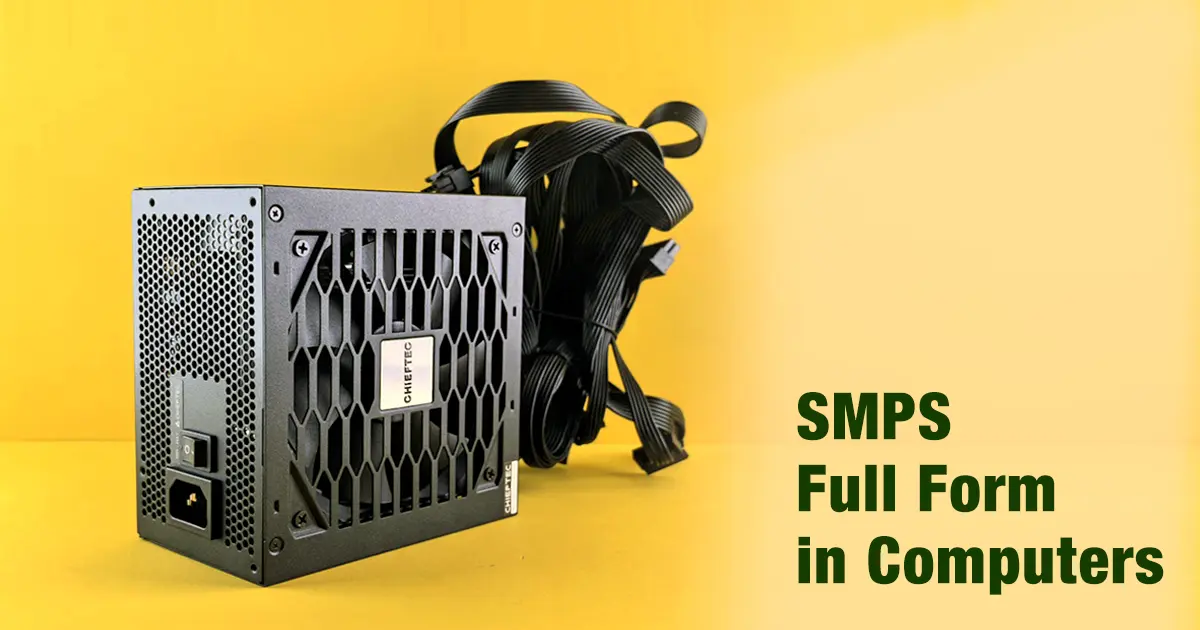
To power a computer, more is required than simply connecting it to the mains supply. The intricate electronic circuits inside a computer cannot handle the high-voltage alternating current that comes directly from the main power source. Therefore, an intermediary device is required to convert and regulate the power safely. This device is known as the SMPS. In this article, we will explore the SMPS full form, its evolution, and why it remains an essential component of modern computing.
What is SMPS?
To begin with the basics, the SMPS full form stands for Switched-Mode Power Supply. In computer hardware discussions, this is often referred to as the computer SMPS full form, as it powers and regulates electricity for the various internal components of a computer. An SMPS uses a switching regulator to convert electrical power efficiently. Unlike older linear regulators that waste excess energy as heat, an SMPS rapidly switches the power device on and off to minimize energy loss and improve efficiency.
The History of SMPS
The history of SMPS reflects a significant phase in the evolution of power electronics. Although the concept of switching power supplies dates back to the 1930s, it did not become practical for portable electronics until much later. Early computers relied on linear power supplies, which were inefficient, bulky, and heavy.
By the late 1970s and early 1980s, switching power supplies began to gain widespread acceptance. This shift was driven in part by advancements in power conversion technology, including improvements made to address weight and heat dissipation challenges in space missions. As these designs proved more efficient and compact, companies such as Apple and IBM adopted them in their computer systems, contributing to the wider recognition of the SMPS full form in modern computing technology.
Working Principles of SMPS
The working principles of SMPS are based on the concept of pulse-width modulation (PWM). Instead of reducing voltage through resistance or heat dissipation, the system rapidly switches the input voltage on and off at a very high frequency to regulate power efficiently.
The basic stages involved are usually as follows:
- Rectification: The incoming alternating current (AC) from the mains is first converted into direct current (DC).
- High-frequency switching (inversion): This DC is then switched at a very high frequency using electronic components such as metal-oxide semiconductor field-effect transistors (MOSFETs), effectively converting it into high-frequency AC.
- Transformation: A compact transformer is used to step the voltage up or down to the required level. Because the signal is at a high frequency, the transformer can be much smaller and lighter than those used in traditional power supplies.
- Output rectification and filtering: Finally, the high-frequency AC is converted back into DC and filtered to produce stable output voltages such as 3.3V, 5V, and 12V.
By adjusting the ratio of the switch’s “on-time” to “off-time,” the SMPS maintains a constant output voltage even when there are fluctuations in the input supply.
Key Features of SMPS
When examining the features of SMPS, several characteristics explain its widespread use in modern electronic devices:
- Compact Design: Because it operates at high frequencies, it can use smaller transformers and capacitors, resulting in a lighter and more compact design.
- High Efficiency: Most modern units operate at around 80%–90% efficiency, which means less energy is lost during the power conversion process.
- Voltage Regulation: It helps maintain stable output voltages and protects internal components from fluctuations in the input power supply.
- Wide Input Range: Many units can operate across a broad range of input voltages, allowing compatibility with different electrical standards around the world.
Advantages and Disadvantages of SMPS
Understanding the advantages and disadvantages of SMPS helps explain why it is widely used despite certain technical challenges.
Advantages:
- Reduced Heat: Due to its high efficiency, an SMPS generates significantly less heat compared to traditional linear power supplies.
- Multiple Output Voltages: A single unit can deliver several regulated output voltages (such as 3.3V, 5V, and 12V) to support different computer components.
- Cost Efficiency in Production: Although the design is technically complex, the reduced use of heavy materials like copper and iron makes large-scale manufacturing more economical.
Disadvantages:
- Electromagnetic Interference (EMI): High-frequency switching can produce electronic noise, which often requires filtering and shielding.
- Circuit Complexity: The intricate design makes troubleshooting and repair more difficult for non-specialists.
- Higher Quality Units Cost More: While standard units are affordable, high-quality SMPS models with better components may be relatively expensive.
Conclusion
Knowing the full form of SMPS in computer systems is only the first step in understanding how modern computing devices function. From its early development in aerospace engineering to its present-day role as an efficient power supply in electronic systems, the SMPS has played an important role in improving energy efficiency and power management. It provides the stable and regulated power required to support modern processors and graphics hardware.
For those who want to get into the nitty-gritty of system architecture and its interaction with software and hardware, there are specialized courses for that as well. For those looking to dive deeper into technology, check out the B.Tech in Computer Science and Engineering at JAIN (Deemed-to-be University) to build a strong foundation in modern computing systems.
Frequently Asked Questions (FAQs)
Q1. What is the meaning of SMPS?
A1. SMPS stands for Switched-Mode Power Supply, a device that efficiently converts electrical power for use in electronic systems. In computer systems, the full form of SMPS in computer refers to the power supply unit responsible for converting and regulating electricity for internal components.
Q2. What is a SMPS power supply?
A2. It is an electronic circuit which is used for converting alternating current from a mains outlet to the appropriate direct currents needed by the computer's hardware, like the CPU and the hard disk.
Q3. What is the use of SMPS?
A3. Its main function is to regulate the electrical power supply to electronics and protect them against any fluctuation of the power supply source.
Q4. What is SMPS and its voltage?
A4. It is a switching regulator system. Some of the common output voltages that can be supplied by a power unit include +3.3V, +5V, +12V, and 12V.
Q5. Is SMPS necessary?
A5. Yes, it is needed for computers because the computer's hardware cannot operate using an alternating current source.
Q6. Is SMPS ac or dc?
A6. An SMPS takes AC input and converts it into DC output. Internally, it switches between AC and DC to improve efficiency.
Q7. Is SMPS a inverter?
A7. An SMPS is not considered an inverter. The inverter transforms DC into AC, while the SMPS mainly transforms AC into DC at different voltages.
Q8. How to calculate SMPS wattage?
A8. The formula is simple: multiply volts (V) and amps (A) of each rail and add them together. There will be a wattage rating indicated on the unit's label.
Q9. How to check SMPS is working or not?
A9. This test should be performed carefully to avoid electrical hazards.
Q10. How to check a 6-pin SMPS?
A10. The method involves measuring the voltage between the yellow (12V) and black (Ground) wires on the 6-pin connector with a multimeter when the PC is running.