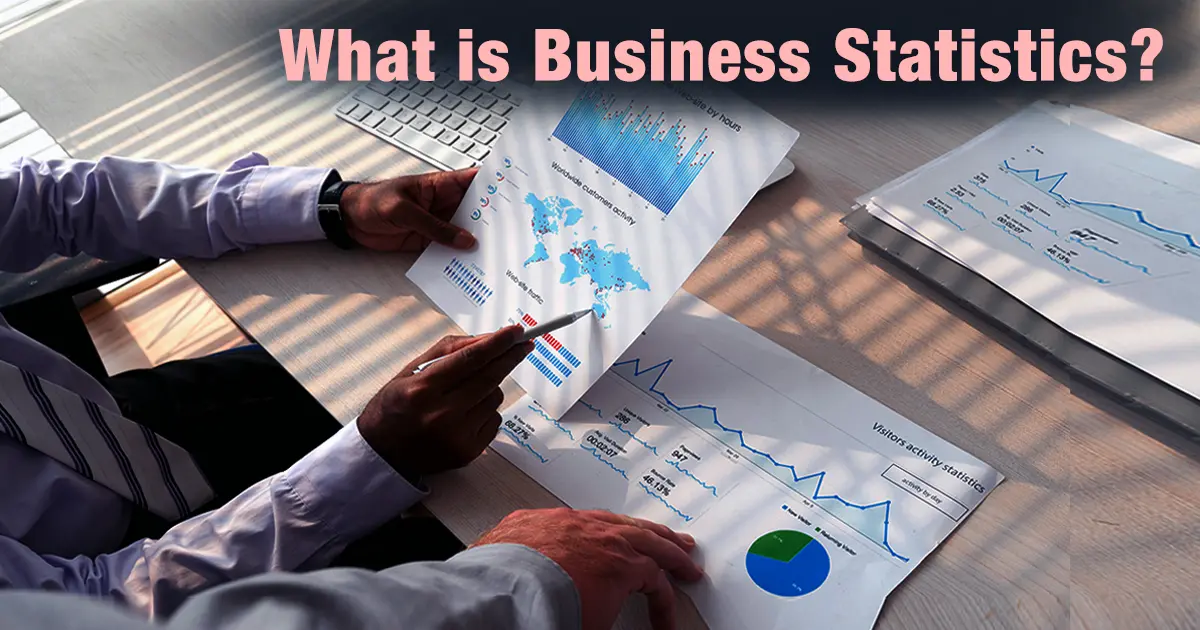
Data influences almost every business activity, from understanding customer behavior to forecasting sales and evaluating financial performance. Organizations today rely on accurate information rather than assumptions to solve problems and plan for the future. This highlights what is Business Statistics and why it is a fundamental area of study for students and professionals alike.
Business Statistics combines statistical methods with business knowledge to collect, organize, analyze, interpret, and present data. It helps managers, entrepreneurs, researchers, and policymakers draw meaningful insights from data to solve business challenges and evaluate performance. Whether a company wants to identify market trends, improve operational efficiency, or measure customer satisfaction, Business Statistics provides the tools needed to analyze available information.
Understanding the importance of Business Statistics is essential for students pursuing business, commerce, economics, management, and analytics, as it equips them with the analytical skills required to interpret data, identify trends, and support effective business strategies across various functions.
What is Business Statistics?
To understand what is Business Statistics, it is helpful to begin with its purpose.
Business Statistics is the application of statistical techniques to business data for analysis, planning, and problem-solving. It involves collecting, organizing, analyzing, and interpreting data to support business operations and strategic planning.
Businesses generate large volumes of data every day through sales transactions, customer interactions, production processes, employee records, and financial reports. Business Statistics helps organize and analyze this information to identify patterns and support practical business decisions.
For example, a retail company may analyze monthly sales data to determine which products perform best during holiday seasons. A manufacturing company may use production statistics to identify quality issues, while a bank may evaluate customer loan data to estimate financial risk.
Rather than relying on assumptions, organizations use Business Statistics to answer questions such as:
- Which product generates the highest profit?
- Which marketing campaign attracts more customers?
- How much inventory should be maintained?
- What factors influence customer satisfaction?
- What sales can be expected next quarter?
These practical uses explain why the importance of Business Statistics continues to grow across industries.
Characteristics of Business Statistics
Understanding the characteristics of Business Statistics helps explain why statistical analysis is useful in business decision-making.
Some important characteristics of Business Statistics include:
- It deals primarily with numerical data.
- Data is collected systematically using appropriate methods.
- Information is analyzed objectively rather than emotionally.
- Statistical findings represent groups or trends instead of isolated observations.
- Results are interpreted based on assumptions, data quality, and the methods used for analysis.
- Statistical analysis helps compare performance across different periods, markets, or business units.
These characteristics enable organizations to evaluate business performance using structured, evidence-based analysis and identify meaningful patterns and trends.
Importance of Business Statistics
The importance of statistics in business extends across planning, operations, finance, marketing, and strategic management. Business Statistics enables organizations to analyze data systematically, identify trends, measure performance, and make accurate forecasts across different business functions.
Some major benefits include:
- Better Business Analysis – Statistical techniques help managers compare alternatives using measurable data, identify patterns, and evaluate the likely outcomes of different business strategies.
- Demand Forecasting – Historical sales data helps organizations estimate future demand, allowing better production planning and inventory management.
- Risk Assessment – Businesses assess financial, operational, and market-related risks by analyzing historical trends, probability distributions, and predictive models.
- Customer Analysis – Organizations examine customer purchasing behavior, feedback, and preferences to identify market segments, improve products, and enhance customer satisfaction.
- Performance Measurement – Statistical reports and key performance indicators (KPIs) help businesses benchmark employee productivity, sales growth, operational efficiency, and financial performance across different periods, departments, or business units.
These examples clearly demonstrate the role of statistics in business as a practical decision-support tool rather than simply a mathematical discipline.
Scope of Business Statistics
The scope of Business Statistics has expanded significantly because organizations now generate larger volumes of digital data than ever before.
Business Statistics supports decision-making across several functional areas.
| Business Function |
Statistical Application |
| Marketing |
Customer segmentation, campaign analysis, pricing decisions |
| Finance |
Investment analysis, budgeting, financial forecasting |
| Human Resources |
Recruitment analysis, employee performance evaluation |
| Operations |
Quality control, production planning, inventory management |
| Supply Chain |
Logistics optimization and demand forecasting |
| Research |
Consumer surveys and market research |
The broad scope of Business Statistics demonstrates that statistical methods are valuable across every department instead of being limited to research alone.
Functions of Business Statistics
The functions of Business Statistics extend beyond calculations. They support the complete decision-making process.
Some important functions of Business Statistics include:
- Decision Support – Provides quantitative evidence to compare alternatives and support strategic and operational business decisions.
- Forecasting – Uses historical data and statistical models to predict future sales, demand, market trends, and business performance.
- Performance Evaluation – Measures organizational performance by analyzing key performance indicators (KPIs), productivity, profitability, and operational efficiency.
- Risk Management – Identifies potential financial, operational, and market risks through trend analysis and probability-based assessments.
- Policy Formulation – Supports the development of business policies and long-term strategies using reliable data and statistical evidence.
- Resource Planning – Helps organizations allocate budgets, workforce, inventory, and other resources more effectively based on data-driven analysis.
Together, these functions help organizations evaluate performance, anticipate future challenges, minimize risks, and develop effective business strategies.
Types of Business Statistics
Understanding the types of Business Statistics helps students appreciate how different statistical methods answer different business questions.
The two primary types of Business Statistics are:
Descriptive Statistics
Descriptive statistics summarize and organize data using tools such as:
- Tables
- Frequency distributions
- Mean
- Median
- Mode
- Standard deviation
- Percentages
- Charts and graphs
For example, a company may summarize annual sales across different regions using tables, charts, and summary measures to understand overall performance and identify trends.
Inferential Statistics
Inferential statistics uses sample data to make predictions or conclusions about larger populations.
Common techniques include:
- Hypothesis testing
- Regression analysis
- Confidence intervals
- Correlation analysis
- Probability distributions
Businesses use inferential statistics to forecast demand, estimate market trends, evaluate customer preferences, and support strategic decision-making.
Both descriptive and inferential statistics complement each other and form the foundation of modern business analytics.
Applications of Business Statistics
The applications of Business Statistics span a wide range of industries, enabling organizations to analyze business data, monitor performance, forecast trends, and optimize operations across different functional areas.
Some of the most common applications of Business Statistics include:
- Marketing Research – Businesses analyze customer demographics, buying patterns, and campaign performance to understand consumer preferences. Statistical techniques also help evaluate the effectiveness of advertising channels and promotional activities.
- Financial Planning – Finance teams use statistical analysis to estimate revenue, prepare budgets, evaluate investment opportunities, and manage financial risks. Historical financial data supports reliable forecasting and resource allocation.
- Sales Forecasting – Companies study previous sales performance, seasonal demand, and market conditions to estimate future sales. Accurate forecasts help maintain appropriate inventory levels and production schedules.
- Quality Control – Manufacturing organizations use statistical quality control methods to monitor production processes, detect defects, and maintain product consistency, contributing to higher customer satisfaction and reduced operational waste.
- Human Resource Management – Human resource professionals analyze recruitment data, employee retention, training effectiveness, and workforce productivity to support workforce planning and performance evaluation.
- Supply Chain Management – Businesses evaluate supplier performance, transportation efficiency, inventory movement, and delivery timelines to improve supply chain operations and reduce unnecessary costs.
Examples of Business Statistics
A simple example makes the concept easier to understand.
Imagine a supermarket wants to know whether weekend discounts increase sales. The store collects sales data for several weeks before and after introducing discounts. After comparing the figures, management finds that weekend sales increased by 18 percent while weekday sales remained relatively stable.
Using statistical analysis, the supermarket can determine whether the increase is significant enough to continue the promotion. Instead of relying on assumptions, the decision is based on measurable evidence.
Similar examples can be found in banks evaluating loan applications, hospitals monitoring patient outcomes, airlines forecasting passenger demand, and online retailers recommending products based on customer behavior.
Business Statistics in the Age of Digital Transformation
As organizations adopt digital technologies, Business Statistics has become even more valuable. Modern businesses collect data from websites, mobile applications, payment systems, customer relationship management (CRM) platforms, and connected devices.
Advanced statistical techniques now support:
- Business intelligence dashboards that visualize key performance indicators (KPIs) and business trends.
- Predictive analytics to forecast future outcomes based on historical data and statistical models.
- Customer segmentation by grouping customers according to demographics, behavior, and purchasing patterns.
- Fraud detection through statistical analysis that identifies unusual transactions and suspicious activities.
- Inventory optimization by analyzing demand patterns to maintain efficient stock levels.
- Demand forecasting to estimate future customer demand and support production and supply chain planning.
- Financial risk assessment by evaluating market trends, credit risk, and investment performance using statistical models.
Professionals who understand statistical concepts are better equipped to interpret analytical reports, evaluate business performance, and contribute to data-driven business strategies.
Why Students Should Learn Business Statistics
Business Statistics is a core subject in commerce, management, economics, finance, and business analytics programs because it develops analytical thinking alongside quantitative skills.
Students learn how to:
- Interpret business data accurately.
- Identify patterns and trends.
- Evaluate research findings.
- Make evidence-based recommendations.
- Communicate statistical results clearly.
- Support strategic business decisions using data.
These abilities remain valuable across both private and public sector organizations.
Learning Business Statistics
Students pursuing business and management education benefit from learning statistical concepts alongside economics, finance, marketing, accounting, operations, and business analytics. At JAIN (Deemed-to-be University), the curriculum is designed to combine theoretical knowledge with practical application so that learners understand how statistical methods are used in real business situations.
Coursework typically emphasizes data interpretation, quantitative analysis, business research, and problem-solving through assignments, case studies, projects, and software-based learning where appropriate. This approach helps students connect classroom concepts with organizational decision-making.
Students interested in exploring academic programs related to business, commerce, management, analytics, and economics can learn more through the official website of JAIN (Deemed-to-be University).
Limitations of Business Statistics
Although Business Statistics provides valuable insights, it also has certain limitations that students and professionals should understand.
- Statistical conclusions depend on the quality and accuracy of the data collected.
- Incorrect sampling methods or biased data may produce misleading results.
- Statistical analysis supports business decisions but does not replace managerial judgment, industry expertise, or qualitative factors such as market conditions and customer behavior.
- Results should always be interpreted within the broader business context rather than in isolation.
- Ethical data collection, responsible analysis, and appropriate interpretation are essential for producing reliable outcomes.
Understanding these limitations helps students apply statistical methods more effectively while recognizing when additional business knowledge and professional judgment are needed.
Conclusion
Understanding what is Business Statistics provides a strong foundation for analyzing business information and making informed decisions. From forecasting demand and measuring financial performance to improving customer satisfaction and supporting strategic planning, statistical methods contribute to better organizational outcomes.
As businesses continue to generate increasing amounts of data, the demand for professionals who can interpret and apply statistical techniques is expected to remain strong. Developing a solid understanding of the importance of Business Statistics, the scope of Business Statistics, the functions of Business Statistics, the types of Business Statistics, and the Applications of Business Statistics prepares students to approach business problems with greater confidence and analytical thinking.
If you are interested in developing analytical, quantitative, and decision-making skills, explore undergraduate and postgraduate programs in business, management, commerce, economics, and analytics.
Reviewing the curriculum, learning outcomes, and industry exposure offered by your chosen institution can help you make an informed academic decision aligned with your career goals.
FAQs
Q1. Is Business Statistics hard?
A1. Business Statistics can be challenging initially because it involves mathematical concepts and data analysis. However, with regular practice, real-world examples, and a clear understanding of statistical principles, most students develop confidence in applying the subject.
Q2. What is Business Statistics example?
A2. A common example is a company analyzing monthly sales data to forecast future demand. Businesses also use statistics to evaluate customer satisfaction, monitor production quality, assess financial performance, and measure marketing campaign effectiveness.
Q3. Who uses Business Statistics?
A3. Business Statistics is used by managers, business analysts, economists, accountants, marketers, financial professionals, researchers, entrepreneurs, policymakers, and consultants to support data-driven decision-making.
Q4. How does social media help Business Statistics?
A4. Social media generates large volumes of customer data that businesses analyze to understand audience behavior, measure campaign performance, identify market trends, evaluate customer sentiment, and improve marketing strategies.
Q5. What is the importance of statistics in economics?
A5. Statistics helps economists measure inflation, unemployment, national income, consumer behavior, and economic growth. It also supports forecasting, policy evaluation, and evidence-based economic decision-making.