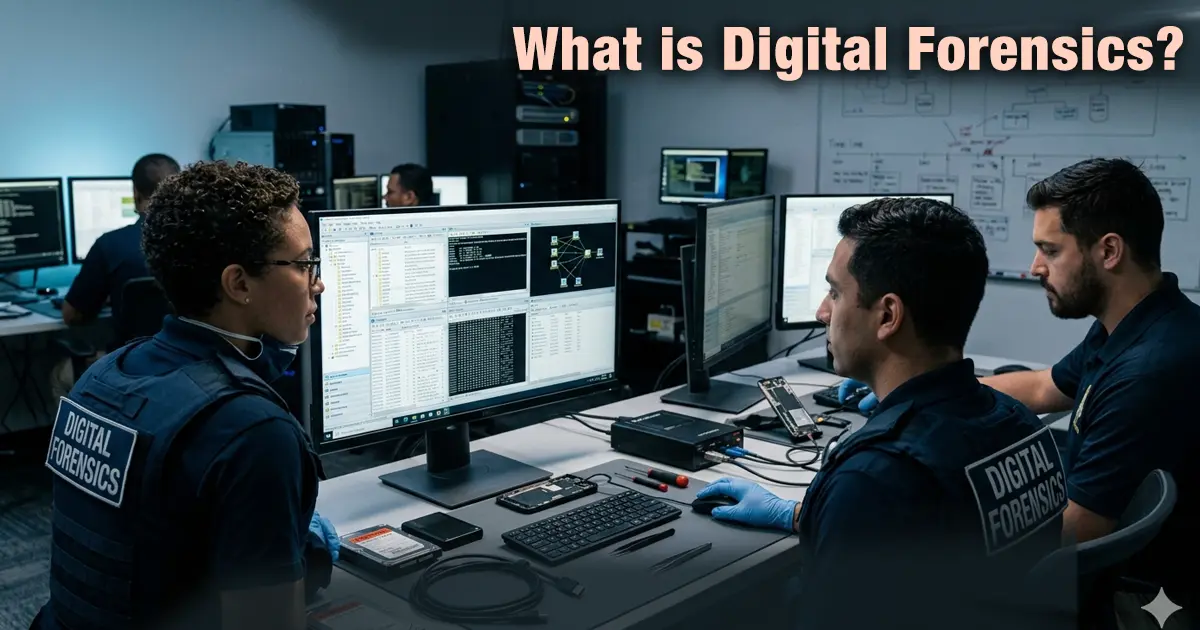
In today’s world, data drives everything from business decisions to criminal justice. It is therefore important to understand digital forensics. The field uncovers evidence in digital devices and networks, helping solve cybercrimes and secure information. This guide helps aspiring analysts, tech enthusiasts, cybersecurity professionals, and students, helping them understand branches of digital forensics, modern tools, the investigation process, and future scope.
What is Digital Forensics?
Digital forensics is a branch of forensic science that identifies, preserves, analyses and documents digital evidence. The field collects evidence from devices and environments such as computers, mobile devices, and cloud systems. It uncovers electronic data, aids in reconstructing historical events, and supports legal proceedings by presenting evidence in court. It also helps maintain integrity while investigating cybersecurity incidents or determining the cause of a breach.
History of Digital Forensics
The history of digital forensics dates back to the 1980s when computers entered homes and offices. A landmark event was the FBI's formation of the Computer Analysis and Response Team (CART) in 1984, which pioneered techniques for seizing and analysing floppy disks and hard drives. By the 1990s, tools emerged for disk imaging and file recovery amid rising internet crime.
With the growth of the internet in the 2000s, the focus shifted to email, mobile, and network forensics. Organisations such as the NIST (National Institute of Standards and Technology) and IACIS (International Association of Computer Investigative Specialists) set global best practices. With the integration of technologies such as Cloud, IoT, and AI, digital forensics has evolved to tackle advanced-level threats.
Why Digital Forensics is Important
The purpose of digital forensics primarily lies in supporting crime investigations and legal proceedings.
- It helps reconstruct events, prevents future threats and breaches, and helps recover important data.
- It helps organisations use digital forensics for internal audits, IP theft detection, and regulatory compliance.
- It supports law enforcement and helps deter potential offenders.
- It identifies breach sources, recovers lost data, and supports faster incident response.
- It preserves evidence in a court-ready manner for cases of identity theft, corporate fraud, and violent crimes.
Branches of Digital Forensics
Digital forensics is categorised into several specialised branches. This is based on the type of technology being investigated and the location of the evidence. Below are some of the major branches and their descriptions:
| Branch |
Key Focus |
| Computer Forensics |
Examines hard drives, RAM, and files on computers to recover deleted data. Traces malware, builds timelines of user activity while ensuring evidence integrity. |
| Mobile Device Forensics |
Extracts call logs, messages, apps, and location data from smartphones, tablets, and GPS units. |
| Network Forensics |
Captures and analyses packet traffic in real-time to detect intrusions, map attack paths, and identify suspicious communications. |
| Forensic Data Analysis |
Reviews structured data in apps and logs for fraud patterns such as unusual transactions or anomalies. |
| Database Forensics |
Inspects SQL logs, queries, and timestamps to spot unauthorised access or tampering. |
Digital Forensics Tools
Digital forensics tools are hardware and software solutions designed to acquire, analyse, and preserve digital evidence from computers, mobile devices, and networks. Popular tools include Autopsy, EnCase, Magnet AXIOM, and FTK. These tools are essential for maintaining data integrity, incident response, litigation, and law enforcement. They offer capabilities such as file recovery, memory analysis, and timeline creation.
| Tools |
Key Capabilities |
| Autopsy |
Performs comprehensive disk analysis with timeline reconstruction, keyword searching, and file carving. |
| EnCase Forensic |
Handles full evidence acquisition from diverse sources, decrypts protected data, and offers AI-driven triage. |
| FTK (Forensic Toolkit) |
Quickly indexes huge datasets for fast searches, recovers passwords, and builds interactive dashboards. |
| Magnet AXIOM |
Integrates analysis across computers, mobiles, cloud services, and IoT devices with deep social media parsing. |
| Cellebrite UFED |
Performs physical and logical extractions from multiple mobile devices, bypassing iOS and Android locks. |
| Wireshark |
Captures live network packets and dissects protocols to reconstruct intrusions and suspicious traffic. |
| Volatility |
Analyses RAM dumps to detect malware, rootkits, and hidden processes. |
| Oxygen Forensic Detective |
Extracts data from cloud apps, drones, and IoT alongside vehicle telematics, team collaboration, and real-time sharing. |
Chain of Custody (CoC)
Chain of custody (CoC) in digital forensics is a meticulous documentation process. It is the chronological, written record of evidence handling, collection, transfer, analysis, and storage. It ensures authenticity and admissibility in court. It is useful in maintaining Integrity, proving the evidence is authentic and has not been tampered with or altered. It also helps track the chain of responsibility, showing who had control of the evidence at all times.
Digital Forensics Investigation Process
The digital forensics investigation process follows a structured framework to ensure evidence integrity and admissibility. Below is the digital forensics investigation process.
- Identification: The step involves identifying potential sources of evidence from laptops, servers, smartphones, and cloud accounts.
- Preservation: Involves creating a bit-for-bit, forensic copy of the data. This forensic copy is called a ‘forensic image’ and is created using write-blocking tools.
- Analysis: Experts use specialised software to look for evidence, such as deleted files, internet history, email logs, and metadata. This helps support or contradict a hypothesis.
- Documentation: The step helps create a detailed record of all findings, methods, and tools used. It is essential for maintaining the chain of custody and recreating the crime scene.
- Presentation: The final findings are presented to non-technical individuals, such as lawyers or judges, involving expert testimony.
Career in Digital Forensics
A career in digital forensics in India offers wide career opportunities in cybercrime, banking, IT, and law enforcement. The field offers competitive salary packages. Key opportunities include Digital Forensic Analyst, Incident Responder, and Malware Analyst. Key sectors of employment include Government & Law Enforcement, Banking, Finance, Fraud Detection, IT, Telecom, and Consulting.
Below are the popular roles in digital forensics along with their starting salary ranges. Most of these roles require a Bachelor’s degree in Computer Science, Cybersecurity, Information Technology, or Forensic Science.
| Job Role |
Description |
Average starting salary range (in LPA) |
| Digital Forensic Analyst |
Investigates digital evidence in legal and corporate cases, preparing court reports.
Required certifications: GIAC Certified Forensic Examiner (GCFE), or Certified Computer Examiner (CCE). |
INR 3 - 6 LPA |
| Cyber Forensics Consultant |
Provides specialised consultancy in firms and advises on forensic strategies to lead incident teams.
Required certifications: EC-Council Computer Hacking Forensic Investigator (CHFI), GIAC Certified Forensic Examiner (GCFE), and CompTIA Security+. |
INR 4 - 6 LPA |
| Malware Analyst |
Examines malicious software to understand attack vectors and develop defences in future exploits.
Required certifications: GIAC Reverse Engineering Malware (GREM). |
INR 4 - 6 LPA |
| Law Enforcement Agency Investigator |
Works with CBI, police, or CERT-In on national security cases, tracing cybercrimes and fraud.
Required certifications: Certified Forensic Computer Examiner (CFCE), Certified Computer Examiner (CCE) |
INR 3 - 5 LPA |
| Mobile/Cloud Forensic Expert |
Specialises in evidence acquisition from mobile devices or cloud environments.
Required certifications: GIAC Advanced Smartphone Forensics (GASF), Certified Mobile Device Examiner (CMDE) |
INR 4 - 7 LPA |
| Incident Response Specialist (DFIR) |
Identifies and manages ongoing cyber threats and breaches, and aids recovery for minimal downtime.
Required certifications: GIAC Certified Incident Handler (GCIH), GIAC Certified Forensic Analyst (GCFA), or CompTIA CySA+. |
INR 6 - 10 LPA |
Future of Digital Forensics
The role of digital forensics is evolving with technologies such as IoT, AI, and quantum computing. Key trends emphasise real-time proactive investigations, blockchain-secured evidence, and deeper cybersecurity integration. AI automation will help collect evidence for anomalies such as deepfakes, while cloud forensics enables investigation across platforms such as AWS and Azure. These innovations promise faster evidence processing, proactive threat hunting, and secure handling of distributed digital ecosystems.
Conclusion
In conclusion, digital forensics stands as a crucial field in the digital world, with its diverse branches and applications. Digital forensics has a rigorous investigation process, helping identify, preserve, and analyse digital evidence. The purpose of digital forensics in legal proceedings not only helps uphold justice but also offers rewarding career opportunities. Embracing the field of digital forensics is no longer optional but is a fundamental component of modern security for organisations, law enforcement, or individuals.
If you are interested in a career in this field, check out the MSc Digital Forensics programme at JAIN (Deemed-to-be University).
FAQs
Q1. What do you mean by Digital Forensics?
A1. Digital forensics is a branch of Forensic Science that focuses on the identification, processing, analysis, and reporting of data stored electronically. It collects evidence from devices, networks, and cloud systems while maintaining its integrity for legal use.
Q2. What is Digital Forensics used for?
A2. Digital forensics is used to investigate cybercrimes, data breaches, fraud, and insider threats by recovering deleted files, reconstructing events, and supporting court cases or incident response.
Q3. How to start a career in Digital Forensics?
A3. Starting a career in digital forensics involves a combination of formal education, technical skill development, industry certifications, and practical, hands-on experience. Most employers require a bachelor's degree in computer science, cybersecurity, IT or digital forensics.
Q4. What do digital forensic investigators do?
A4. Digital forensic investigators are those who identify, preserve, and analyse digital evidence from computers, networks, and mobile devices to investigate various cybercrimes and data breaches.
Q5. Why is Digital Forensics important?
A5. Digital forensics is essential for investigating cybercrimes, identifying perpetrators, and preserving evidence for legal proceedings. It helps handle financial fraud, internal threats, and supports legal cases.