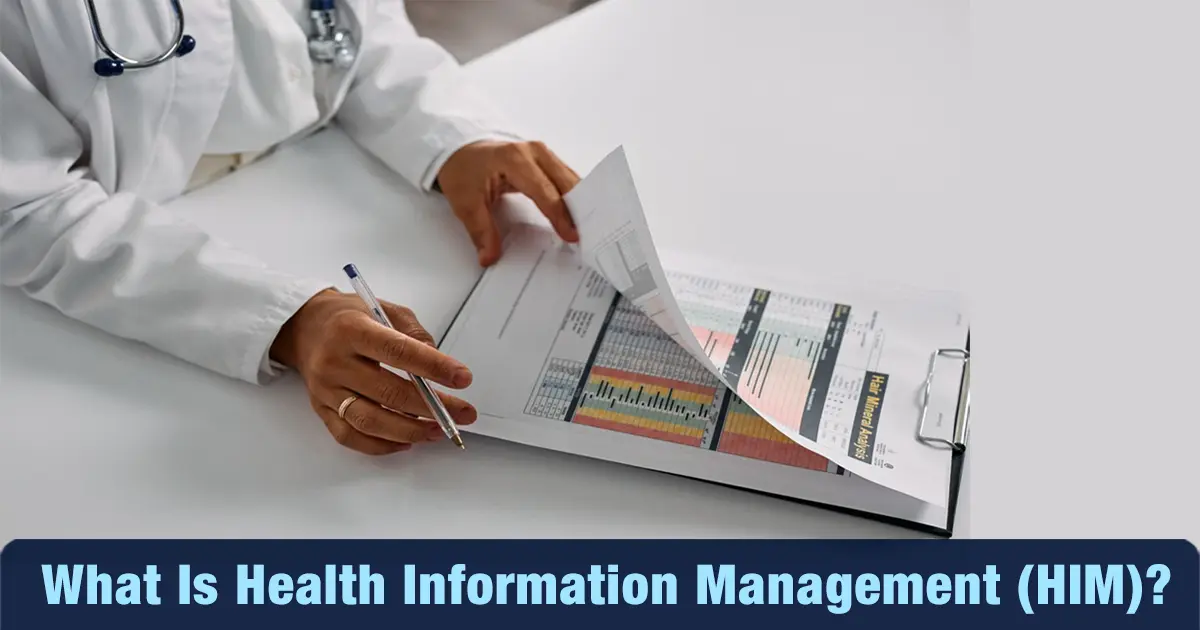
For school students weighing career options beyond the usual doctor or engineer path, this field offers something different. It blends healthcare knowledge with data management and administration, and many entry-level roles do not require candidates to become doctors or clinical professionals. It also does not require years of prior exposure to hospitals or clinics, since most of the groundwork is learned through structured coursework.
Health Information Management
Students researching this area often come across the abbreviation HIM before they understand what it stands for. The HIM full form is Health Information Management, and once that is clear, the rest tends to fall into place fairly quickly. At its core, the field involves managing everything from admission records to discharge summaries, lab results, and insurance paperwork.
India's push toward digital health, through schemes like the Ayushman Bharat Digital Mission, has made this work more visible. Hospitals are moving away from paper files, and someone needs to manage that transition. That someone is usually trained in health and information management, sitting between clinical staff who generate the data and IT teams who maintain the systems. While many hospitals have adopted digital records, implementation continues to expand across India, particularly beyond major metropolitan regions.
Core Functions Within This Field
| Function |
What it Involves |
| Data Collection |
Recording patient details from admission through discharge |
| Data Security |
Preventing unauthorized access to sensitive records |
| Medical Coding |
Assigning standardized codes for billing and research purposes |
| Quality Review |
Checking records for completeness and accuracy |
| Regulatory Compliance |
Meeting legal standards for record keeping |
How HIM Differs From General Hospital Administration
Students sometimes confuse this field with general hospital administration, and there is overlap, but the focus is different. Hospital administration deals with the broader running of a facility: staffing, budgets, and patient services. This field focuses on the data layer underneath all of that. A hospital administrator might decide how many billing staff to hire, while a health information professional makes sure the records those staff work with are accurate and properly coded in the first place.
What the job Actually Looks Like
Ask a professional in this field about their daily routine, and the answer changes depending on where they work. What does a health information manager do at a large hospital differs quite a bit from the same role at a small clinic. In a bigger setup, this might mean overseeing a team that handles coding audits and record verification. In a smaller practice, one person could be responsible for the entire process, start to finish.
There is also a fair amount of coordination involved. Doctors, billing staff, insurance representatives, and occasionally legal teams all rely on accurate records, and someone has to make sure everyone is working from the same accurate information. On a fairly ordinary day, this could mean resolving a coding discrepancy in the morning and reviewing a compliance checklist by the afternoon.
Skills That Matter in This Line of Work
Nobody expects a fresh graduate to walk in knowing everything. Still, a few skills tend to separate those who thrive in this field from those who struggle.
| Skill |
Why it is Useful |
| Attention to detail |
Small errors in records can affect diagnosis or billing |
| Medical terminology knowledge |
Needed to read and code clinical documents correctly |
| Data privacy awareness |
Patient information is sensitive and must be handled carefully |
| Comfort with hospital software |
Most records today are managed digitally |
| Analytical thinking |
Useful for spotting inconsistencies in large datasets |
None of these requires years of clinical training beforehand. They are usually built through coursework, internships, and on-the-job practice. Some students pick up basic coding software skills during their degree itself, which tends to help once they start job hunting.
Where This Career can Take You
A common question is: Where do health information managers work? It is a question worth asking early, since the answer is broader than most students expect. Hospitals are the obvious choice, but they are far from the only one.
| Work Setting |
Typical Work |
| Hospitals |
Managing patient records and coding accuracy |
| Diagnostic labs |
Handling test data and report verification |
| Insurance companies |
Reviewing claims against medical documentation |
| Government health bodies |
Supporting public health data systems |
| Health tech firms |
Building or maintaining electronic record software |
This spread matters. A student who enjoys hospital environments can stay close to patient care, while someone drawn to technology can lean toward the software side instead. Neither path is more valid than the other, and many professionals move between the two over the course of their career.
Why it Matters More Than it Seems
Why is health information management important is not a difficult question to answer once you look at what happens when records go wrong. A misfiled report can delay a diagnosis. An incomplete insurance claim can hold up treatment. Poorly maintained data can even complicate legal matters for a hospital down the line.
There is a research angle too. Much of India's public health data, the kind used to track disease patterns or plan hospital resources, depends on consistent record-keeping at the ground level. Without accurate input, that larger picture falls apart rather quickly, no matter how good the analysis on top of it might be.
Career Paths and job Opportunities
For students thinking ahead, health information management jobs in India range from entry-level positions like records assistant to senior roles such as health information manager or clinical data analyst. Medical coding has become a particularly steady area, partly because Indian professionals handle a large share of coding work outsourced from hospitals in the United States and Europe.
Beyond hospitals, health and information management professionals also find roles in insurance firms, health tech startups, and research institutions. The underlying skill, organizing and interpreting health data accurately, applies across all of these settings, which is part of why the field appeals to students who are not fully sure which type of employer they want yet.
Approximate Salary Ranges in India
| Role |
Approximate Annual Salary (INR) |
| Medical records assistant |
2.5 to 4 lakh |
| Medical coder |
3 to 4 lakh |
| Health information manager |
6 to 10 lakh |
| Clinical data analyst |
5 to 7 lakh |
These numbers vary depending on the city, employer, and years of experience. Based on figures reported by Glassdoor India and AmbitionBox, entry-level roles cluster toward the lower end, while candidates with coding certifications or specialized training tend to earn more over time.
Getting There: The Educational Route
Most students enter this field through undergraduate or postgraduate programs in health information management, health informatics, or hospital administration. Certifications in medical coding can add weight to a resume later on, especially for roles connected to insurance or outsourcing work. Depending on the institution and program, prior exposure to biology or computer applications may be beneficial.
It helps to think of the degree path in two stages. The first stage builds foundational knowledge, medical terminology, basic healthcare systems, and introductory data handling. The second stage, often through electives or short certifications, lets students specialize, whether that is coding, data analytics, or health information privacy. Students who plan this out early tend to have an easier time choosing electives that actually align with the job they want later.
What Comes Next for This Field
The future of health information management in India is closely tied to how quickly hospitals adopt digital systems. As electronic health records become standard and government schemes expand their reach, the need for people who can manage this data responsibly will likely grow alongside it. Newer specializations, such as health data analytics and health information privacy, barely existed as job titles a decade ago and are now becoming more common.
A Quiet but Necessary Career
This is not a field that gets much attention in career fairs or school assemblies. Even so, it plays a steady, necessary role in how healthcare functions day to day in India.
Students who like structure, notice details, and enjoy blending healthcare with technology may find this field worth exploring. For those curious about higher education options, JAIN (Deemed-to-be University) provides resources on programs in healthcare administration and data management.
FAQs
Q1. What is HIM in healthcare?
A1. In healthcare, HIM stands for health information management. The HIM full form is used to describe the practice of collecting, organizing, and protecting patient records across hospitals, clinics, and insurance settings.
Q2. What do Health Information Management professionals do?
A2. These professionals manage patient records, handle medical coding, run quality checks on documentation, and make sure data practices meet legal and regulatory standards.
Q3. Is Health Information Management a good career?
A3. It can be a solid option for students who want a healthcare-related career without pursuing a clinical role. The field offers steady demand, a range of work settings, and room to specialize over time.
Q4. What degree is best for Health Information Management?
A4. An undergraduate or postgraduate degree in health information management, health informatics, or hospital administration is generally the most direct route. Certifications in medical coding can strengthen job prospects further.
Q5. Is health information management in demand?
A5. Yes, largely due to the growth of digital health records and coding work outsourced to India. Health information management jobs have grown steadily as hospitals shift toward electronic systems.
Q6. What is the importance of health information management?
A6. It keeps patient records accurate, secure, and accessible when needed, which affects patient safety, billing accuracy, and a hospital's ability to meet legal requirements.