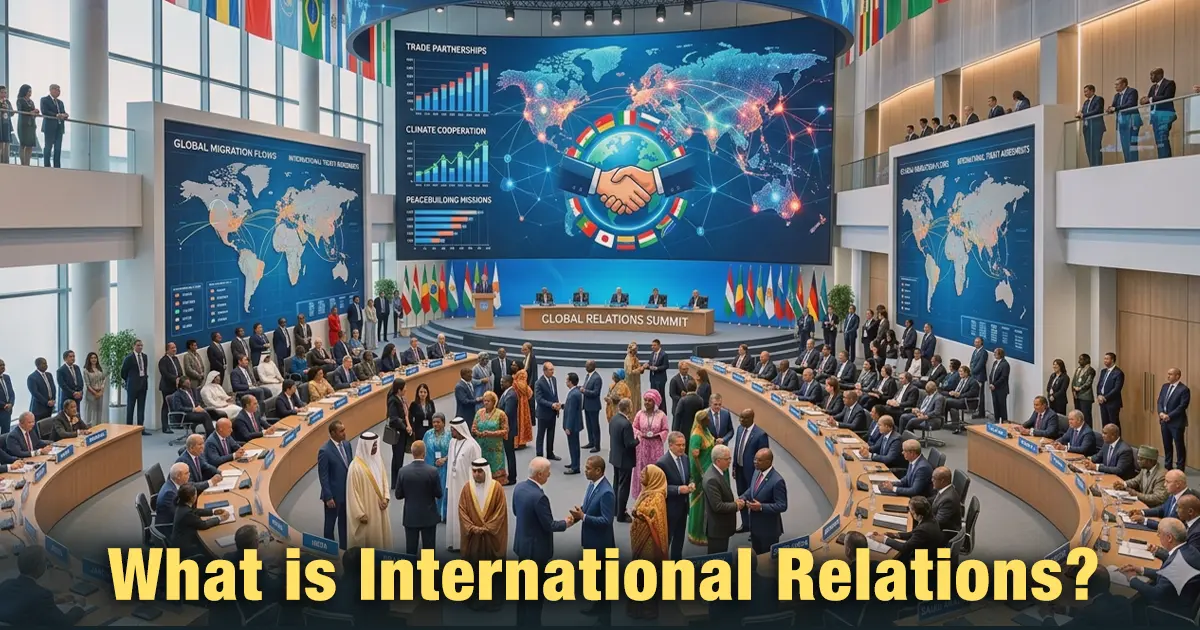
In the modern world, no country can exist in isolation. Almost every country is interconnected through trade and commerce, migration, digital platforms, and shared concerns like environmental challenges.
This growing interdependence calls for individuals who can understand complex global interactions and respond effectively.
International Relations is the field that helps you develop the knowledge and skills required to analyse global issues, foster cooperation, and design policies and business strategies for a changing world.
With its interdisciplinary approach, IR helps you understand international dynamics and pursue diverse career opportunities in diplomacy, policy-making, governance, and international affairs.
This blog covers areas like the meaning of International Relations, along with its nature, scope, importance, career opportunities, and more, to make an informed career decision.
What is International Relations?
International Relations is the study of how countries interact with each other on the world stage.
It is concerned with the nature of relationships between nations, governments, international organisations, non-governmental organisations (NGOs) and multinational companies.
International Relations helps us to understand:
- How power is distributed globally
- How cooperation and conflicts arise
- How international rules, organisations, and laws are made and maintained
The subfields of International Relations are as follows:
| Subfield |
Description |
Example |
| Diplomacy |
Focuses on negotiations and communication between countries to maintain relations and reach agreements. |
Peace talks or trade agreements between two countries |
| Foreign Policy |
Examines how a country makes decisions and acts in its dealings with other nations. |
A country imposing sanctions or forming alliances |
| Conflict Resolution |
Studies strategies and methods to manage and resolve disputes between states or groups. |
Mediation by international bodies to end a war |
| Globalisation |
Explores how global economic, cultural, and technological changes affect international interactions. |
Spread of global trade networks or digital communication |
| International Law |
Deals with the legal rules and norms that govern relations between global actors. |
Laws like the Geneva Conventions or climate agreements |
Theories of International Relations
There are several theories in International Relations that discuss how global politics works. The theories of International Relations are discussed below:
| Theory |
Core Assumption |
Key Focus |
Variants / Features |
| Realism |
States compete for power and security, and the balance of power determines outcomes. |
Power, security, war, alliances |
Classical realism, Neo-realism, Offensive & Defensive realism |
| Liberalism |
Cooperation and mutual benefit are possible, with interdependence, institutions, and norms playing an important role. |
Trade, democracy, human rights, cooperation |
Idealism, Neo-liberalism, Liberal institutionalism |
| Constructivism |
Ideas, norms, and identity shape behaviour, and perceptions influence interactions between actors. |
Culture, identity, norms, global change |
Social, Critical, Feminist constructivism |
| Marxism |
Capitalism drives behaviour, and the pursuit of profit leads to exploitation and domination. |
Inequality, capitalism, class struggle |
Focus on class conflict and the dominance of the ruling class |
Nature and Scope of International Relations
International Relations is an interdisciplinary field that draws knowledge from areas like economics, political science, sociology, anthropology, and history.
It cannot be studied in isolation. Political decisions have economic and cultural outcomes around the world.
Nature of International Relations
International Relations is multi-faceted, dynamic, and evolving in nature. It is never static and changes over time.
For example, it moved from a bipolar system during the Cold War to a unipolar world led by the United States. Currently, it is moving towards a multipolar system with countries like China and India.
IR is also power-centred and interest-oriented. It aims to protect a country’s national interests, such as security and economic growth.
It also follows an anarchic system where there is no global authority, so states depend on their own strength for security. This lack of central authority can contribute to conflicts like the Russia–Ukraine War or Israel–Hamas conflict on a greater level.
Scope of International Relations: From the Indian Perspective
India’s International Relations cover different regions and global platforms, and focus on cooperation, security, and economic growth.
| Area/Region |
Explanation |
Purpose/Focus |
| South Asia |
India gives high importance to its neighbouring countries and works to strengthen regional ties through organisations like South Asian Association for Regional Cooperation and Bay of Bengal Initiative for Multi-Sectoral Technical and Economic Cooperation. |
Regional cooperation, stability, and development |
| Indo-Pacific Region |
India actively participates in the Indo-Pacific to protect its strategic and economic interests, especially in maritime security and trade. It also engages in forums like the East Asia Summit and the ASEAN Regional Forum. |
Maritime security, trade, infrastructure, and regional influence |
| BRICS |
As a member of BRICS (Brazil, Russia, India, China, South Africa), India promotes cooperation in trade, investment, and technology. |
Economic collaboration and political dialogue |
| G20 |
India is part of the G20, where major global economic issues are discussed, allowing India to push for reforms and growth. |
Global economic governance, financial reform, trade and investment |
Difference Between International Relations and International Politics
International Relations is a broad field that studies relationships between nations across economic, social, and political areas.
Conversely, International Politics is a subset of IR. It focuses only on political interactions between nations.
The difference between IR and International Politics is discussed below:
| Aspect |
International Relations (IR) |
International Politics |
| Scope |
Covers multiple disciplines and areas of interaction. |
Limited to the political aspects of global interactions. |
| Focus |
Includes trade, culture, society, economics, and politics. |
Focuses on foreign policy, diplomacy, and power relations. |
| Nature |
Interdisciplinary and wide-ranging. |
More specialised and focused. |
| Skills Required |
Requires understanding of multiple fields along with analytical skills. |
Requires strong critical thinking and cross-cultural communication skills. |
| Area of Study |
Examines overall global relationships and cooperation. |
Deals specifically with nation-to-nation political affairs. |
Importance of International Relations
International Relations play an important role in shaping global interactions and promoting cooperation in the modern world. The significance of International Relations is discussed below:
- Helps in understanding complex global issues such as climate change, terrorism, pandemics, and economic crises
- Supports the promotion of peace and security by enabling strategies to prevent conflicts and maintain stability
- Encourages cooperation among countries and non-state actors in areas like trade, human rights, and sustainable development
- Assists in addressing emerging challenges such as cyber threats, nuclear proliferation, and the rise of new global powers
Career in International Relations
India’s growing presence internationally has opened the doors to some lucrative career opportunities in International Relations.
The important recruitment areas include government sectors, international bodies like the United Nations, World Bank, and IMF, NGOs, think tanks, and others.
Some of the sought-after jobs in International Relations after completing a specialised course in this field are as follows:
| Job Title |
Job Description |
| Diplomat* |
Represents the country abroad by managing diplomatic relations, negotiations, and foreign policy matters. |
| Public Affairs Consultant |
Advises organisations on managing public image, government relations, and policy communication. |
| Think Tank Analyst |
Conducts research and provides policy recommendations on global and strategic issues. |
| Intelligence Analyst* |
Gathers and analyses information to assess national security threats and global risks. |
| International Aid/Development Worker |
Works on global development projects to improve living conditions and provide humanitarian support. |
| Policy Analyst |
Analyses public policies and data to develop recommendations that support effective government decision-making. |
| International Journalist |
Reports on global events and issues by gathering, verifying, and presenting news from an international perspective. |
| Trade Analyst |
Evaluates international trade trends, policies, and market data to guide business or government trade strategies. |
*In India, these job roles are available in government institutions, and you may need to clear competitive civil services examinations to pursue them.
Final Thoughts
International Relations is more than just understanding how countries interact. It helps you understand the nuances of the globalised world and make positive change towards it.
If you are interested in shaping narratives, influencing public opinion, and building strong global connections, pursuing a course in International Public Relations or Political Science can be a valuable next step.
Studying this specialised course can help you develop skills in communication, media strategy, and reputation management, opening doors to impactful career opportunities in the modern economy.
FAQs
Q1: What do you mean by International Relations?
A1: International Relations is the study of interactions between countries, including political, economic, and social relationships. It examines how nations cooperate, compete, and resolve conflicts on a global level.
Q2: Why study International Relations?
A2: Studying IR helps in understanding global issues like conflicts, trade, and diplomacy. It also develops analytical and communication skills useful for international careers.
Q3: Is International Relations a good career?
A3: Yes. IR offers diverse career opportunities in government, international organisations, media, and corporations. It is especially valuable in the modern world.
Q4: What is the highest paying job in International Relations?
A4: High-paying roles include diplomats, international lawyers, policy advisors, and global consultants. Salaries vary based on experience, organisation, and location.
Q5: Who is the father of International Relations?
A5: German-born American political scientist and historian Hans Morgenthau is widely regarded as a key figure in realist theory in International Relations.
Q6: Is International Relations a good career?
A6: Yes. IR provides global exposure, impactful work, and career flexibility across sectors. Growth depends on specialisation and skills.
Q7: Is International Relations a hard major?
A7: It can be challenging as it involves critical thinking, analysis, and understanding global events. However, it is manageable with consistent study and interest.
Q8: Which course is best for International Relations?
A8: Undergraduate courses like the Bachelor of Arts in Political Science, followed by Master of Arts (MA) in Political Science and International Relations, are recommended to build a career in IR.
Q9: What is the main purpose of International Relations?
A9: The main purpose is to understand and manage relationships between nations. It aims to promote peace, cooperation, and effective handling of global issues.