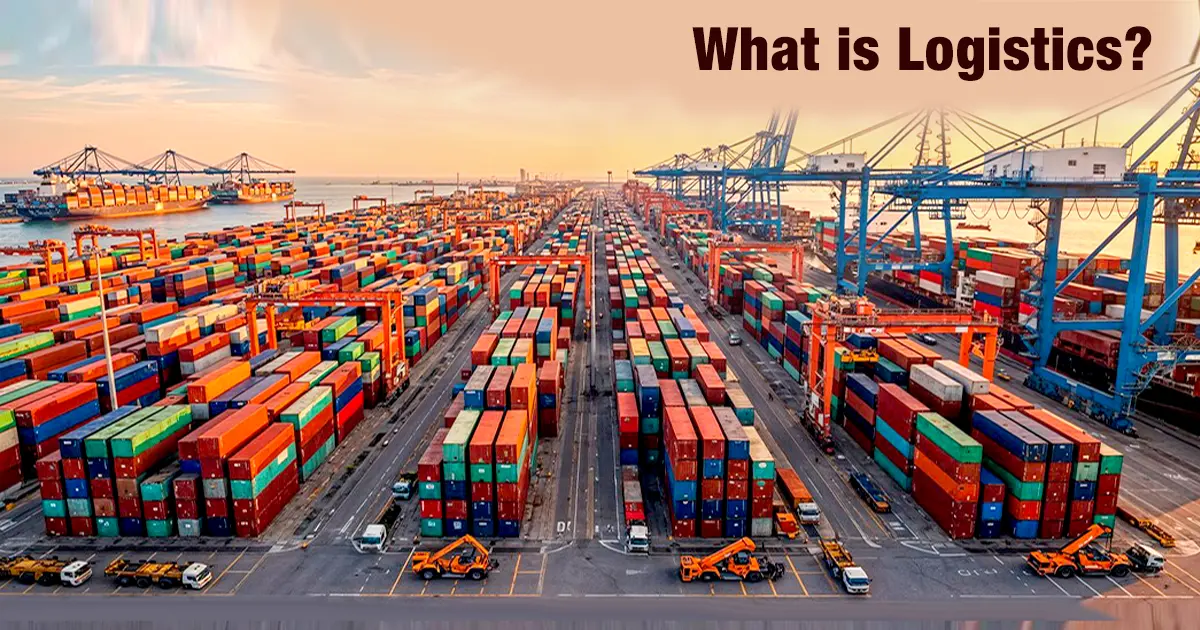
Ever wondered what really happens after you click “Buy Now” on your favourite shopping app?
Think about ordering a smartphone online. Within minutes, your order is confirmed.
Behind the scenes, warehouse personnel pick the product, the packaging team ensures it is protected, and a delivery partner maps the fastest route to your home. Within a day or two, it reaches your doorstep: safe and on time.
Logistics forms the backbone of how businesses handle the flow and storage of information, goods, and services.
It is an invisible mechanism that makes everything run smoothly between the point of origin and the destination. Logistics includes several processes that help a company achieve efficiency and reliability in transportation routes, inventory management, warehousing, and last-mile delivery.
It resembles a well-coordinated system in which planning, execution, and control are integrated in a seamless manner.
This blog aims to shed light on the logistics definition, its types, functions, the benefits of logistics management and career scope.
What is Logistics?
Logistics is derived from the French word ‘logistique’, which was used in the early 19th century to describe the moving, quartering, and supplying of army troops.
To answer the question ‘what is logistics’, it is the structured planning and coordination of operations involved in moving goods, data, and resources from one place to another.
This flow can be both forward (towards customers) and reverse (returns or recycling), ensuring smooth delivery from origin to end user.
Is Logistics the Same as Supply Chain?
No. Logistics is a part of the broader supply chain and mainly focuses on inventory planning, order fulfilment, transportation and warehousing activities.
Together, all these activities form the physical backbone of logistics. The role of logistics is to help businesses deliver products efficiently and ensure customers receive the correct orders at the right time and place.
Types of Logistics
Companies use different types of logistical approaches based on their company requirements, with each focusing on a particular component of the supply chain.
One of the examples of logistics is the use of demand planning logistics by an electronics manufacturer. The company will use warehouse logistics to store its materials and third-party logistics to distribute its finished product. It will also use reverse logistics to process warranties.
Businesses overcome operational challenges when they combine these logistics types and create an integrated logistics strategy. The different types of logistics and their examples are discussed below:
| Type of Logistics |
Description |
Examples of Logistics |
| Inbound logistics |
Involves sourcing, ordering, and transporting raw materials into a business to ensure production runs smoothly, and resources are available on time. |
A car company receives steel, engines, and components from suppliers |
| Outbound logistics |
Focuses on storing, packaging, and delivering finished goods to customers, ensuring timely and accurate order fulfilment. |
An e-commerce company delivering products to customers |
| Reverse logistics |
Manages the return flow of goods for refunds, repairs, recycling, or disposal, supporting cost recovery and sustainability efforts. |
Returning defective or unwanted products |
| Transportation logistics |
Deals with planning and executing the movement of goods, including selecting routes, carriers, and transport modes for efficiency. |
Shipping goods via trucks, ships, rail, or air |
| Distribution logistics |
Ensures the efficient movement of goods from warehouses to retailers or final delivery points, focusing on timely delivery. |
Supplying products from warehouses to retail stores |
| Production logistics |
Manages the internal movement of materials within a production unit to maintain a smooth and continuous manufacturing process. |
Moving components across different stages in a factory |
| Third-party logistics |
Involves outsourcing logistics operations to external providers to improve efficiency, reduce costs, and focus on core business functions. |
Hiring a logistics firm to manage storage and delivery |
| Freight logistics |
Handles the large-scale movement of goods across long distances using multiple transport modes, focusing on cost control and regulatory compliance. |
Transporting bulk goods internationally using ships, trains, and trucks |
Functions of Logistics
Logistics is the process that enables these goods and services to move and complete that exchange. The functions of logistics are as follows:
Transportation
Transportation is the movement of goods between the production and consumption points. It involves the choice of appropriate modes of transportation, including road, rail, sea, or air, depending on cost, speed, and reliability. The purpose is to make sure that goods reach their destinations on time and are not damaged or delayed during transit.
Warehousing
Warehousing is concerned with the storage of goods and materials until they are required. It assists in maintaining inventory levels and ensures that the supply chain flows smoothly. Warehouses serve as buffers where companies can store their goods well beforehand and release them to the market when demand is high.
Inventory management
Inventory management is a process of monitoring the stock levels, stock locations, and stock replacement requirements. It makes sure that the companies have the correct balance of supply and demand. Proper management prevents overstocking and prevents a shortage of products to satisfy customer demand.
Order processing
Order processing starts with a customer making an order. It involves accepting orders, verifying the availability of the products, and planning fulfilment. The effective order processing guarantees timely and accurate delivery, enhancing customer satisfaction.
Packaging
Packaging refers to the process of preparing commodities to be stored or transported. It helps in safeguarding the products against damage and keeping them in proper conditions. It also involves correct labelling that aids in the identification and correct handling of orders.
Distribution
The last phase of logistics is distribution, which entails the delivery of products to its customers. It entails planning of routes, maintenance of transport and timely delivery. This is aimed at ensuring that the products are in the right place and at the right time.
Importance of Logistics
Logistics helps facilitate flawless activities and assists companies in achieving their objectives successfully. The benefits of logistics are as follows:
Timely Delivery
Logistics ensures that the goods arrive at the appropriate destination on time. Timely delivery is necessary to meet the expectations of the customer and ensure reliability, be it in terms of raw material or finished goods.
Cost Efficiency
Effective logistics minimises the operational costs through better transportation, effective management of the inventory and enhancement of processes. This enables the businesses to be competitive and to be able to offer better prices.
Efficiency in the Use of Resources
Logistics helps in ensuring that resources like transport, storage and workforce are used appropriately. It will minimise waste, eliminate delays and enhance productivity as resources are efficiently used.
Customer Satisfaction
An effective logistics system will make products readily available and delivered on time, which will directly enhance customer experience. Quality service establishes confidence and customer retention.
Market Penetration
Logistics allows companies to conduct business globally as it helps to connect suppliers and customers situated in various regions. It facilitates market growth and enables companies to conduct international trade effectively.
Logistics Jobs and Salary
There are several courses to pursue in Logistics and Supply Chain that can help you start a career in this field.
Undergraduate options include Bachelor of Commerce (BCom) in Logistics & Supply Chain Management, Bachelor of Business Administration (BBA) in Logistics & Supply Chain Management, Bachelor of Science (BSc) in Logistics & Supply Chain Management, and others.
These UG courses will help you pursue entry-level roles across various industries, and with experience, you can advance into specialised roles. You can also pursue a postgraduate degree, such as a Master of Business Administration (MBA) in Logistics & Supply Chain Management, to pursue niche and specialised career roles in procurement, warehousing, transportation, etc.
Some of the promising logistics jobs and salary are as follows:
| Job Role |
Job Level & Experience |
Job Description |
Annual Salary |
| Supply Chain Analyst |
Entry
(0-3 Years) |
Analyses supply chain data to improve efficiency, reduce costs, and support decision-making |
INR 5.4 to 6 Lakhs |
| Procurement Executive |
Entry
(0-3 Years) |
Manages the purchasing of goods and services while negotiating with suppliers for the best value |
INR 3.4 to 4.3 Lakhs |
| Logistics Coordinator |
Entry
(0-3 Years) |
Coordinates transportation, schedules shipments, and ensures timely delivery of goods |
INR 3.3 to 4.5 Lakhs |
| Inventory Planner |
Mid
(1-3 Years) |
Monitors stock levels and plans inventory to meet demand while avoiding overstocking |
INR 5 to 6.3 Lakhs |
| Warehouse Operations Manager |
Mid–Senior
(3-6 Years) |
Oversees warehouse activities, including storage, inventory control, and staff management |
INR 5.2 to 6.7 Lakhs |
| E-commerce Logistics Manager |
Mid–Senior
(3-6 Years) |
Manages end-to-end logistics for online orders, including fulfilment, delivery, and returns |
INR 4.4 to 5.5 Lakhs |
Key Takeaways
Logistics has a great role to play in how businesses operate, compete, and grow across industries.
This field ensures timely deliveries and enables global trade, thereby developing efficient, responsive and customer-centric operations.
The requirement for a professional workforce is on the rise as businesses scale and incorporate technology systems.
If you wish to pursue a career in this dynamic field, now is the right time to take the appropriate action.
Explore a specialised logistics course from JAIN (Deemed-to-be University) to build strong foundational knowledge and acquire industry-relevant skills in this field.
FAQs
Q1: What does logistics mean?
A1: Logistics refers to the planning, coordination, and movement of goods, services, and information from origin to destination. It also includes storage and handling to ensure smooth flow across the supply chain.
Q2: Why is logistics important?
A2: Logistics is important because it ensures timely delivery, cost efficiency, and smooth operations. It helps businesses meet customer expectations and maintain competitiveness.
Q3: What is the main purpose of logistics in business?
A3: The main purpose of logistics is to deliver the right product to the right place at the right time. It ensures efficient movement and storage while minimising costs.
Q4: How does logistics impact customer satisfaction?
A4: Logistics affects customer satisfaction by ensuring the timely and accurate delivery of products. Delays or errors can lead to dissatisfaction and loss of trust.
Q5: Can logistics be outsourced?
A5: Yes. Logistics can be outsourced to third-party providers, known as Third-Party Logistics, who specialise in transportation, warehousing, and distribution. This helps businesses focus on core activities and improve efficiency.
Q6: How does efficient logistics contribute to cost savings?
A6: Efficient logistics reduces costs by optimising routes, managing inventory effectively, and minimising waste. It improves overall operational efficiency.
Q7: What does a logistics person do?
A7: A logistics professional plans and manages the movement, storage, and delivery of goods. They coordinate transportation, track inventory, and ensure smooth supply chain operations.