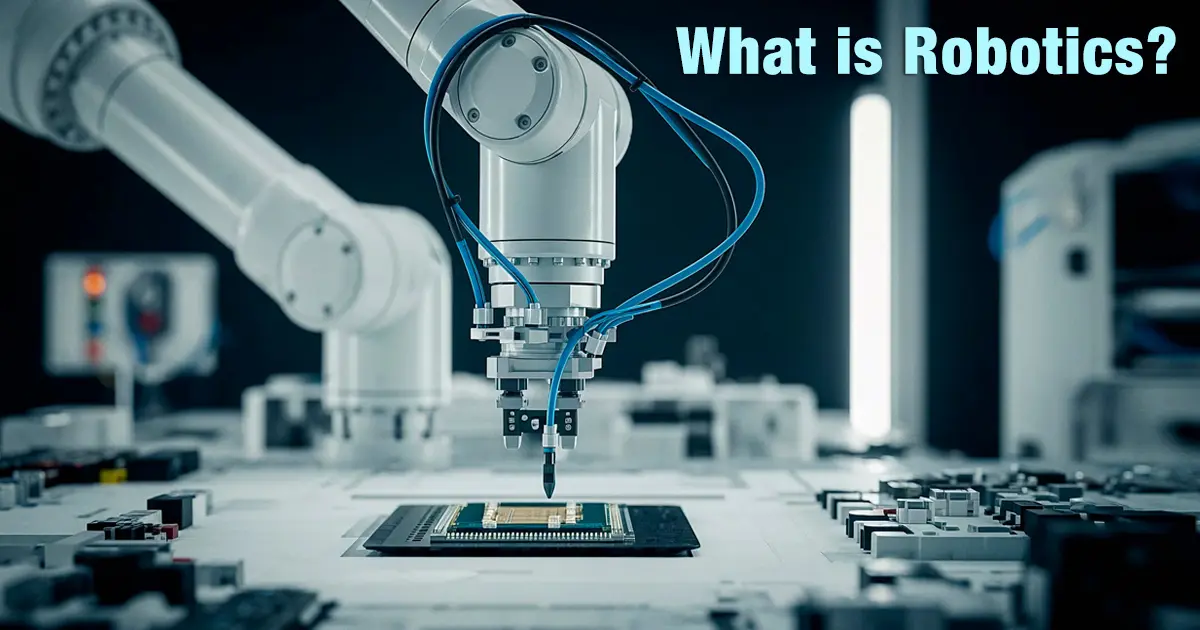
Robotics is no longer science fiction. It has emerged as a dynamic field that is driving innovation and development of modern industries, be it a simple manufacturing unit or high-tech healthcare system.
Robotics is an interdisciplinary field that incorporates aspects of computer science, engineering and technology to design, develop and run machines that can imitate human behaviour.
As India moves steadily towards Industry 4.0, Robotics is emerging as a key driver of innovation, efficiency, and economic growth.
If you are interested in knowing more about this field of study, this blog explores robotics basics, types, importance, applications, and future scope.
What is Robotics?
Robotics is a multidisciplinary field that focuses on designing, building, operating, and using robots. A robot is a mechanical or virtual machine that is programmable and can autonomously (or with human assistance) execute tasks. These activities may be simple, such as lifting things, or challenging, such as conducting surgeries or space exploration.
History of Robotics
The history of Robotics spans centuries. It evolved from early mechanical inventions to today’s advanced robotics machines available in the market. The table below discusses the series of events that have shaped the world of Robotics that we know today.
| Time Period |
Stage in Robotics |
Description |
| Ancient Era |
Ancient Automation |
Early civilisations created mechanical devices that mimicked human actions, often for entertainment or religious purposes. |
| 18th–19th Century |
Industrial Revolution |
Machines powered by water, steam, and electricity automated manufacturing processes, laying the foundation for robotics. |
| 1920 |
Term “Robot” was introduced |
The word “robot” was coined, bringing the concept of artificial workers into popular imagination. |
| 1954 |
Birth of Modern Robotics |
George Devol developed the first programmable industrial robot, Unimate, marking the beginning of modern robotics. |
| 1960s |
Robotics in Space |
Robots began being used in space missions to explore and collect data from other celestial bodies. |
| 1980s |
Automation + AI Growth |
Integration of computers and artificial intelligence enabled robots to perform complex and adaptive tasks. |
| 21st Century |
Collaborative Robots (Cobots) |
Robots designed to safely work alongside humans, expanding applications across industries. |
Robotics Basics
Although robots perform different functions, the common denominator is that most systems have the following key elements:
Control System
The control system is the brain of the robot. It relies on software, algorithms, or programmable logic controllers (PLCs) to determine how a robot responds to the inputs. They are used to make sure that the robot functions effectively and safely.
Motors
Electrical energy is transformed into mechanical motion by motors. They facilitate the movement of various sections of the robot, including wheels, arms or joints. Common types include DC motors, servo motors and stepper motors.
Actuators
Actuators convert energy into physical motion. They enable robots to move, pick, or perform any action on a given object. Actuators collaborate with sensors to enable the robot to react favourably to its surroundings.
End Effectors
End effectors are instruments fitted on the arm of a robot that are used to interact with objects. They function like a robot’s “hands” and perform tasks such as gripping, cutting, welding, or assembling. They can be customised based on the task.
Power Supply
The power supply provides the energy required for the robot to operate. It may be provided through batteries, electrical or renewable energy. This is required to have reliable power in order to operate smoothly and continuously.
Communication System
This system enables the various components of the robot to communicate with each other, as well as to communicate with other systems or users. It can be wired or wireless and ensures smooth data transfer for proper functioning.
Program
The program is the set of instructions that controls the robot’s actions. It is written in a language such as Python or C++, and it defines how the robot operates, moves, makes decisions, and communicates with the environment.
Types of Robots
Robots come in all shapes and sizes. They are used in various industries such as education, healthcare, manufacturing, and entertainment, etc. The popular types of Robotics are as follows:
| Types of Robot |
Description |
Key Features |
| Humanoid Robots |
Robots designed to resemble humans in appearance and behaviour. |
Actuators for movement, sensors, computer vision, AI, and speech recognition. |
| Automotive Robotics |
Specialised industrial robots are used in the automobile industry. |
High precision, repetitive motion, welding and painting capabilities, and durability. |
| Social Robots |
AI-powered robots designed for human interaction and companionship. |
Cameras, microphones, sensors, emotion recognition, AI-based responses. |
| Medical Robots |
Robots that assist in healthcare procedures and hospital workflows. |
Imaging systems, sensors, telemanipulators, and high-precision control. |
| Service Robots |
Robots designed to assist humans in daily tasks outside industrial settings. |
Task automation, mobility, and user-friendly interfaces. |
| Educational Robots |
Robots used as learning tools to teach STEM concepts. |
Programmable, interactive, scalable complexity levels. |
| Autonomous Robots |
Robots that can perform tasks and make decisions independently without human intervention |
AI and machine learning sensors (LiDAR, cameras), real-time decision-making, and adaptability to environments |
| Industrial Robots |
Robots used in manufacturing and production processes to automate repetitive and high-precision tasks |
High speed and accuracy, programmable, heavy payload handling |
Importance of Robotics
Almost every business can reap the benefits of Robotics. This field of engineering helps companies reduce costs and automate tasks that were previously outsourced.
Robots can perform the hazardous, risky, menial, and repetitive jobs that can help reduce the dependency on manual intervention. The importance of Robotics is discussed below:
| Aspect |
Explanation |
Real-Life Example |
| Productivity Growth |
Robots handle repetitive and dangerous tasks continuously, improving output and efficiency. |
Robotic arms used by Tesla assemble car parts continuously at high speed and precision. |
| Enhanced Accuracy |
Robots perform tasks with high precision and consistency, reducing errors and defects. |
Chip manufacturing robots by Intel place microscopic components with extreme precision. |
| Cost Savings |
Automation reduces labour, time, and material waste, leading to lower operational costs. |
Automated manufacturing systems at Foxconn reduce reliance on manual labour and minimise errors. |
| Role in Society |
Robots improve safety and convenience across industries and daily life. |
The da Vinci Surgical System by Intuitive Surgical, Inc. helps surgeons perform minimally invasive surgeries with high precision. |
Robotics Applications in Real-Life
Earlier, the use of Robotics was limited to only the manufacturing and service-based industries. Now, Robotics is used in various spheres of life, serving distinct purposes:
| Industry/Area |
Robotics Applications |
| Manufacturing |
- Car Assembly Lines
- Electronics Manufacturing (Smartphones, Chips)
- Automated Quality Inspection Systems
|
| Healthcare |
- Robotic-Assisted Surgeries (e.g., Minimally Invasive Procedures)
- Automated Pharmacy Systems
- Hospital Delivery Robots
|
| Agriculture |
- Autonomous Tractors
- Robotic Harvesters for Fruits/Vegetables
- Drone-Based Crop Monitoring and Spraying
|
| Construction |
- Robotic Bricklaying
- 3D Printing of Buildings
- Automated Welding and Drilling Systems
|
| Shipping & Delivery |
- Warehouse Robots (Like Amazon Fulfillment Systems)
- Last-Mile Delivery Robots
- Drone Deliveries
|
| Energy & Mining |
- Pipeline Inspection Robots
- Wind Turbine Maintenance Robots
- Autonomous Mining Vehicles
|
| Disaster Response |
- Search-And-Rescue Robots in Earthquakes
- Firefighting Robots in Forests
- Underwater Rescue Drones
|
| Domestic & Personal Use |
- Robot Vacuum Cleaners
- Robotic Lawn Mowers
- Assistive Robots for Elderly and Disabled Individuals
|
Career in Robotics
Studying Robotics gives you the opportunity to gain essential skills required to work in an ever-changing world driven by technology.
A degree in Robotics helps you cultivate innovation and creative thinking as well as logical reasoning skills. After completing a degree in Robotics or related fields, the top job roles that can offer strong career prospects are as follows:
| Job Roles |
Job Description |
| Robotics Engineer |
Designs, builds, and tests robotic systems for industrial, medical, or commercial use. |
| Automation Specialist |
Develops and implements automated systems to improve efficiency and reduce manual work. |
| AI & Machine Learning Engineer (Robotics) |
Creates intelligent algorithms that enable robots to learn, adapt, and make decisions. |
| Robotics Technician |
Installs, maintains, and repairs robotic systems and equipment. |
| Robotics Product Designer |
Designs the structure, functionality, and user experience of robotic products. |
Future of Robotics
The future of Robotics is driven by rapid advancements in artificial intelligence, computer vision, and sensory technologies. Robots are becoming more capable and human-like, taking on roles across industries such as healthcare, agriculture, retail, and manufacturing. Robots are already assisting humans in everyday tasks and complex operations, improving efficiency and quality of life.
Final Thoughts
Robotics is a force driving modern innovation, steering industries, improving daily life and redefining the way work is done.
With growing industrialisation, the field of robotics is evolving at a rapid pace, bringing forth promising prospects in industries.
If you are interested in building a career in this field, explore relevant courses that can help you develop the expertise and skills needed to excel.
A Bachelor of Technology (BTech) in Robotics and Automation at JAIN (Deemed-to-be University) can be your first step to building a global career in technology, automation and innovation. Enrol now.
FAQs
Q1: Why is it called robotics?
A1: The term Robotics comes from the word ‘robot’, which was introduced by Czech writer Karel Čapek in his play R.U.R. (Rossum’s Universal Robots). Robotics refers to the field that deals with designing, building, and programming robots.
Q2: What is robotics in simple words?
A2: Robotics is a branch of technology that involves creating and using robots to perform tasks automatically or with minimal human assistance.
Q3: Is robotics a good career?
A3: Yes. Robotics is considered a promising career because industries such as manufacturing, healthcare, aerospace, defence, and automation increasingly rely on robotic systems and AI-driven technologies.
Q4: What are four types of robotics?
A4: The four common types of Robotics are:
- Industrial robotics
- Automotive Robotics
- Medical Robotics
- Service Robotics
Q5: Is JEE required for robotics?
A5: JEE is not mandatory for a career in robotics, but it is necessary for admission to top-tier institutes like IITs and NITs.
You can pursue Robotics Engineering (B.Tech/BE) through other national, state, or private university entrance exams if you have completed 10+2 with Physics, Chemistry, and Mathematics (PCM).