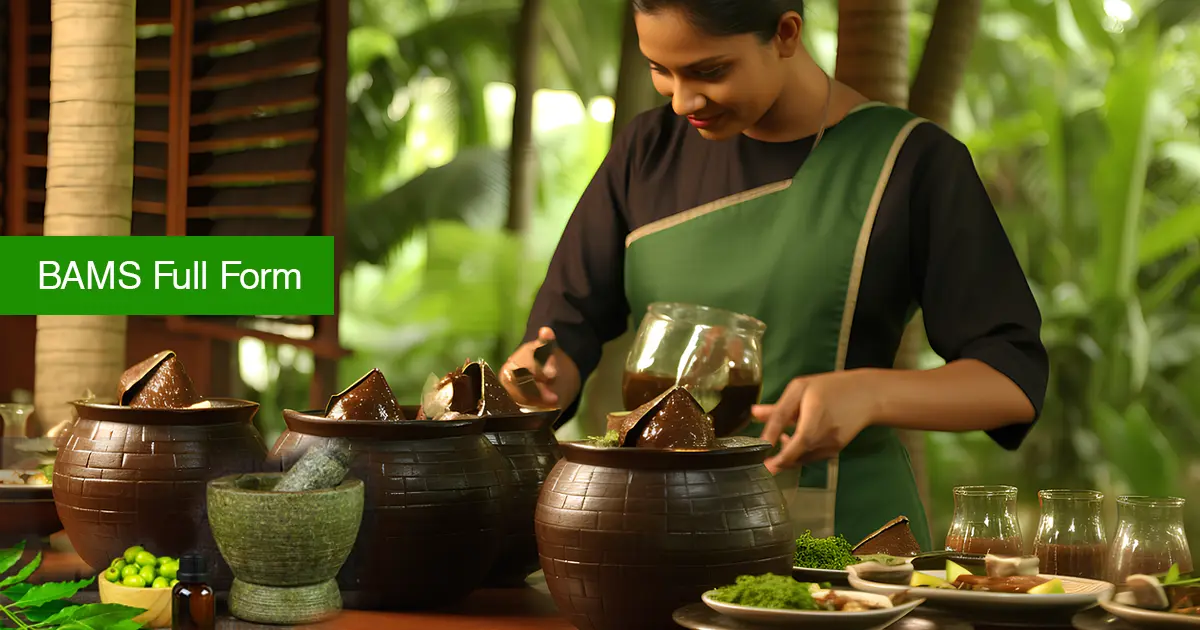
Are you thinking about a career in healthcare that goes beyond modern medicine? You can explore BAMS, a course that combines the traditional knowledge of Ayurveda with key principles of medical science. BAMS full form in medical is Bachelor of Ayurvedic Medicine and Surgery.
If you are interested in exploring important information about BAMS, this blog explains what BAMS is, what you study during the course, and the different career paths you can pursue after completing a BAMS degree.
What is BAMS?
BAMS is an undergraduate degree course which mainly focuses on traditional Indian medicine known as Ayurveda. The BAMS full form is Bachelor of Ayurvedic Medicine and Surgery. You study various important Ayurvedic principles in detail, along with subjects such as herbal medicine and nutrition. After completing BAMS and registering with the respective State Ayurveda Council/ CCIM/ NCISM, one can practice as an Ayurvedic doctor in India.
If you are passionate about promoting healthy living through traditional Indian medicine, BAMS helps you turn your passion into a profession. Note that the field of Ayurveda is known worldwide for its treatment and prevention of diseases through natural medicine and lifestyle modifications.
You can read about important BAMS course details in the next section.
BAMS Course Details
Glance through the table below for a quick overview of the BAMS course.
| Parameter |
Details |
| Full Form |
Bachelor of Ayurvedic Medicine and Surgery |
| Duration |
4.5 years academic + 1 year internship |
| Degree Level |
Undergraduate |
| BAMS Eligibility |
50% marks in 10+2 (Science: Physics, Chemistry, Biology), a pass in the NEET exam with a relevant score |
| BAMS entrance test |
NEET |
| Areas of Employment |
Government/Private Hospitals, Ayurvedic Clinics, Wellness Centres, Research Institutes, etc |
BAMS Eligibility and Admission Process
If you are planning to pursue the BAMS course, here are more details on the BAMS eligibility criteria.
| Requirement |
Details |
| Educational Qualification |
Completion of 10+2 with Physics, Chemistry, and Biology |
| Minimum Marks |
50% aggregate for the general category; 40% for SC/ST/OBC |
| BAMS Entrance Test |
NEET (National Eligibility cum Entrance Test) |
| Admission |
Based on NEET rank |
BAMS Scope and Salary
You can explore career paths across healthcare, research, management, and academics after completing the BAMS course. The BAMS degree allows you to work in both clinical and non-clinical roles.
You can choose to work as an Ayurvedic practitioner and offer consultations, treatments, and therapies to the patients. Relevant hospital or healthcare administration roles can also be explored in Ayurvedic hospitals and wellness centres. Opportunities also exist in research and development areas.
Regarding salary, you should note that in India, the starting salary range of BAMS graduates is ₹20,000 to ₹30,000 per month, though income can vary by experience, location, and role. The table below gives you a quick idea of BAMS roles and average salary.
| Sector |
Job Role |
Average Salary (INR/Year) |
| Ayurvedic Hospitals/Clinics |
Ayurvedic Doctor, Resident Physician |
₹4 – ₹7 LPA |
| Government Health Services |
Medical Officer (Ayurveda), AYUSH Doctor |
₹5 – ₹9 LPA |
| Private Practice |
Independent Practitioner, Clinic Owner |
Varies (₹6 – ₹12+ LPA) |
| Panchakarma / Wellness Centres |
Panchakarma Specialist, Wellness Consultant |
₹4 – ₹8 LPA |
| Pharmaceutical Industry |
Product Executive, Ayurveda Pharmacologist |
₹4 – ₹7.5 LPA |
| Health Tourism Sector |
Ayurvedic Therapist, Spa Manager |
₹3.5 – ₹6.5 LPA |
| Research & Development |
Clinical Research Associate, Ayurveda Researcher |
₹4 – ₹8 LPA |
| Academia |
Lecturer in Ayurvedic Colleges |
₹4 – ₹7.5 LPA |
| NGOs / Public Health |
Community Health Officer, Program Coordinator |
₹3.5 – ₹6.5 LPA |
If teaching interests you, you can also consider the academic roles in colleges. Government jobs are yet another option, with roles available in public hospitals and departments under the Ministry of AYUSH. To explore “after BAMS govt jobs”, you need to visit various relevant government portals and apply for the relevant vacancies.
Courses After BAMS Degree
Once you have finished your BAMS course, you can choose various options for further relevant studies. After completing MD/ MS, one can also pursue a PhD. This advanced qualification supports research careers and opens doors to academic roles, including teaching and professorships.
Along with this option, there are several postgraduate courses you can consider after finishing BAMS, depending on your interests.
- MD (Ayurveda)
- MS (Ayurveda)
- PG Diploma in Panchakarma
- Certificate Course in Ksharasutra
- Certificate Course in Nadi Pariksha
- Certificate Course in Panchakarma Therapy
- Certificate Course in Yoga
- Certificate Course in Ayurvedic Nutrition and Dietetics
The next section discusses the BAMS syllabus. Going through the syllabus gives you the basic idea of what the BAMS programme includes.
BAMS Syllabus
The BAMS syllabus covers foundational concepts to advanced clinical understanding in Ayurveda. It covers core Ayurvedic principles along with supporting subjects that help you understand diagnosis, treatment, and patient care. Throughout the course, you study areas related to human anatomy, physiology, herbal medicine, therapeutic procedures, nutrition, and practical clinical training. The syllabus is designed to help you build both theoretical knowledge and practical skills needed to work as an Ayurvedic healthcare professional. Remember, the duration of the BAMS course is 5.5 years. It includes 4.5 years of academic study and 1 year of mandatory internship.
| BAMS Course Year |
BAMS Course Syllabus |
| BAMS First Year |
- Padartha Vigyan and Ayurved Itihas
- Maulik Siddhant Evam Ashtang Hridaya
- Rachana Sharir
- Kriya Sharir
- Sanskrit
|
| BAMS Second Year |
- Dravyaguna Vigyan
- Charak Samhita
- Rasashastra
- Roga Nidan
|
| BAMS Third Year |
- Agadatantra
- Charak Samhita (Uttarardha)
- Kaumarbhritya Parichaya
- Prasuti Tantra Evam Stri Roga
- Swasthavritta
|
| BAMS Fourth Year |
- Kayachikitsa
- Research Methodology and Medical Statistics
- Shalakya Tantra
- Shalya Tantra
- Panchakarma
|
Advantages of Pursuing a BAMS Degree
Pursuing the BAMS course gives you several significant advantages. Ayurveda focuses strongly on the prevention and treatment of diseases through natural, traditional medicine, which serves the growing demand for sustainable healthcare practices worldwide.
You often guide individuals through lifestyle changes and natural therapies, making the work deeply fulfilling.
Career stability is another strong reason. The demand for Ayurvedic practitioners is steadily increasing across hospitals, wellness centres, research organisations, and government sectors. This growing acceptance of alternative medicine creates reliable career opportunities.
BAMS also offers flexibility. You can choose to specialise in areas such as Panchakarma therapy, pharmacology, women’s health, or clinical practice. This freedom allows you to choose a career path based on your interests, making BAMS a versatile choice.
Conclusion
BAMS is the right option for you when you want to learn and practise Ayurveda while understanding modern medical concepts. The BAMS degree gives you the eligibility and qualification to apply for jobs in both government and private healthcare sectors. If you are interested in holistic healthcare, BAMS offers a promising career path.
To explore wider opportunities in healthcare, you need to pursue the relevant programmes. The School of Allied Healthcare and Sciences at JAIN (Deemed-to-be University) offers a wide range of programmes that prepare you for diverse roles in the healthcare industry.
FAQs
Q1: What is BAMS?
A1: The full form of BAMS is Bachelor of Ayurvedic Medicine and Surgery. It is a 5.5-year undergraduate programme which includes 4.5 years of academic studies and one year of compulsory internship. The programme focuses on Ayurveda, which is traditional Indian medicine.
Q2: BAMS or BHMS which is better?
A2: BAMS focuses on Ayurveda, whereas BHMS (Bachelor of Homoeopathic Medicine and Surgery) focuses on homoeopathy. The choice of “better” between these two depends on an individual’s career objectives.
Q3: What can I do after BAMS?
A3: You can work as an Ayurvedic consultant, researcher or practitioner after completing a BAMS degree. You can also choose the option of further studies. Some courses after BAMS degree which you can consider include an MD, MS, or various relevant certificate courses. You can also consider pursuing a PhD. Having a PhD degree can help take on the role of a professor.
Q4: MBBS or BAMS which is better?
A4: The choice of “better” between MBBS and BAMS depends totally on one’s career goals. BAMS full form in medical is Bachelor of Ayurvedic Medicine and Surgery. It is the study of Ayurveda, and it also includes a few concepts from modern medicine. MBBS, on the other hand, is the Bachelor of Medicine & Bachelor of Surgery, focusing solely on modern allopathic medicine.
Q5: How many marks are required in NEET for BAMS?
A5: NEET score requirements for BAMS admission vary by state, category and college. Cutoffs change each year, but past trends suggest the approximate ranges as 450–550+ marks required for the general category students, 400–500 marks for OBC candidates, and 300–420 marks for SC/ST categories to secure admission.
Q6: How many years is BAMS?
A6: The duration of the BAMS course is 5.5 years. It includes 4.5 years of academic study and 1 year of mandatory internship.
Q7: Is BAMS a paramedical course?
A7: No, BAMS is not a paramedical course. BAMS full form is Bachelor of Ayurvedic Medicine and Surgery. It is a medical degree course. One becomes a doctor after gaining the BAMS degree and registering with the respective State Ayurveda Council/ CCIM/ NCISM.
Q8: Is BAMS a good career?
A8: Yes, BAMS is a good career option because it offers diverse job opportunities, including research, academia, and practice. People all over the world are realising the value of natural medicine and treatment, leading to an increase in demand for Ayurvedic professionals.