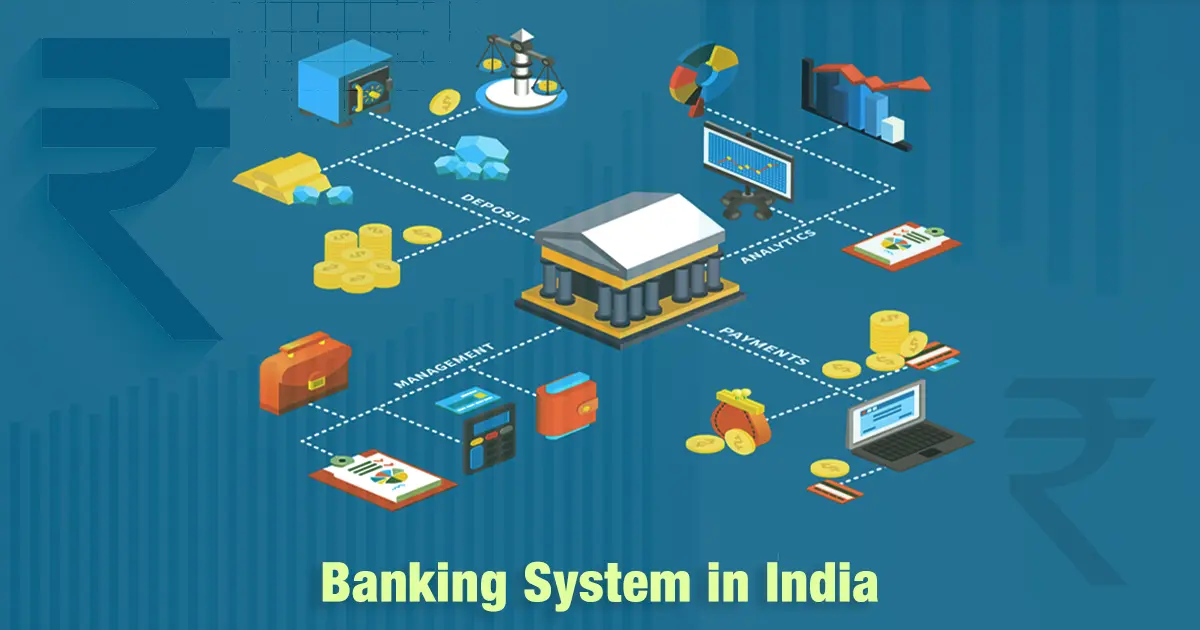
Note that banks do much more than accept deposits or provide loans. They support economic policies that influence national development.
In this blog, you will learn about the banking system in India, the history of banking and the types of banks in India.
What are Banks?
Banks are institutions authorised to accept money from the public and provide loans when needed.
Banks help the economy grow in many ways. They ensure that payments are safe for everyone. They influence the flow of money and provide a wide range of financial services. These functions make banks an important part of everyday money matters and long-term economic growth.
History of Banking in India
The history of banking in India dates back to the pre-independence period.
You can get a quick idea about the growth and development of banking in India with the help of the table below.
| Phase |
Description |
| Pre-Independence (before 1947) |
This period marks the early development of banking in India, including the establishment of initial banks and gradual growth under colonial influence. |
| Nationalisation Phase (1969–1991) |
During this stage, major banks were nationalised to expand banking access, especially in rural areas, and to align with economic priorities. |
| Liberalisation Phase (1991 onwards) |
This phase focuses on reforms, increased competition, private sector participation, and modernisation of banking services. |
Functions of Banks
Although banks may serve different groups of customers, their core responsibilities remain largely similar. These functions explain how banks support financial transactions and provide essential services.
| Function |
How It Helps You |
| Acceptance of Deposits |
Banks allow you to keep your savings safely through accounts such as savings or current accounts. |
| Withdrawal Facility |
You can access your money when needed through cheques, ATMs, or digital banking services. |
| Lending Services |
Banks provide loans for education, housing, business, and other financial needs. |
| Fund Transfers |
They help you send and receive money easily within the country or internationally. |
| Issue of Drafts |
Banks issue financial instruments like demand drafts for secure payments. |
| Locker Facilities |
You can store valuable items or important documents in safe deposit lockers. |
| Foreign Exchange Services |
Banks assist you in dealing with international currency transactions and travel-related payments. |
Banking System in India
The banking system in India consists of a wide network of banks. These banks support financial activities for individuals, businesses, and government bodies.
Banks play an important role in directing available funds towards productive purposes. They encourage economic growth and financial stability. The Indian banking sector also contributes significantly to social development. It helps implement welfare initiatives that improve access to banking and credit facilities for different sections of society.
Classification of Banks in India
You should know that banks in India are broadly classified into two categories: Scheduled and non-scheduled banks. The table below helps you understand the same.
| Category |
Key Features |
| Scheduled Banks |
These banks are listed in the Second Schedule of the Reserve Bank of India Act, 1934. They meet certain financial and operational conditions set by the central bank and can access facilities such as financial support and regulatory benefits. |
| Non-Scheduled Banks |
These are usually smaller banks that are not included in the Second Schedule. Although they still operate under supervision, they may not qualify for the same level of regulatory privileges as scheduled banks. |
If you want to further understand the difference between scheduled and non-scheduled banks, glance through the table below.
Difference Between Scheduled and Non Scheduled Banks
| Factor |
Scheduled Banks |
Non-scheduled banks |
| Presence in the Second Schedule |
They are listed in the Second Schedule of the Reserve Bank of India Act, 1934 |
They are not listed in the Second Schedule of the Reserve Bank of India Act, 1934 |
| Meaning |
A scheduled bank is a duly registered company with a minimum paid-up capital as prescribed by the RBI |
There is no such express requirement for non-scheduled banks |
| Cash Reserve Ratio (CRR) |
CRR is kept with the Reserve Bank of India |
CRR must be maintained with RBI (for applicable banks) |
| Borrowing |
The scheduled banks are allowed to borrow from the Reserve Bank of India |
Non-scheduled banks are not allowed to borrow from the Reserve Bank unless in an emergency |
| Risk |
Scheduled banks are generally considered more stable due to stricter regulatory compliance |
Non-scheduled banks are considered risky |
| Reports to the Reserve Bank |
Scheduled banks have to mandatorily send periodic reports to the Reserve Bank |
The non-scheduled banks are regulated and must report (though differently) to the Reserve Bank |
| Clearinghouses |
Scheduled banks automatically become members of clearinghouses |
Non-scheduled banks do not have a membership in the clearinghouses |
| Examples |
Most of the banks under the Banking System in India are Scheduled Banks. For example, Commercial Banks, Private, and Public Sector Banks. |
Only a few types of banks under the Banking System in India are Non-Scheduled Banks. For example, Local Area Banks (LABs), and some Urban Cooperative Banks (UCBs). |
Banking Structure in India
When you study the structure of banking system in India, you will notice that it follows a multi-layered arrangement designed to serve different financial needs across the country. This framework includes a range of institutions, from large commercial banks operating nationwide to smaller cooperative organisations that focus on regional or rural areas.
At the top of the banking structure in India is the Reserve Bank of India (RBI), which functions as the central authority overseeing banking operations. It guides policies, regulates financial institutions, and helps maintain stability within the system.
Below the central bank (RBI), various types of banks in India operate at different levels, as discussed in the next section.
Types of Banks in India
Understanding the different types of banks helps you see how banking services in India reach individuals, industries, and regional communities in an organised way. Each type of bank performs a specific role, whether it is regulating the system, supporting business activities, promoting rural development, or offering specialised financial services.
You should also note that there is no single fixed number of categories, but banks are generally grouped into around seven major types according to the classifications used by the Reserve Bank of India (RBI) and related regulatory norms.
Central Bank (Reserve Bank of India)
At the top of the banking framework, you will find the central bank, which guides the overall functioning of the financial system. As you have read in the earlier sections, in India, this role is performed by the Reserve Bank of India, which mainly works with the government and other banks rather than dealing directly with the public.
| Aspect |
Details |
| Nature of Institution |
The apex monetary authority that is responsible for overseeing the banking and financial system. |
| Main Objective |
Maintains monetary stability by managing the money supply and ensuring a balanced financial environment. |
| Policy Role |
Designs and implements monetary policy to control inflation and support economic growth. |
| Regulatory Function |
Supervises banks and financial institutions to protect depositors and maintain system stability. |
| Government Banking Role |
Handles banking transactions and financial operations for central and state governments. |
| Support to Banks |
Acts as the lender of last resort and maintains statutory reserves of commercial banks. |
| Currency Authority |
Holds the sole power to issue currency notes in India, except for one-rupee notes and coins. |
| Legal Framework |
Operates under the provisions of the Reserve Bank of India Act, 1934. |
Commercial Banks
These banks mainly operate with the objective of earning profits while offering essential financial facilities such as deposits, loans, and investment options to individuals and businesses. Under banking laws, these banks function within a regulated framework and contribute significantly to credit distribution in the economy.
You should also know that there are various types of commercial banks in India, as shown below.
| Category |
Role and Characteristics |
| Public Sector Banks |
Operate with majority government ownership and support priority sectors such as agriculture and small industries. |
| Private Sector Banks |
Function with private shareholding and introduce technology-driven services and modern banking practices. |
| Foreign Banks |
Operate as branches of overseas institutions and mainly handle corporate, trade, and urban retail banking. |
| Regional Rural Banks (RRBs) |
Extend credit and basic banking services in rural and semi-urban areas through joint ownership support. |
Cooperative Banks
Cooperative banks function on the idea of mutual support and community-based banking rather than pure profit orientation. They mainly serve local groups by offering basic financial services and credit facilities suited to regional needs.
| Category |
Role and Characteristics |
| Operating Principle |
Work on a mutual assistance approach and focus on serving members within a specific community or locality. |
| Regulatory Framework |
Function under co-operative laws and remain supervised for banking operations by the Reserve Bank of India, along with state authorities. |
| Organisational Structure |
Follow a multi-tier arrangement at the state, district, and primary society levels to extend services widely. |
| Economic Contribution |
Provide agricultural finance and support small businesses, especially in rural and semi-urban regions. |
| Major Types |
Include Urban Cooperative Banks serving towns and cities, and Rural Cooperative Banks focusing on village-level credit needs. |
Small Finance Banks (SFBs)
Small Finance Banks were introduced to strengthen access to formal banking services for groups that were earlier outside the organised financial system. These institutions focus on basic banking operations while directing credit towards priority segments of the economy.
| Category |
Role and Characteristics |
| Main Objective |
Promote financial inclusion by extending deposit and lending services to underserved individuals and small enterprises. |
| Operational Scope |
Conduct essential banking activities such as accepting savings and providing small-ticket loans. |
| Lending Focus |
Allocate a major share of credit to priority sectors like micro businesses, marginal farmers, and small industries. |
| Policy Background |
Function as a specialised category of commercial banks was introduced on regulatory recommendations. |
| Regulatory Framework |
Operate under banking laws and remain supervised by the Reserve Bank of India. |
Payments Banks (PBs)
Payments Banks were introduced to expand access to simple banking facilities and encourage digital financial transactions. These banks mainly focus on deposit services and safe money transfers rather than traditional lending activities.
| Category |
Role and Characteristics |
| Primary Objective |
Promote financial inclusion by offering basic savings accounts and convenient payment services. |
| Deposit Facility |
Accept demand deposits up to the prescribed limit per individual customer as per regulatory guidelines. |
| Service Focus |
Facilitate remittances, digital payments, and mobile-based banking solutions for wider accessibility. |
| Operational Restriction |
Do not provide loans or issue credit cards, which reduces exposure to credit risk. |
| Target Users |
Serve migrant workers, small businesses, and low-income groups needing simple banking support. |
| Regulatory Oversight |
Function under banking regulations and remain supervised by the Reserve Bank of India. |
Local Area Banks (LABs)
Local Area Banks were introduced to strengthen banking access in limited geographic regions by focusing on local savings and credit needs. Their operations are usually confined to a small cluster of neighbouring districts.
| Category |
Role and Characteristics |
| Main Objective |
Promote local financial development by mobilising savings and extending credit within specific regions. |
| Operational Area |
Function within a restricted geographical zone, generally covering a few contiguous districts. |
| Ownership Pattern |
Operate as private sector institutions registered under company law provisions. |
| Service Role |
Provide basic deposit and lending facilities to rural and semi-urban customers. |
| Sectoral Importance |
Help bridge gaps in credit availability where large commercial banks have limited presence. |
Specialised Financial Institutions / Development Banks
Specialised financial institutions focus on supporting long-term development needs in selected sectors of the economy. Instead of routine banking services, they mainly provide structured financial assistance for growth-oriented projects.
| Category |
Role and Characteristics |
| Primary Function |
Offer long-term finance and term loans for projects linked to economic development. |
| Sectoral Focus |
Support areas such as agriculture, industry, infrastructure, and international trade. |
| Development Role |
Encourage expansion of key sectors where conventional banking finance may be insufficient. |
| Operational Nature |
Function as specialised institutions rather than full-service commercial banks. |
| Illustrative Examples |
Include organisations that assist rural development, small industries, and export financing. |
Conclusion
In this blog, you learnt how the banking system in India has evolved and why it matters for economic growth. You explored the structure, history, classification, and different types of banks, along with their key functions. This understanding can help you connect financial concepts with real-world economic development.
If you wish to study such topics in greater depth, you may consider exploring academic programmes in Commerce, Finance, or Banking offered by JAIN (Deemed-to-be University). Visit the official website today for programme details.
FAQs
Q1: What is banking?
A1: Banking is the activity of accepting deposits, providing loans, and offering financial services through authorised institutions. Banks help manage money, support transactions, and promote economic growth.
Q2: How does the banking system work?
A2: The banking system works by collecting savings from individuals and organisations and lending these funds to those who need financial support. This process ensures smooth payments, credit flow, and effective use of financial resources in the economy.
Q3: What are the different types of banking system?
A3: The Indian banking system is a structured network regulated by the Reserve Bank of India (RBI), consisting of scheduled and non-scheduled banks, commercial banks (public, private, foreign, RRBs), cooperative banks, and specialised financial institutions.
Q4: What is the purpose of the banking system?
A4: The main purpose of the banking system is to promote economic development by mobilising savings, providing credit, supporting financial inclusion, and facilitating safe and efficient financial transactions.
Q5: When was the banking system introduced in India?
A5: Modern banking in India began in the late 18th century. The first bank, the Bank of Hindustan, was established in 1770 in Calcutta (now Kolkata). This was followed by the General Bank of India in 1786 and later the Presidency Banks, such as the Bank of Bengal in 1806.
Q6: What are the different types of bank accounts?
A6: Some of the common types of bank accounts are:
- Savings Account
- Current Account
- Salary Account
- Fixed Deposit (FD) Account
- Recurring Deposit (RD) Account
- Basic Savings Bank Deposit Account (BSBDA)