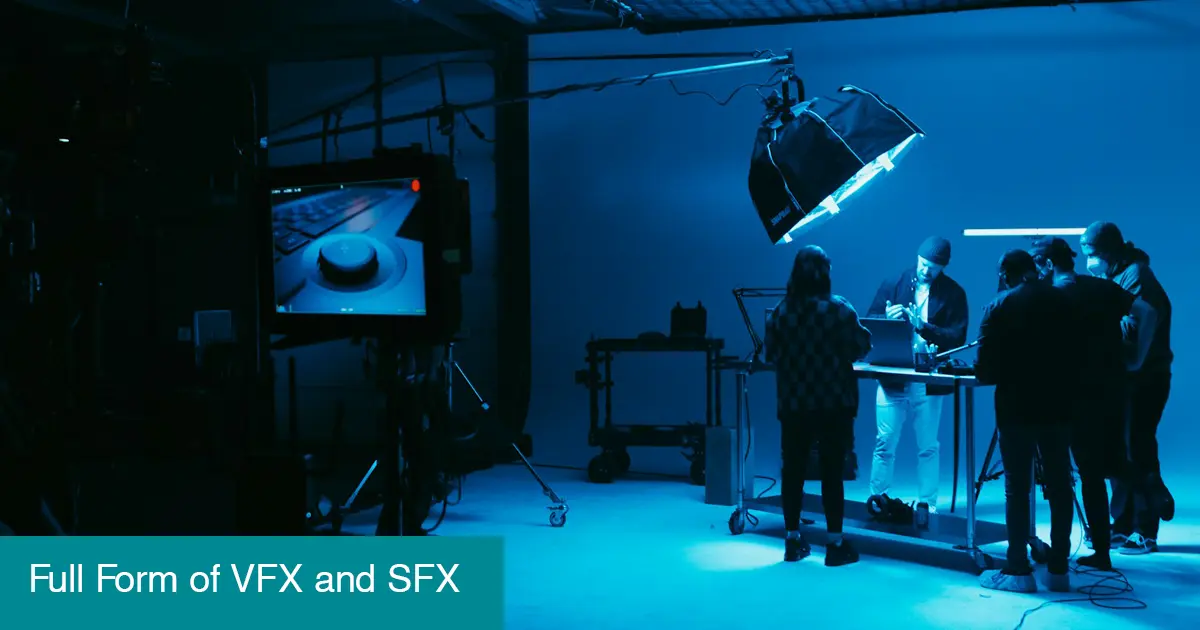
Have you ever imagined a career where you get to turn ideas in your head into scenes people watch on the big screen? If you enjoy thinking creatively, playing with visuals, and building worlds that don’t exist in real life, this field might catch your interest. Special Effects and Visual Effects, often called SFX and VFX, let you do exactly that.
In this blog, you’ll understand the full form of VFX and SFX, how these effects work, and how they are different from each other. You will also read about the SFX and VFX careers in India.
So let’s dive deep into the world of these amazing effects and discover how this field is the right pick for you or anyone who loves creativity mixed with technology.
What is the Meaning and Full Form of VFX and SFX?
SFX Full Form and Meaning – The full form of SFX is Special Effects. Special effects mean illusions created practically on sets with the help of real items, such as animatronics and mechanical props. These are effects that look impossible but are physically created on sets and in front of the camera. You can consider these effects as visual tricks that are generated using real things.
VFX Full Form and Meaning - What is the full form of VFX? The full form of VFX is Visual Effects. Visual effects mean digital effects. VFX is the process of creating, improving or adding imagery that wasn’t captured on location or during live-action filming.
What are Visual Effects?
Imagine a city flying in the sky, or a dragon emerging from the ocean. Scenes like these cannot be achieved through traditional or practical filming methods. You need to add or enhance the imagery to get the desired results. Visual effects help achieve such outcomes.
Visual effects are used in movies and videos to show scenes or objects that cannot be filmed in real life. These effects are integrated during post-production. In short, VFX help you create impressive illusions that smoothly combine with the real-world footage.
Some important types of visual effects include:
Green Screen – In green screen work, actors perform in front of a green background, which is later replaced with a different digital setting.
Matte Painting – It is used when only part of a location is real, and the rest is digitally drawn to make the scene look larger or more detailed.
Motion Tracking – This helps computers follow movement in a scene so that digital objects move correctly with the actors or the camera.
Computer-generated Imagery – Computer-generated Imagery, or CGI, is a broad term under which most of the VFX fall. CGI involves using computer graphics in media and the arts.
What are Special Effects?
Unlike visual effects, which are added post-production, the special effects are created directly on set. Special effects are real effects. They are not created digitally. You can create the special effects using materials, objects or actions from the real world. That’s the reason why the SFX look realistic.
SFX full form is Special Effects. In simple terms, whatever you see in special effects actually happens in front of the camera. Some common SFX examples are
Explosions and fire in movies – Explosions or fire in movies are created using controlled blasts and safe fire techniques by trained experts.
Prosthetic makeup – It is yet another example of special effects, in which actors wear prosthetics to look older or to transform into monsters or aliens.
Animatronics – SFX also involve animatronics and puppetry. These mechanical or hand-controlled models exist in reality and are used to create the effects. The movie Jurassic Park creatively used animatronics and CGI to create impressive, realistic dinosaurs.
Differences Between VFX and SFX
You must have noticed that SFX and VFX are often used together, especially in films and videos. Remember that both special effects and visual effects rely on principles of science, mathematics and engineering. They may sound similar, but note that they differ from each other. There are certain important differences between VFX and SFX. Let us understand those differences in an easy way.
When film producers or directors need to create dramatic scenes or fantasy worlds, they decide whether to use real-world or digitally created elements. This is where you start noticing the differences between VFX and SFX.
Special effects are created practically on the film set, whereas visual effects are created and added in post-production of films or videos.
Special effects use real things, whereas visual effects use digitally created elements.
In special effects, actors can see and touch the effect, for instance, the prosthetic makeup. Whereas, in visual effects, actors act against nothing. The imagery is added later, after the filming is done.
The best example to understand special effects is the rotating hallway scene from the movie “Inception”. This hallway was actually created so that actors could walk on the wall. One of the best examples of visual effects is the movie “Avatar”, where the whole world, including the flora and fauna, was created digitally.
Career Scope of SFX in India
As an SFX professional, you can explore a wide variety of job roles in India and abroad. You can find opportunities in the fashion, television, film, and theatre industries. There is especially a high demand for special-effects makeup artists in the film industry. Using your creativity and knowledge in special effects, you can make the actors look older or younger or create a supernatural look for them. You can even participate in international events, such as Comic-Con and showcase your skills.
VFX Career in India
The Indian visual effects industry is booming as many international studios are outsourcing their work to India. If you have the right skills, you can explore a range of career opportunities, including roles in VFX animation. Some of the most popular and interesting VFX job roles are:
1. Compositor
A compositor merges several scenes or images to get the final result. You get different images that have to be put together for the expected outcome. Imagine a scene in which an actor walks through a forest with fierce animals. You may get the footage of the forest, but you will have to create the animals digitally.
2. 3D Modeller
Just as the name suggests, a 3D modeller creates digital objects for games, commercials and movies. You will make the three-dimensional models of various characters and objects. For example, a car racing video game requires 3D models of cars before they are converted into animations.
3. VFX Artist
As a VFX artist, you can work on a variety of tasks such as designing realistic simulations, creating shader effects, making VFX animation, etc. You will combine computer-generated elements with live-action footage to produce realistic or fictional scenes that are impossible to capture in real life.
Also read “Graphic Design and Animation Courses – An Overview”.
Conclusion
If you love bringing stories to life and want to work in a field where the sky is the limit for your imaginative abilities, choose the exciting field of visual and special effects. VFX and SFX professionals are in high demand because of the growing need for content creation across different platforms.
If this field attracts you, explore the relevant and promising programmes at JAIN (Deemed-to-be University) today.
FAQs
Q1: Is VFX a good career?
A1: Yes, VFX is a good career. There is a high demand for VFX professionals not just in the entertainment industry but also in healthcare, advertising and architecture. VFX full form is Visual Effects. The VFX field helps one convert ideas and imagination into real work. Professionals have multiple opportunities to showcase their creativity.
Q2: What is VFX in film?
A2: Visual Effects, or VFX in films, are a combination of live-action footage and digital elements. The visual effects are used to create or modify visuals that cannot be achieved through real shooting. These effects help generate impossible scenes or characters, such as mermaids or futuristic worlds.
Q3: How to start learning VFX?
A3: You can start learning VFX with the help of online courses, tutorials and free software like Blender. Begin by learning simple techniques, such as basic three-dimensional modelling or green-screen compositing. You may gradually move on to advanced softwar e and tools.
Q4: Why is VFX so expensive?
A4: Creating a single scene or a character using VFX demands a lot of time and effort. This is the main reason why visual effects are so expensive. Visual effects artists have to work for days to complete a single task. It reportedly took several weeks for teams to create and refine complex CGI characters in the Transformers films.
Q5: Does VFX need coding?
A5: Visual effects require creativity and knowledge of different software, such as Nuke and Maya. Most of the VFX roles do not need coding, but it can be a very valuable asset, especially for technical roles in VFX, like pipeline developers.
Q6: How to make VFX in mobile?
A6: You can create visual effects on mobile with the help of some efficient applications. Apps like InShot or CapCut have built-in features that help in creating and editing for VFX.
Q7: Is VFX a high paying job?
A7: Yes, VFX is a high-paying job offering competitive salaries. Remuneration varies with a person's experience and skills. It also depends on the scope of the projects one works on.