Introduction
The education system is critical in building a strong and prosperous nation. A nation’s economy is linked directly to the quality of its education system. India, with a population of over 1.3 billion people, has the third-largest education system in the world. Since gaining independence, the country has made significant progress in education. India as a country since ancient years have practiced the Gurukul system and there has always been a deep connection between ‘Guru and Shishya’ and as the year passed by we have adopted the education system which was laid down by the British government during colonial period.
Detail Understanding of Education System in India
Primary and Middle (lower primary (Standards I to V) and upper primary (Standards VI to VIII)) education is compulsory and free in India. Primary education begins at age 6 with Middle/Upper Primary school education ending at age 14. Schooling is offered at state-run and private schools, however, private schools often have poorer facilities and infrastructure than government schools. The regional language is the medium of instruction for most primary schools and English as a second language generally begins by grade 3.
Secondary education begins in grade 9 and lasts until grade 12. The secondary stage is broken into two, two year cycles, generally referred to as General/Lower Secondary School, or ‘Standard X’, and Upper/Senior Secondary School, or ‘Standard XII’. Education continues to be free at government schools, although private education is more common at the secondary level. Public examinations are held at the end of both cycles and grant access to grade 11 and university level study respectively. General curriculum for lower secondary school in India consists of three languages (including the regional language, an elective, and English language), Mathematics, Science and Technology, Social Sciences, Work/Pre-Vocational Education, Art, and Physical Education. Secondary schools are affiliated with Central or State boards which administer the Secondary School Certificate at the end of grade 10.
Based upon performance in the first two years of secondary school, and upon the SSC results, students may enter Senior/Upper Secondary School. Upper Secondary School offers the students a chance to select a ‘stream’ or concentration of study, offering science, commerce, and arts/humanities. Education is administered both in schools or two-year junior colleges which are often affiliated with degree granting universities or colleges. Curriculum for the Higher Secondary Certificate Examination is determined by the boards of secondary education of which there are 31. Although the HSCE is the most common Standard XII examination, the All India Senior School Certificate (CBSE), Indian School Certificate, Certificate of Vocational Education (CISCE), Senior Secondary Certification (NIOS), Intermediate Certificate and the Pre-University Certificate are also offered.
Young people who do not wish to go on to tertiary education, or who fail to complete secondary school often enrol at privately-owned vocational schools that specialize in just one or only a few courses. Unlike in the United States, vocational and technical education is not highly specialized and is rather a broad overview of knowledge applicable to employment. The curriculum offered is composed up of a language course, foundation courses, and electives, of which half of electives are practical in nature. Examinations at the end of vocational education are conducted by the All India and State Boards of Vocational Education.
University education is overseen by the University Grants Commission (UGC), which is responsible for the development of higher education, allocating funds, and recognition of institutions in India. The National Accreditation and Assessment Council (NAAC) was established by the UGC to assess universities and college based upon an alphabetical ranking system ranging from A++ to C. The assessment and Accreditation is broadly used for understanding the Quality Status of an institution and indicates that the particular institution meets the standards of quality as set by the NAAC. Participation in the accreditation process of NAAC is voluntary.
There are various types of tertiary institutions in India, namely Universities (Central, State, Open), Universities of National Importance, and Deemed universities. Instruction of the majority of students, almost 80%, is completed at affiliated colleges with the curriculum, examinations, and final degree being designed and granted by the university. Constituent and Autonomous colleges also exist; though less common although they do enjoy greater autonomy in regards to curriculum development and assessment.
New Educational Frameworks in India
The idea of now educational policies have been introduced by Central and as well as State government to provide vast opportunities to our students at School and as well as Degree level. These changes were being brought in to give a wider perspective and adapting to new technologies in the field of education system. Some of the important features
Growth of Digital and Online Education:
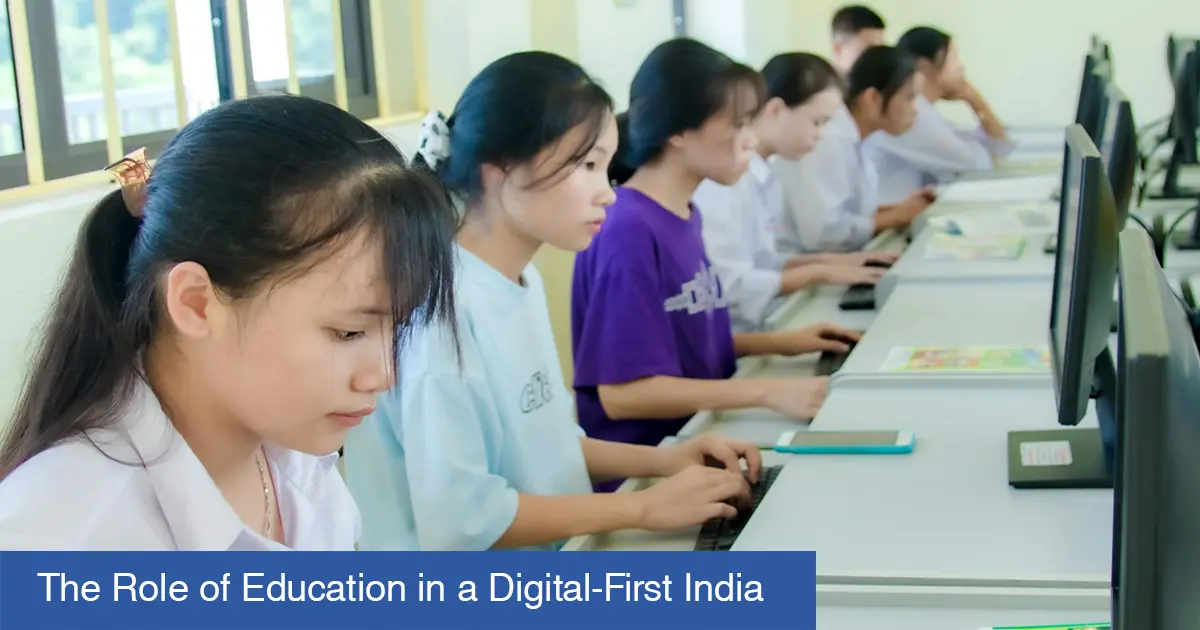
India's education system has swiftly adopted digital learning, particularly in the aftermath of the pandemic. The shift to online platforms and blended learning models has made education more accessible, especially for students in remote regions. The growth of education tech companies, along with government initiatives like Prime Minister E- Vidya, has greatly extended the reach of education. The major shift towards online education was seen drastically towards Covid time, wherein all the educational institutions has to shift from offline to Online mode.
Integration of Vocational Education and Skills Development:
The National Education Policy (NEP) 2020 emphasizes skill development and vocational education as key solutions to India's employment challenges. By embedding skill-based learning into mainstream education, India seeks to better equip its youth with the practical skills required to meet evolving industry demands. The Skill India mission aims to enhance employability and promote skill development across the country.
Enhanced Focus on Research and Innovation: India is gradually transitioning towards a research-driven education model with an emphasis on innovation and industry collaboration.
The government's push for research in higher education institutions has been supported by initiatives like the Atal Innovation Mission (AIM) and funding through the Research and Innovation in Higher Education (RISE) program. Over 10,000 Atal Tinkering Labs have been established across schools, engaging over 1.1 crore students in hands-on learning.
Moreover, India’s rank in the Global Innovation Index improved from 76 in 2014 to 39 in 2024. Anusandhan National Research Foundation (ANRF) has been established to promote research and development and foster a culture of research and innovation. Indian government has also been in support of encouraging the students to pursue research and innovative methods which overall can bring in a major change in society.
Challenges in Educational System in India
Limited Access to Quality Higher Education
Quality education in small towns and other marginalised communities is held back due to a lack of access to institutions that offer robust academics, qualified professors, and good infrastructure. Even though India has thousands of colleges and universities, the top institutions are all in cities. Because of this, many inevitably have to migrate, which puts pressure on their finances or makes them settle for a lesser quality education, expanding the gap between those who have opportunities and those who do not.
Outdated Curriculum Not Aligned with Industry Needs
Many courses are still too theoretical, placing less emphasis on skill-based education. It also diminishes the need to be engaged in solving real-world problems. Youth are finishing programs with degrees and no practical knowledge, rendering most students incompetent to transition into meaningful employment. The widening gap between market requirements and student exposure seems to be a prime contributor to youth unemployment.
Weak Industry-Academia Collaboration
There is little collaboration between post-secondary institutions and industries, meaning that there are inadequate entry point opportunities for students to have real-world exposure in internships, live projects, or training from industry professionals. Poor industry inclusion in post-secondary studies will quickly lead to even well-structured academic programs being outdated.
Low Focus on Research, Innovation, and Development
Many colleges, especially private institutions, are lacking research funding, labs and mentors for professors and students. Even if there were better funding, the motivation to seek new ideas or projects is lacking. If India is to be effective in solving local and global issues through innovation, it must develop a strong research culture. This has significant implications for India’s academic reputation globally and for measuring the level of scientific contribution by India.
Inequality in Access Based on Region, Caste, and Gender
Students from rural areas, lower caste backgrounds, minority communities, and marginalized gender identities face an array of challenges when it comes to access to quality education. These include socio-economic barriers (e.g., financial resources), socio-cultural challenges (e.g., familial expectations and cultural support), and a lack of knowledgeable guardians, cultural capital and preparedness in schools.
Digital Education in India and its future prospects
Online learning platforms have shifted from being alternatives to becoming the new norm. The focus has moved beyond traditional academics to practical skill development that actually prepares people for today's job market. In this article, we'll explore how EdTech is genuinely reshaping the education future in India.
Expansion of India’s EdTech Industry
India's classrooms are undergoing a remarkable change in both physical and virtual platforms. EdTech has become the driving force transforming how we learn, reaching students from Mumbai's high-rises to Rajasthan's villages with equal ease. The numbers tell an incredible story. Forbes estimates India's EdTech market will reach USD 10.4 billion by 2025, fuelled by affordable internet, widespread Smartphone adoption, and our growing demand for flexible education options.
Why This Growth Matters
This isn't just about impressive statistics. India is breaking traditional educational barriers that held back millions for decades. Online learning, personalized education paths, and skill-based curricula are preparing students and professionals for a globalised, automation-driven world where adaptability matters more than memorization.
For the first time, quality education isn't limited by geography or economic background; it's accessible to anyone with the will to learn.
Trends Shaping Online Learning in India
The digital-first generation in India seeks to find interesting, useful, and affordable education. These trends of digital education include AI-based personal tutors and gamified applications and are defining the future of teaching and learning.
Here are certain trends in digital education.
- Gamification and Edutainment: Immersive and fun learning.
- Adaptive Learning Systems: Customizing lessons based on performance with AI.
- Hybrid Learning Models: The best of both online and offline.
- Micro learning Modules: Providing brief and targeted lessons that are ideal when learners are in a hurry..