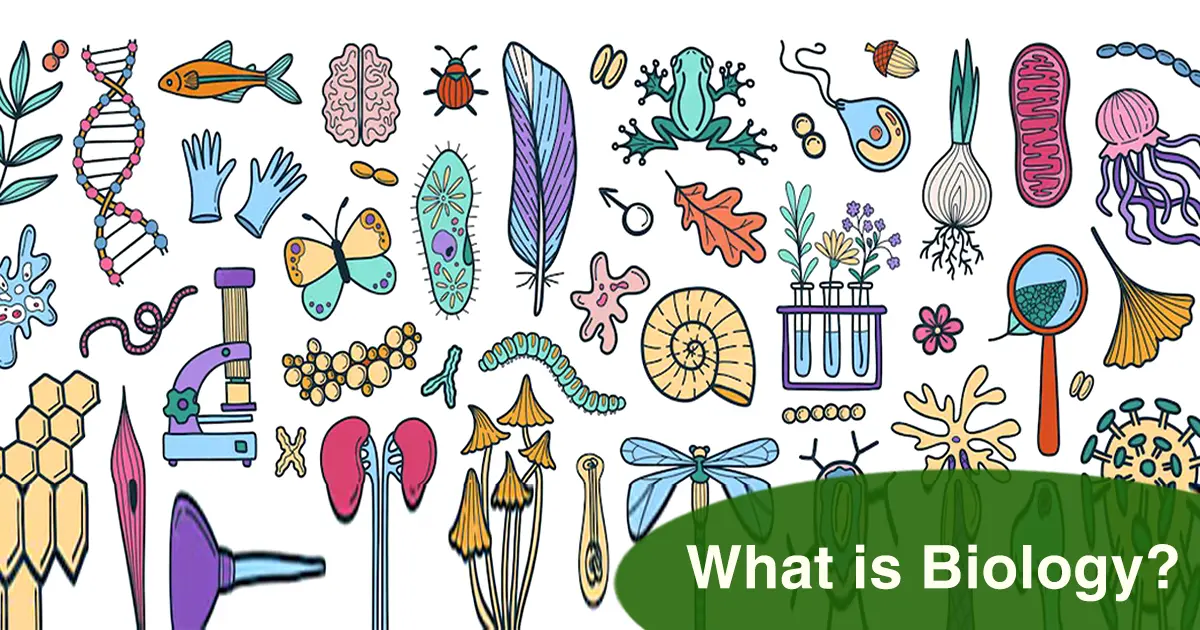
What is Biology?
Biology is defined as the branch of science that deals with living organisms and their processes. The term ‘Biology’ is derived from the Greek words “bios” (life) and “logos” (study), which means the study of life. It examines how microscopic organisms, complex plants and animals interact with one another. The field also utilises knowledge from Chemistry and Physics to understand vital life processes.
Why Study Biology?
Biology helps in understanding essential processes of life. It provides foundational knowledge about human health, diseases, and the interconnectedness of living organisms. It is a broad discipline that also encompasses concepts related to the environment, conservation, and climate change.
This study enables developments in fields of medicine, healthcare, research, agriculture, forensics, nutrition and conservation. The discipline also offers wide career opportunities for aspirants.
Key Branches of Biology
Biology is subdivided into multiple branches, each focusing on specific aspects. Core fields of Biology include:
- Microbiology: Refers to the study of microscopic organisms like bacteria, viruses, fungi, algae, and protists.
- Biochemistry: The study of the chemical processes and substances that occur within living organisms.
- Cell Biology: A branch of Biology that deals with the structure and function of cells.
- Botany: Refers to the study of plant life, including their structure and growth.
- Immunology: Immunology deals with understanding the body's immune system, cells, tissues, and organs.
- Zoology: Refers to the study of the animal kingdom, their structure, function, behaviour, and distribution.
- Anatomy: A branch of Biology that deals with the study of the structure and organisation of living things.
- Ecology: Ecology studies the interactions between organisms and their environments.
Biotechnology, Genetics, Marine Biology, and Evolutionary Biology are some other crucial branches of Biology.
Popular Biology Courses
There are many popular Biology courses offered in India. Regular B.Sc programmes typically span 3 years, while B.Sc. (Honours) or research programmes extend to 4 years. These courses prepare students for careers in healthcare, research, biotech, and environmental science.
| Programme |
Programme Duration
|
|
B.Sc Biotechnology
|
3 - 4 years
|
|
B.Sc Microbiology
|
3 years
|
|
B.Sc Genetics & Molecular Biology
|
3 years
|
|
B.Sc Zoology
|
3 years
|
|
B.Sc in Botany
|
3 years
|
|
B.Sc Biochemistry
|
3 years
|
|
B.Sc Environmental Science
|
3 - 4 years
|
|
B.Sc. Food Science
|
3 years
|
Career Opportunities in Biology
Career opportunities in Biology are vast in areas such as healthcare, biotechnology, research, and conservation. A bachelor's degree in Biology provides entry-level opportunities in many of these fields. Completing an M.Sc or PhD in Biology or related fields can help find specialised roles in genetic counselling, bioinformatics, environmental science, pharmacology, and forensic sciences. Below are some common work areas and job roles.
| Areas of Work |
Job Roles |
| Research |
Research Scientist, Laboratory Technician, Microbiologist, and Biochemist. |
| Healthcare & Pharmaceuticals |
Pharmacologist, Clinical Research Associate, Genetic Counsellor, and Biotechnologist. |
| Agriculture |
Food Scientist, Soil Scientist, Toxicologist, and Agricultural Consultant. |
| Biotechnology |
Research Scientist, Microbiologist, Clinical Research Coordinator, and Bioinformatics Analyst. |
| Academics |
Higher Education Lecturer, Research Scientist, and Post-doctoral Researcher. |
Key Skills Required to Succeed in Biology
Success in Biology requires a combination of strong analytical and technical skills. Below are some of the general technical skills required for success in the field.
- Proficiency in handling equipment such as microscopes, micropipettes, and autoclaves
- Ability to formulate hypotheses for scientific experiments.
- Skills in Molecular Biology and Genetics, including DNA extraction, PCR, and gel electrophoresis.
- Skills in Computational Biology, such as using software for DNA or protein sequence analysis.
- Conducting ecological surveys, species identification, and environmental monitoring.
- Knowledge of lab safety protocols, sterilisation techniques, and ethical handling of subjects.
Future of Biology
The field of Biology is advancing rapidly with the integration of technologies like AI, CRISPR-based gene editing, AI-driven drug discovery, and prime editing, which are shaping the future of Biology. Personalised mRNA vaccines, therapies for autoimmune disorders, and spatial biology for mapping gene expression are also gaining prominence. The field of synthetic biology is also redesigning crop production, biofuels, and bioremediation. Thus, the field is rapidly moving forward, ready to address the global challenges and needs.
Summary
In conclusion, Biology is an important discipline that finds applications in scientific discovery, agriculture, pharmacy, genetics and microbiology. The field offers endless opportunities in diverse branches, promising a future driven by innovation. Biology not only helps understand life on earth but also aids in solving major global challenges, such as the treatment of diseases and crop production. Careers in medicine, research, conservation, and synthetic biology are highly valued and offer stable jobs. Hence, a rewarding future awaits aspirants in this field.
Learn more about the top Biology programmes after Class 12 to start a career in this field.
FAQs
Q1. What is meant by Biology?
A1. Biology is the scientific study of life and living organisms. It encompasses structure, function, growth, origin, evolution, and distribution of living things. It explores microscopic cells, complex plants and higher-level organisms like human beings.
Q2. What are the 4 types of Biology?
A2. The four primary types of Biology include Botany (the study of plants), Zoology (the study of animals), Human Anatomy (the study of the human body and structure) and Microbiology (the study of microorganisms).
Q3. What is Biology used for?
A3. Biology has various applications, including understanding and treating human health, crop production, ecosystem management, production of biofuels, pharmacology and conservation. It helps in the making of vaccines, sustainable farming, environmental protection, and addressing climate change.
Q4. What are the basic principles of Biology?
A4. The basic principles of Biology include cell theory, gene theory, evolution by natural selection, homeostasis, and energy flow. These basic principles unify the field and explain life's core mechanisms.
Q5. What is the future of Biology?
A5. Biology's future involves integration of technologies like AI, advancements in CRISPR, gene editing, synthetic biology, and personalised medicine like mRNA vaccines. Spatial biology for tissue analysis, biomanufacturing, and targeted therapies will also see advancements.