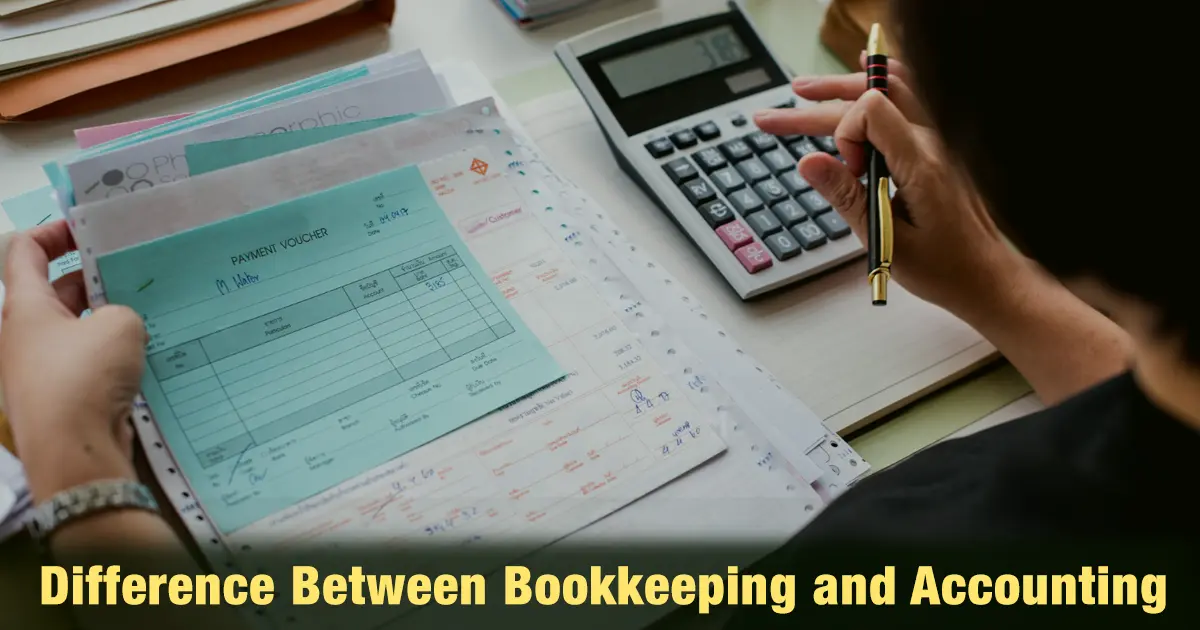
Bookkeeping vs Accounting: Definitions
Bookkeeping refers to the action of maintaining and organizing a company's financial records.
The process includes recording the transactions in books of accounts (e.g., the journal, ledger, cash book, etc.) by classifying and categorizing them in the appropriate manner.
Accounting is the activity of analyzing, interpreting, and reporting on business activity based on the data obtained from bookkeeping.
It involves compiling financial statements, assessing the company financial health, and calculating its assets and liabilities.
Accounting vs Bookkeeping: Primary Functions
The primary purpose of bookkeeping is to ensure accurate and organized financial records. It does not involve analyzing or interpreting financial data.
On the other hand, accounting provides analysis and strategic advice for informed decision-making, financial planning, and regulatory compliance.
The primary functions of bookkeeping vs accounting are given below:
| Bookkeeping Functions |
Accounting Functions |
| Recording financial transactions: Records daily business transactions such as sales, purchases, receipts, and payments. |
Analysing financial data: Examines financial records to evaluate the organisation's financial performance and position. |
| Maintaining books of accounts: Organises and updates financial records to ensure they are complete and accurate. |
Preparing financial statements: Prepares key financial reports such as the income statement, balance sheet, and cash flow statement. |
| Processing payroll: Maintains payroll records and ensures employees are paid accurately and on time. |
Interpreting financial information: Identifies trends, opportunities, and potential risks to support business growth. |
| Recording accounts receivable and payable transactions: Maintains records of customer invoices, supplier bills, receipts, and payments. |
Supporting business decisions: Provides insights for budgeting, forecasting, financial planning, and resource allocation. |
| Reconciling bank and ledger records: Matches financial records with bank statements and reports discrepancies for correction. |
Ensuring compliance: Ensures financial reporting complies with accounting standards, tax regulations, and statutory requirements. |
| Maintaining supporting financial documents: Organises receipts, invoices, vouchers, and other financial documents for record-keeping and audits. |
Advising stakeholders: Helps business owners, investors, lenders, and management make informed financial decisions based on financial reports. |
| Assisting with month-end record preparation: Ensures financial records are complete and ready for accounting review and reporting. |
Strategic financial planning: Uses financial analysis to recommend improvements, optimise resources, reduce risks, and support long-term business objectives. |
Key Difference Between Bookkeeping and Accounting
While the primary bookkeeping and accounting difference lies in their focus (bookkeeping is more day-to-day, while accounting is more holistic), there are other, more subtle differences. The key difference between bookkeeping and accounting is as follows:
| Basis of Difference |
Bookkeeping |
Accounting |
| Objective |
Maintains accurate and systematic records of financial transactions. |
Interprets financial data to evaluate performance and support business decisions. |
| Nature of Work |
Clerical, administrative, and routine. |
Analytical, interpretative, and advisory. |
| Stage in Financial Process |
Forms the foundation of accounting by recording financial data. |
Begins where bookkeeping ends by using recorded data for analysis and reporting. |
| Decision-Making Role |
Does not support strategic decision-making directly. |
Provides financial insights that help management and stakeholders make informed decisions. |
| Analysis and Interpretation |
Does not analyze or interpret financial information. |
Analyzes and interprets financial data to identify trends, opportunities, and risks. |
| Output |
Produces books of accounts, journals, ledgers, cash books, and trial balances. |
Produces financial statements, tax returns, audit reports, and management reports. |
| Financial Position |
Does not determine the overall financial health of a business. |
Evaluates profitability, assets, liabilities, cash flow, and overall financial position. |
| Skill Requirements |
Requires accuracy, attention to detail, and knowledge of recording financial transactions. |
Requires expertise in accounting principles, financial reporting standards, taxation, auditing, and analysis. |
| Complexity |
Comparatively simple and procedural. |
More complex due to analysis, interpretation, and regulatory compliance. |
| Professionals Responsible |
Performed by a Bookkeeper or Accounts Assistant. |
Performed by an Accountant, such as a Chartered Accountant (CA), Cost Accountant, or Management Accountant. |
| Frequency |
Carried out regularly, often daily or weekly, as transactions occur. |
Usually performed monthly, quarterly, or annually, depending on reporting requirements. |
| Regulatory Role |
Maintains records required for taxation and compliance. |
Prepares financial reports, tax filings, and statutory documents to meet legal and regulatory requirements. |
Difference Between Accounting and Bookkeeping: Skills and Duties
While they are similar, there is a significant accounting and bookkeeping difference with respect to skills and responsibilities. The table below summarizes the distinction:
| Bookkeeping Skills and Duties |
Accounting Skills and Duties |
| Recording financial transactions: Accurately records and maintains daily financial transactions in an organised manner. |
Financial analysis: Evaluates financial data to assess profitability, performance, and the overall financial health of a business. |
| Data accuracy and record management: Ensures financial records are complete, error-free, and up to date with strong attention to detail. |
Financial statement preparation: Prepares financial statements, including the income statement, balance sheet, and cash flow statement, in accordance with accounting standards. |
| Software proficiency: Uses bookkeeping and accounting software to record transactions and maintain financial records efficiently. |
Tax planning and compliance: Prepares tax returns, ensures compliance with tax laws, and advises on tax-related matters. |
| Accounts payable and receivable management: Manages invoices, records payments and receipts, reconciles accounts, and monitors outstanding balances. |
Auditing and internal controls: Establishes internal controls, supports audits, and verifies the accuracy and reliability of financial information. |
| Payroll processing: Calculates salaries, deductions, taxes, and maintains payroll records. |
Financial forecasting and planning: Develops financial forecasts, budgets, and models to support business planning and growth. |
| Basic financial reporting: Generates routine financial summaries and reports based on recorded transactions. |
Strategic financial advice: Interprets financial information and provides recommendations to support business decision-making. |
| Communication and coordination: Communicates with vendors, customers, employees, and internal teams regarding financial records and transactions. |
Stakeholder reporting: Presents financial reports and insights to management, investors, auditors, and regulatory authorities. |
| Essential skills: Accuracy, attention to detail, organisation, numerical ability, and proficiency in bookkeeping software. |
Essential skills: Analytical thinking, problem-solving, knowledge of accounting standards, taxation, financial reporting, and strong communication skills. |
Final Thoughts
Bookkeeping and accounting work hand in hand, but they are different from each other.
Bookkeeping concerns itself with the recording and maintenance of financial transactions. Accounting utilizes this information to understand business performance holistically.
By differentiating between the two, you will be able to choose the right career option for yourself and also understand how businesses manage their finances.
A degree in Commerce, Accounting or Finance will prepare you for a career in finance where you can work as a bookkeeper, accountant, financial analyst, auditor, tax consultant etc.
You can now explore all industry-relevant programs on our website that will help you prepare for a rewarding career in the field of accounting and finance.
FAQs
Q1: What is the difference between bookkeeping and accounting?
A1: The difference between bookkeeping and accounting is that bookkeeping focuses on recording financial transactions, while accounting involves analyzing, interpreting, and reporting financial information to support business decisions.
Bookkeeping is a part of accounting and provides the financial records that accountants use to prepare reports, ensure compliance, and offer strategic advice.
Q2: Is bookkeeping and accounting the same?
A2: No, bookkeeping and accounting are not the same. The bookkeeping and accounting difference lies in their scope.
Bookkeeping is the foundation, focusing on recording, classifying, and organising daily financial transactions.
On the other hand, accounting is a broader, analytical process that uses this data to interpret financial health, prepare tax returns, and support strategic business decisions.
Q3: What is bookkeeping in accounting?
A3: Bookkeeping is the process of recording, organising, and maintaining a business's daily financial transactions, such as sales, purchases, receipts, and payments. It forms the foundation of accounting by ensuring accurate financial records.
Q4: What can an accountant do that a bookkeeper can't?
A4: An accountant analyzes financial data, prepares financial statements, files tax returns, ensures regulatory compliance, and provides strategic financial advice.
A bookkeeper primarily focuses on recording and maintaining financial transactions.
Q5: Is it better to be an Accountant or bookkeeper?
A5: It depends on your career goals. If you enjoy managing financial records, bookkeeping can be a good choice, while accounting offers broader responsibilities, higher earning potential, and greater career advancement opportunities.