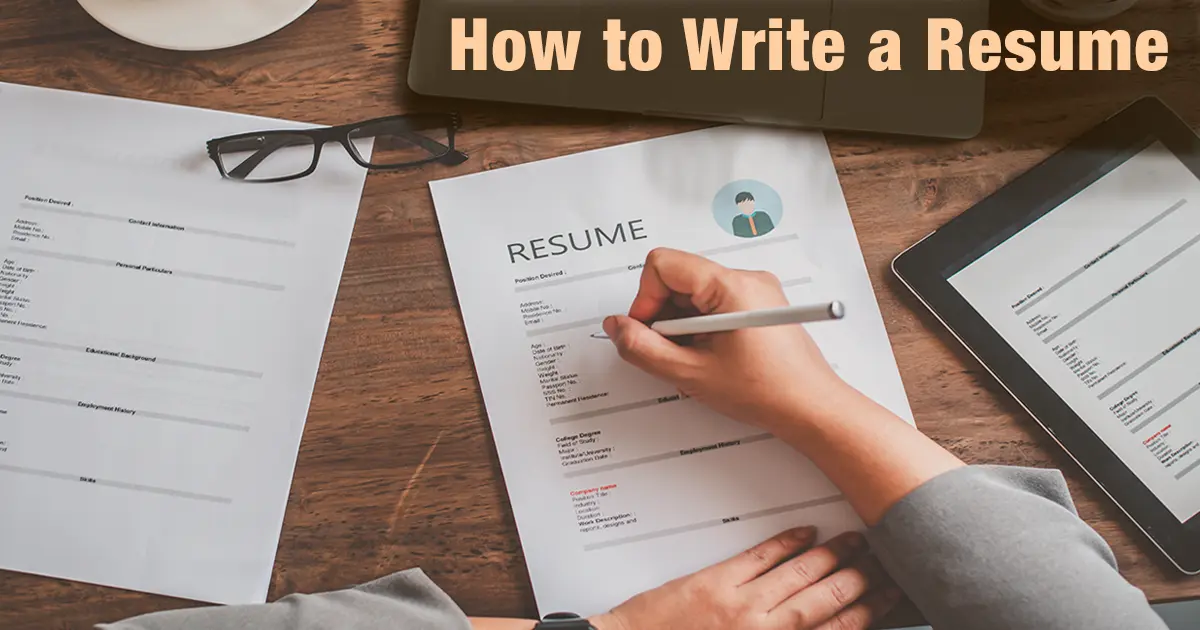
What is a Resume?
A resume is a professional document that provides a concise overview of your qualifications, skills, work experience, and key achievements. Its primary purpose is to demonstrate your suitability so that recruiters or hiring managers shortlist you for the next stage of the recruitment process.
Ideally, a resume should be one page long for freshers and one to two pages long for experienced professionals. It should also include only the most relevant information for the position you are applying for.
Things to Consider Before Writing a Resume
Before we answer how to prepare resume, it is important to understand what the potential employers or hiring managers are looking for.
Therefore, you need to spare some time in planning and understanding the market demands so that you can develop the best resume format that fits your work experience and achievements within one or two pages.
The following points should be taken into account before you focus on how to make resume:
| Checklist |
Why It Matters |
| Research your target role |
Learn about the job profile, responsibilities, and qualifications required so you can customize your resume for the position. |
| Analyze job descriptions |
Identify commonly mentioned skills, keywords, and requirements to make your resume more relevant to recruiters and Applicant Tracking Systems (ATS). |
| Identify ATS keywords |
Note frequently used skills, job titles, certifications, and keywords, and include them naturally in your resume. |
| Connect with industry professionals |
Gain practical insights into what employers value and understand the skills and experiences that can strengthen your application. |
| Stay updated with industry trends |
Read industry magazines, journals, blogs, or reports to understand current trends and employer expectations in your chosen field. |
| Review successful resume examples |
Explore well-written resume samples to understand how to format, organize and present your content effectively. |
| Gather your information |
Keep your education, work experience, certifications, projects, achievements, and skills ready to ensure a smooth and organised resume-writing process. |
How to Write a Resume: Format
There are three important resume formats that are widely used by individuals to showcase education, experience level, achievements and skills.
The subsequent sections discuss how to make CV and a resume as per each format:
An Overview of Resume Format
| Resume Format |
Best For |
Typical Sections |
| Chronological Resume |
Most job seekers, including freshers with internships, projects, or relevant academic experience, as well as professionals with a consistent work history. |
- Contact Information
- Career Objective/Summary
- Professional Experience
- Skills
- Education
- Additional Information (Optional)
|
| Functional Resume |
Candidates with significant employment gaps, career changers, or those re-entering the workforce who want to emphasise transferable skills over work history. |
- Contact Information
- Career Objective/Summary
- Key Skills
- Work Experience
- Education
- Additional Information (Optional)
|
| Combination Resume |
Professionals or freshers with internships, projects, certifications, or freelance experience who want to showcase both skills and work experience. |
- Contact Information
- Career Objective/Summary
- Work Experience
- Key Skills
- Education
- Additional Information (Optional)
|
Resume Sections Explained
| Resume Section |
What to Include |
Appears In |
| Contact Information |
Full name, phone number, professional email address, city/state, LinkedIn profile or portfolio (if applicable). |
All resume formats |
| Career Objective/Professional Summary |
A concise introduction summarising your career goals, qualifications, or professional experience. |
All resume formats |
| Professional Experience |
Job title, employer, employment duration, responsibilities, and measurable achievements. |
Chronological, Combination |
| Key Skills |
Technical and soft skills to write on a resume that are relevant to the job role and demonstrate your capabilities. |
Functional, Combination (also included in Chronological resumes) |
| Education |
Degree, institution, graduation year, and academic achievements (if applicable). |
All resume formats |
| Projects/Internships |
Academic, personal, freelance, or internship projects relevant to the role. |
All resume formats
(Highly recommended for students and freshers) |
| Certifications (Optional) |
Industry certifications, online courses, workshops, or licences. |
All resume formats |
| Volunteer Experience (Optional) |
Community service, NGO work, or unpaid experience demonstrating transferable skills. |
All resume formats |
| Achievements & Awards (Optional) |
Scholarships, honours, competitions, employee recognition, or notable accomplishments. |
All resume formats |
| Additional Information (Optional) |
Languages, professional memberships, publications, hobbies (if relevant), or references when requested. |
All resume formats |
How to Prepare Resume: Tips
So far, we have discussed how to make CV with respect to its format. But writing a CV that incorporates all the elements, the DOs and DON'Ts, its various aspects, etc., can be overwhelming.
Therefore, the table below summarizes how to make resume that is effective and eye-catching.
| Resume Tip |
Do's |
Don'ts |
| Choose the right format and layout |
- Select a chronological, functional, or combination format based on your experience.
- Use a clean, professional, ATS-friendly layout with clear headings and readable fonts.
|
- Don't choose a format based only on visual appeal.
- Avoid excessive graphics, tables, or complex formatting unless appropriate for the role.
|
| Write a strong introduction |
- Include a career objective in resume for freshers if you are beginning your career.
- Write a professional summary if you have prior work experience.
- Tailor the introduction to the specific job you are applying for.
|
- Don't use generic statements that could apply to any role.
- Avoid lengthy introductions that repeat information from the rest of the resume.
|
| Highlight relevant experience and achievements |
- List your work experience in reverse chronological order.
- Begin bullet points with strong action verbs.
- Quantify achievements using measurable results.
- Include internships, projects, or volunteer work that strengthen your profile.
|
- Don't copy your job description word for word.
- Don't focus only on responsibilities without demonstrating impact.
- Don't leave significant employment gaps unexplained when clarification is needed.
|
| Showcase your qualifications and skills |
- Include relevant education, certifications, and projects.
- Add skills to write on a resume that match the job requirements, including both technical and soft skills.
- Naturally incorporate keywords from the job description.
|
- Don't list every skill you possess.
- Avoid including outdated, irrelevant, or unverifiable skills and qualifications.
|
| Include professional contact information |
- Mention your full name, phone number, professional email address, and city/state.
- Add your LinkedIn profile or portfolio if it strengthens your application.
|
- Don't use an unprofessional email address.
- Don't include unnecessary personal details unless specifically requested by the employer.
|
| Review before submitting |
- Proofread your resume for grammar, spelling, formatting, and factual accuracy.
- Save the file in the requested format (PDF is generally preferred).
- Submit a tailored cover letter whenever appropriate.
|
- Don't send a resume with typographical or formatting errors.
- Don't use the same resume and cover letter for every job application.
|
Best Resume Examples
Here are some best resume examples that you can refer to and integrate into your own CV:
Resume Example 1: Experienced Graphic Designer
| Section |
Details |
| Name |
Rohan Bansal |
| Job Title |
Creative Designer & Illustrator |
| Contact Information |
Phone: +91 98775 26401
Email: rohanbansal@mail.com
Portfolio: linkedin.com/in/rohanbansal |
| Professional Summary |
Creative Designer with over five years of experience working in agencies and product-based companies. Skilled in graphic design, branding, UI/UX design, interaction design, and motion graphics. Experienced in leading cross-functional design teams and managing end-to-end design projects for clients. |
| Key Skills |
Technical Skills: Illustration, Concept Art, Branding, Storyboarding, Motion Graphics, UI/UX Design
Soft Skills: Leadership, Team Building, Project Management |
| Tools |
Adobe Creative Suite, Sketch, Figma, InVisionApp |
| Professional Experience |
Lead Designer – Lasso Design Studio (Feb 2020 – Present)
Senior Graphic Designer – Icons Galaxy Inc. (Feb 2018 – Jan 2020)
Graphic Designer – Oliver & Matthar Co. (Dec 2016 – Feb 2018) |
| Education |
Bachelor of Design (Graphic Design)
JAIN (Deemed-to-be University) (2012–2016)
Master of Design (User Experience Design)
JAIN (Deemed-to-be University) (2018–2020) |
Resume Example 2: Entry-Level Graphic Designer
| Section |
Details |
| Name |
Ishita Gupta |
| Job Title |
Graphic Designer |
| Contact Information |
Phone: +91 92251 66706
Email: gupta.ishita@gmail.com |
| Career Objective |
Creative and detail-oriented Graphic Design graduate with knowledge of illustration, typography, branding, interface design, and industry-standard design tools. Seeking an entry-level Graphic Designer role to apply creative skills, contribute to impactful design projects, and grow as a design professional. |
| Key Skills |
Technical Skills: Illustration, Typography, Hand Lettering, Branding, Animation & Motion Graphics
Soft Skills: Time Management, Teamwork, Effective Communication |
| Tools |
Adobe XD, Adobe Illustrator, Adobe After Effects, Sketch, InVisionApp |
| Education |
Bachelor of Design (Graphic Design)
JAIN (Deemed-to-be University) (2021–2025) |
| Certifications |
Typography and Hand Lettering (Online), 2026
Logo Design Masterclass (Online), 2025 |
| Projects |
Graphic Design for College Festival
Created and managed a personal design blog showcasing 50+ original illustrations and weekly design projects. Built a professional portfolio while consistently publishing creative work and experimenting with diverse design styles and digital illustration techniques.
Creator – Art & Muse
Created and managed a personal design blog showcasing original illustrations and weekly design projects to build a professional portfolio. |
Way Forward
A strong resume can improve your chances of getting shortlisted for interviews by showcasing your skills, qualifications, and achievements in the best possible way.
When you understand the nuances of resume writing by including the right sections and avoiding common mistakes, you increase your chances of getting shortlisted for interviews.
The key is to keep it relevant, well-structured, and tailored to the job you're applying for.
Making a good resume starts with career readiness and acquiring the right set of skills.
At JAIN (Deemed-to-be University), you can gain industry-relevant knowledge through practical learning, internships, certifications, and hands-on projects.
Explore the university's programmes to build in-demand skills, strengthen your resume, and prepare for a successful career.
FAQs
Q1: What is a resume?
A1: A resume is a professional document that summarises your education, work experience, skills, achievements, and qualifications. It helps recruiters assess your suitability for a job and shortlist you for interviews.
Q2: How do I write my resume?
A2: Start by choosing the right resume format and adding your contact information, career objective or professional summary, education, work experience, skills, and relevant achievements. Tailor your resume to the job description and proofread it before submitting.
Q3: What is another name for a resume?
A3: In many countries, including India, the terms resume and Curriculum Vitae (CV) are often used interchangeably.
However, they are not always the same. A resume is typically a concise, one- to two-page document tailored to a specific job, while a CV is a more detailed record of your academic, research, and professional achievements.
In countries such as the United States and Canada, the distinction is more pronounced, with CVs primarily used for academic, research, and medical positions.
Q4: What are hard skills for a resume?
A4: Hard skills are technical, job-specific abilities that can be learned through education, training, or experience. Examples include programming, data analysis, graphic design, accounting, foreign languages, and digital marketing.
Q5: What is a simple CV format?
A5: A simple CV format includes your contact information, career objective or professional summary, education, work experience, skills, certifications, and achievements in a clear, easy-to-read layout. It uses consistent formatting and focuses on relevant information without unnecessary design elements.