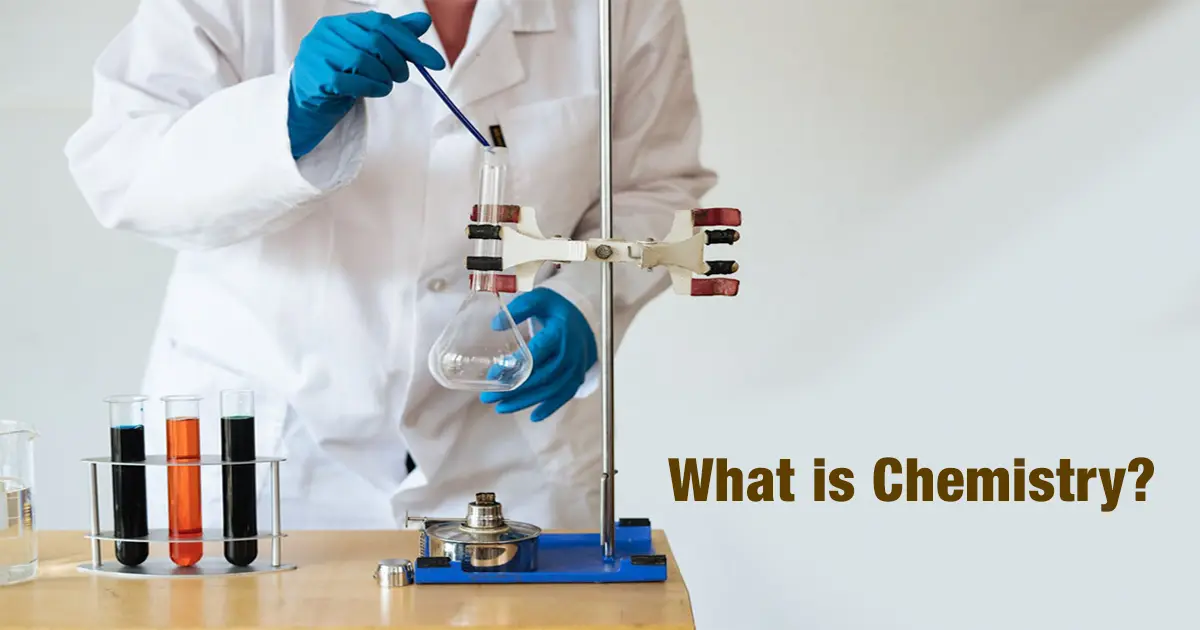
Chemistry gives us a deep understanding of the properties, composition, and structure of substances. This subject combines Maths, Physics, Biology and Environmental Science.
Individuals who have sound knowledge of Chemistry can work in many areas, including education, manufacturing, healthcare, and even forensic investigation. Because the field is so flexible, it is useful in both academic and business settings.
This blog talks about the main types of Chemistry, what they study, and why Chemistry is important in everyday life.
What is Chemistry?
Chemistry is a branch of science that examines matter, its composition and the changes it undergoes. It focuses on substances, their properties and the reactions through which new substances are formed.
At its core, Chemistry studies atoms, ions and molecules that combine to create elements and compounds.
Basic Concepts of Chemistry
Anyone planning to study Chemistry must be familiar with the basic concepts . These basics help one grasp more advanced principles of Chemistry later in their studies. The basic concepts of Chemistry are as follows.
| Concept |
Explanation |
| What is Matter and Its States? |
Matter is anything that has mass and occupies space. It exists mainly in solid, liquid and gaseous states, each defined by differences in particle arrangement and movement. |
| How is Matter Classified? |
Matter is broadly divided into pure substances and mixtures. Pure substances have a fixed, uniform composition, whereas mixtures are physical combinations of two or more substances with variable composition. |
| What are Atoms and Molecules? |
Atoms are the smallest units of elements. When atoms combine, they form molecules or compounds, which represent the basic structural units of substances. |
| Physical and Chemical Properties |
Physical properties can be observed without altering the substance’s identity, whereas chemical properties describe how a substance reacts to form new substances. |
| Measurement and SI Units in Chemistry |
Chemistry uses standard SI units such as metre, kilogram, second and mole to measure quantities like mass, length, time and amount of substance accurately. |
What are the Various Branches of Chemistry?
Chemistry is divided into several branches. Here is a quick overview of these branches of Chemistry.
| Branch of Chemistry |
Description |
| Organic Chemistry |
Organic Chemistry studies carbon-containing compounds, especially those combined with hydrogen, oxygen, nitrogen and halogens. It focuses on the synthesis of new compounds, reaction mechanisms and the use of spectroscopy to determine molecular structure. |
| Physical Chemistry |
Physical Chemistry explains chemical behaviour using fundamental principles such as thermodynamics, quantum mechanics and kinetics. It connects molecular structure with energy changes, reaction rates and the physical laws governing matter. |
| Inorganic Chemistry |
Inorganic Chemistry deals with minerals, metals, ores and some carbon-containing compounds like cyanides, carbon oxides and carbonates. It now includes advanced areas such as metal catalysis, superconducting materials and coordination compounds. |
| Biochemistry |
Biochemistry examines the Chemistry of living systems. It applies concepts from multiple branches of Chemistry to understand biological molecules, metabolic pathways and cellular processes. |
| Analytical Chemistry |
Analytical Chemistry focuses on identifying the composition, structure and quantity of substances in a sample. It uses precise measurement techniques to determine chemical content and purity. |
Scope of Chemistry
A degree in Chemistry can lead to many different jobs in fields like healthcare, research, and education. If one has a strong understanding of the basics, they can use chemical principles in quality control, production, and other areas.
The table below shows the different areas of Chemistry and helps to understand the scope of this subject with clarity.
| Area of Opportunity |
Focus |
| Research & Development |
Contribute to the development of new materials, formulations and chemical products in pharmaceutical, industrial or material science sectors. |
| Quality Control & Testing |
Evaluate raw materials and finished products to ensure safety, purity and compliance with industry standards. |
| Environmental Science |
Monitor environmental samples, assess pollution levels and support sustainable waste management practices. |
| Education & Training |
Teach Chemistry concepts, guide laboratory work and support academic research in schools and higher education institutions. |
Importance of Chemistry in Everyday Life
Why is Chemistry important? Because it provides the foundational knowledge that connects matter, energy and life processes in practical, observable ways. Every day, Chemistry influences activities and products that are familiar and essential to daily living.
Chemical reactions occur when ingredients are cooked, transformed and preserved. The development and action of pharmaceuticals depend on chemical interactions within the body. Soaps, detergents and disinfectants rely on chemical mechanisms to remove dirt and eliminate microbes. Plastics, fuels, batteries and other products are created and improved using chemical science.
Conclusion
Chemistry explains the structure of matter, the scientific principles behind reactions and the role of substances in everyday life and industry. This field offers a wide scope where one can find career opportunities in various industries, including research and academia.
Those planning to build a high-growth career in Chemistry must explore and choose from the relevant programmes at JAIN (Deemed-to-be University). These programmes build strong conceptual knowledge along with practical exposure, preparing one for future academic or industry pathways.
FAQs
Q1: What is meant by Chemistry?
A1: Chemistry is the branch of science that studies matter, its composition, properties and the changes it undergoes. It explains how substances interact and transform at the atomic and molecular level.
Q2: What are the branches of Chemistry?
A2: The main types of Chemistry include Organic, Inorganic, Physical, Analytical and Biochemistry. Each branch focuses on a specific area, such as carbon compounds, minerals, reactions, measurement or living systems.
Q3: What are the importance of Chemistry?
A3: Chemistry helps understand how materials are formed, how reactions occur and how products are developed. It supports industries like healthcare, agriculture, manufacturing and environmental protection.
Q4: How to become a Chemistry scientist?
A4: Becoming a Chemistry scientist involves a long-term commitment to academic study, research training, and hands-on laboratory experience. The journey generally takes four to ten years, starting from high school and moving through bachelor's, master's, and doctoral degrees (PhD).
Q5: Who is the father of Chemistry?
A5: Antoine Lavoisier is widely recognised as the Father of Modern Chemistry for establishing clear scientific principles, naming elements and developing the law of conservation of mass.
Q6: Why is it called Chemistry?
A6: The term “Chemistry” is derived from the ancient practice of alchemy, which was concerned with transforming substances, such as attempts to convert base metals into gold. When early scientists adopted systematic experiments and tried to explain matter and reactions based on evidence rather than mysticism, the term evolved into “Chemistry”.
Q7: What is Chemistry in daily life?
A7: Chemistry in daily life refers to the reactions and processes happening around us every day. Cooking, digestion, cleaning, and even breathing involve chemical changes.
Q8: What are the benefits of studying Chemistry?
A8: Studying Chemistry builds analytical thinking and problem-solving skills. It also opens career opportunities in research, education, healthcare, Environmental Science and industrial sectors.