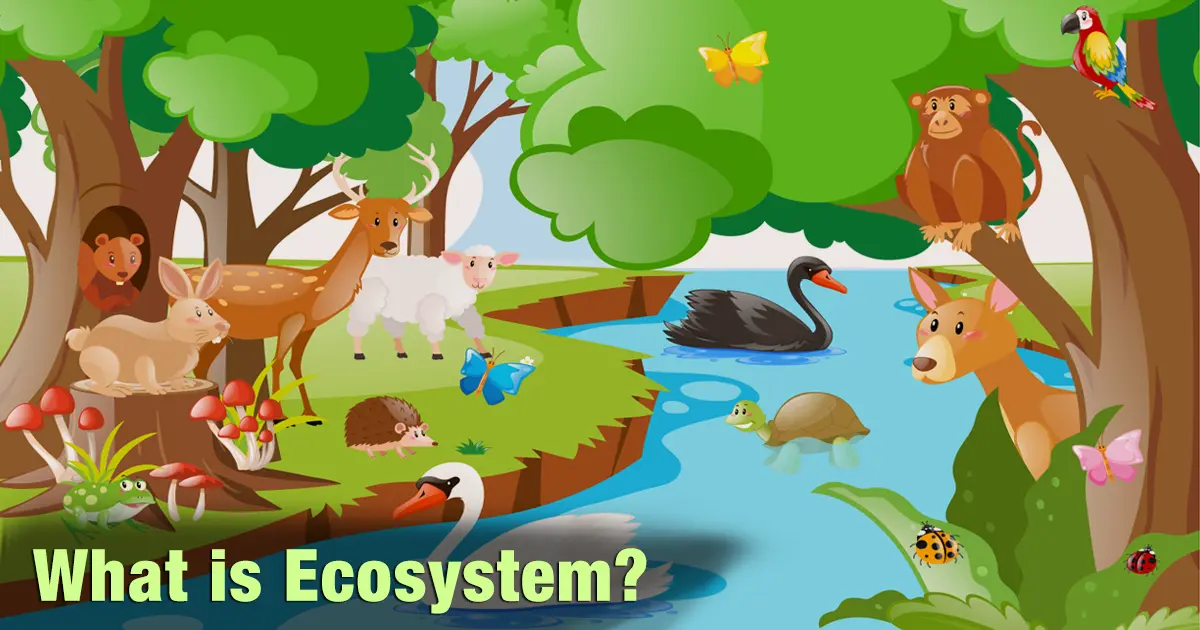
Natural processes such as the growth of plants or the changes in weather are interdependent rather than independent occurrences. They function within a system in which living organisms and their surroundings interact, forming an organized interaction between biotic and abiotic components known as an ecosystem.
This guide examines the structure of ecosystem while explaining the essential functions that maintain ecological continuity and balance.
What is Ecosystem?
First introduced by British botanist A.G. Tansley in 1935, the term was used to describe every habitat as an integrated whole. A standard ecosystem definition identifies it as a functional unit of nature where living organisms interact among themselves and with their surrounding physical environment.
Within this system, plants, animals, and microorganisms exist alongside non-living elements such as soil, water, and sunlight.
Understanding environmental science requires a clear grasp of these natural systems. Every environment, from a small pond to a vast tropical rainforest, maintains balance through the continuous exchange of energy and materials.
Structure of Ecosystem
The structure of an ecosystem is defined by the organization and distribution of its biotic and abiotic constituents.
| Component |
Category |
Description |
| Abiotic Components |
Non-living |
Includes physical factors like sunlight and temperature, and chemical factors like soil pH and minerals. |
| Biotic Components |
Living |
Consists of producers (plants), consumers (animals), and decomposers (fungi and bacteria). |
| Species Composition |
Biological Diversity |
Refers to the specific types of plant and animal species present in a particular habitat. |
| Stratification |
Vertical Layering |
The vertical distribution of different species occupying different levels (e.g., trees forming the top layer of a forest). |
Types of Ecosystem
Ecosystems are categorized primarily by the environment in which they exist. The table below presents the main types of ecosystems along with their characteristics.
| Category |
Type |
Description |
Examples |
| Terrestrial |
Forest |
Areas with dense tree cover and high biodiversity. |
Tropical Rainforests, Taiga |
| Terrestrial |
Grassland |
Regions dominated by grasses with moderate rainfall. |
Savannas, Prairies |
| Terrestrial |
Desert |
Arid regions with low rainfall and flora/fauna featuring unique adaptations. |
Sahara, Thar Desert |
| Terrestrial |
Tundra |
Cold regions with frozen ground and limited vegetation. |
Arctic Tundra, Alpine Tundra |
| Aquatic |
Freshwater |
Bodies of water with low salt concentrations. |
Rivers, Lakes, Ponds |
| Aquatic |
Marine |
Water systems with high salinity levels. |
Oceans, Coral Reefs |
Functions of Ecosystem
Every primary function of ecosystem involves the essential processes that maintain environmental stability. These operations ensure that energy moves through the food chain and that vital nutrients are recycled.
- Energy Flow: Solar energy captured by producers is passed to herbivores and carnivores. This unidirectional flow follows the 10% law, where only a fraction of energy reaches the next level.
- Nutrient Cycling: Also known as biogeochemical cycles, this process facilitates the movement of elements like carbon and nitrogen between organisms and their surroundings.
- Productivity: This refers to the rate at which organic matter is produced through photosynthesis.
- Decomposition: Decomposers break down dead matter, returning nutrients to the soil. This critical function of ecosystem restarts the life cycle by making minerals available for new growth.
Importance of Ecosystem
Ecosystems are fundamental to sustaining life and supporting human civilization by providing the following essential benefits:
- Agricultural Support: Ecosystems facilitate soil development and nutrient cycling, which are foundational to crop production and global food security.
- Resource Provisioning: They act as primary sources for vital resources, including freshwater, timber, and medicinal plants.
- Natural Regulation: Through pollination and climate regulation, ecosystems maintain the biological balance necessary for environmental stability.
- Biodiversity Conservation: Protecting diverse regions is essential for maintaining these processes. In India, areas like the Western Ghats (a global biodiversity hotspot) and the Himalayan ecological zones are subject to strict conservation efforts to protect endangered species and sustain water cycles.
Conclusion
Grasping the intricate balance between biotic and abiotic elements provides essential insight into the stability of our natural world. Every component contributes uniquely to environmental health, which ultimately shapes the quality of both ecological and human life. Recognizing the importance of ecosystem preservation is vital for building a sustainable future.
For students pursuing advanced studies in this field, programs at JAIN (Deemed-to-be University) offer a comprehensive curriculum that bridges theoretical frameworks with practical environmental applications.
FAQs
Q1: What do you mean by ecosystem?
A1: An ecosystem is a functional biological unit where living organisms, such as plants and animals, interact with each other and their non-living surroundings, including air, water, and soil. These components are linked together through nutrient cycles and energy flows, forming a self-sustaining system.
Q2: What is biotic and abiotic?
A2: Biotic components include all living entities, such as producers, consumers, and decomposers. Abiotic components consist of non-living elements like sunlight, temperature, and minerals. Together, these chemical and physical factors provide the essential life-support system for the biotic community.
Q3: How do ecosystems work?
A3: Ecosystems function by continuously cycling energy and matter. Producers capture solar energy and transfer it through the food chain to consumers. Finally, decomposers break down waste into soil nutrients, maintaining a balanced ecological cycle.
Q4: What is the largest ecosystem?
A4: The marine ecosystem is the largest ecosystem on Earth. It covers approximately 71% of the planet's surface and contains roughly 97% of Earth's water.