Strategically located across Bengaluru, our schools and centres reverberate with lively student life at every corner

For JAIN, implementing the NEP 2020 is more a matter of finetuning its educational processes, and procedures, as the essential principles of the policy are already engrained in the university’s milieu. JAIN has adopted the NEP 2020 in letter and spirit in keeping with its present status of a Deemed to be University.
Para-wise compliance is indicated below:
The University already has a Department of Languages offering programmes in Indian Languages (Sanskrit, Kannada, Hindi as third languages) with the objective of removing language barriers. While multiple Indian languages are offered as electives, the University is committed to promote bilingual mode of instructions. Imbibing Indian Heritage, culture and values has always been a part of the JAIN education process. A mandatory course on Mind Management & Human Values (MMHV) is already included in the UG programmes. This along with the volunteering practice by students in Adult Education and other NGOs leads to perceivable character building.
The other initiatives planned are:
NEP - 2020 has laid emphasis on India’s long tradition of holistic & Multidisciplinary learning thrust is place on literature 64 kalas, Vocational Skills, STEM, Liberal Arts & the like. This will enable a holistic & multidisciplinary education which would aim to develop capacities of Human beings ranging from intellectual, Aesthetics, Social, and Physical, Emotional and Moral Perspective in & integrated manner. In order to achieve this emphasis in laid on development of capacities in fields across arts, Humanities, Languages, Sciences, Social Sciences, Professional Technical & Vocational fields. In addition to this the primary stake holders that are students are also trained in the ethics of Social engagement Soft Skills, Communication Skills, Refined oratory & Rigorous specialization in the chosen fields. Towards this efforts have been made by JAIN (Deemed-to-be University) right from its inception to nurture the talent of the Student Community & nourish there Holistic development.
Various courses are introduced in the University to enable the students understand multidisciplinary approach. The following are some of the courses available at the University.
| Ethics, Awareness & Gender related issues | Cross cultural Management |
| Critical Thinking | Sociology of Women |
| Past History | Gender & Literature |
| Women’s Studies | Visual Narratives & Film Studies |
| Environmental Science | Shabdh Se celluloid tak |
| Philosophy & Public Policy | Janapada Kalegalu |
| Sociology & Elements of History for Engineers | Sahitya Mattu Parisara |
| MMHV | Rangabhoomi |
| Indian Aesthetics | Indian dramaturgy |
| History of Indian Art |
In addition to the above courses the departments across the schools of the University have proposed the following general electives to the students enrolled in various programmes of the University.
| Indian Culture | Western classical |
| Dance forms | Concepts of music |
| Dance & Theatre | Appreciation of Instrumental Music |
| World dance | Folk Dance & Folk theatre |
| Practionars of performing arts | Music Appreciation |
| Indian Cinema |
Specific areas of above activities: Spirituality, Yoga, Language, epics, classics, theatre, performing arts, Visual arts, women studies, gender & equity.
Towards inculcating values amongst our Learners, a unique mandatory course on Mind Management & Human Values (MMHV) is being taught to all the Undergraduate students, spread over semesters 1 and 2. Delivery and assessment of MMHV courses are implemented in a mission mode and brings unparalleled benefits to students wherein, curiosity is not suppressed, inquisitiveness is encouraged, excitement and dynamism are created, learning is expedited, intellectual debates, deliberations, and creativity & innovation become the routine. Through the well-planned course content of this course, mutual respect, mindfulness and resourcefulness are inculcated to ensure that everyone remains within accepted social norms of mannerism, civility and sensitivity towards every other living being, the community, the society, the nation as also the environment. After semester 2, students are continuously assessed for practicing/demonstrating the learning from MMHV, using the following rubrics:
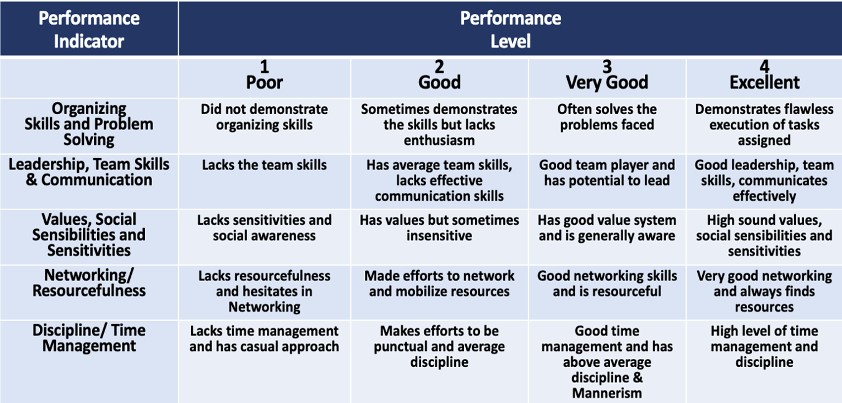
Additionally, several programmes for social good are also planned to be reached to our students through "Radio Active? - the community radio of JAIN.
In addition, JAIN (Deemed-to-be-University) is known for its vibrant campus, with the active participation of its students and staff in various social awareness activities, which brings about holistic development. These activities are organized under the auspices of the in-house NCC, NSS and other clubs. These events on average see active participation of 41% of the student community. In the last 5-years, about 300 programs have been organized in collaboration such as NGOs, Hospitals, Blood Banks, Govt., agencies and more. The various programs, as highlighted below provide a holistic development of students be it – the importance of blood donation, safe living in the neighborhood, empathy to fellow humans, make students aware of the current social challenges the society and nation at large are facing or be it the importance of body-mind wellness.
The orientation program is conducted for the first-year students to sensitize them to social issues and motivate them to enroll for NSS, NCC and other Student Forums/ Clubs, etc. for their holistic development. Through these Club/Forum the registered students will be able to participate in various extension and outreach programs organized.
In collaboration with various institutions such as Lion/Rotary Club(s), Rashtrotthana Blood Bank, Kidwai Hospital, Victoria, Vani Villas and around 20 blood donation camps have been organized in the last 5 years. On average 750 students and faculty have donated blood in these blood donation camps.
Programs for traffic rule awareness, self-defense, Women and Child Safety, etc., are conducted. In the recent past awareness of mask and being safe from COVID-19 has been also introduced.
Students organized relief camps for floods and other natural calamities. Visits to Orphanages and other Charitable Institutions to understand the societal issues and support the inmates.
Students and faculty participate in various rallies like ‘Rally for River’, BBMP swachata sarvekshan, Fitness, Against Open defecation, De-addiction, Cancer awareness, AIDS, Bone marrow, etc., are organized.
JAIN has adopted 9 villages, with the aim to contribute towards the economic and social betterment of these village communities.
Throughout the year various awareness programs are organized such as Health check-up, No-Smoking, Women empowerment, Rights to Education, Against Child labor, Cavery River basin conservation, etc., are all organized with the active participation of students and staff members. In the recent pandemic awareness of using masks in the correct way and sanitization was promoted.
The students and faculty participate in various programs for overall wellness such as – Yoga sessions, Fitness, Eye-Check-up camps, Spiritual wellness leading to wellness and living a purposeful life. In the recent pandemic, a 40-day Yoga practice (online) was organized for faculty and students.
The students and faculty are engaged in neighborhood community service by supporting the needy citizens by donating stationary, old garments and other items as per their requirements.
The University has already become a member of the Academic Bank of Credit. Skill based courses are integrated into each programme matrix, with appropriate credit units distributed, to provide ample opportunities for life-long and life-wide learning.
As a step forward towards implementing NEP 2020, UGC issued Regulations/ Guidelines for implementing Academic Bank of Credit and Multiple Entry and Exit System on July 28, 2021 and July 29, 2021 respectively. Both together, when implemented offer unprecedented flexibility and interdisciplinarity to learners as much as it the innovative programmes and pathways. The framework requires Universities to offer 4th year Undergraduate Degrees (level 8), that can be pursued by eligible students leading to Graduation in Honors/ Research and later one year Masters’ Degree. Below is the framework adopted in recasting UG Degrees offering the optional 4th Year. Since students may exit at the end of every year with appropriate credential (certification), each year is somewhat conclusive and incorporate all features and tenets of CBCS, Blended Learning and NEP 2020.
| Course Types Semester-wise |
1 | 2 | Year Tot |
Sum | 3 | 4 | Year Tot | Sum | 5 | 6 | Year Tot |
Grand Total | (%) |
| Core | 09 | 09 | 18 | 09 | 09 | 18 | 09 | 09 | 18 | 54 | 45 | ||
| Languages | 02 | - | 02 | 02 | - | 02 | - | - | - | 04 | 3.33 | ||
| SEC | - | 02 | 02 | 02 | - | 02 | 02 | 02 | 04 | 08 | 6.67 | ||
| DSE | 05 | 05 | 10 | 05 | 05 | 10 | 05 | 05 | 10 | 30 | 25 | ||
| TD Projects/ Dissertation | 02 | 02 | 04 | 02 | 02 | 04 | 02 | 02 | 04 | 12 | 10 | ||
| Generic/ Open Electives | - | 02 | 02 | - | 02 | 02 | 02 | 02 | 04 | 08 | 6.67 | ||
| AECC | 02 | - | 02 | - | 02 | 02 | - | - | - | 04 | 3.33 | ||
| Total | 20 | 20 | 40 | 10* | 20 | 20 | 40 | 10* | 20 | 20 | 40 | 120 | 100 |
| Credential | Certificate | Diploma | UG Degree | ||||||||||
Note: Efforts are made that each level has almost all types of courses so that each certification offers a complete experience during the period of learning.
While each semester is of minimum 15 weeks’ duration (excluding examinations), there will be a summer term of about 10 weeks between two academic years.
One credit unit requires 15 contact hours which need to be articulated in terms of lectures (L) having 100% weightage, Tutorials (T) having 100% weightage and Practical/ Projects (P) having 50% weightage.
| Course Types Semester-wise |
Up to Level 7 | Sum | 7 | 8 | Year Tot |
Grand Total | (%) |
| Core | 54 | - | - | - | 54 | 33.75 | |
| Languages | 04 | - | - | - | 04 | 2.5 | |
| SEC | 08 | - | - | - | 08 | 5 | |
| DSE | 30 | 30 | 16.75 | ||||
| TD Courses | - | 04 | 04 | 08 | 08 | 5 | |
| Research Projects/ Dissertation | 12 | 12 | 12 | 24 | 36 | 22.5 | |
| Generic/ Open Electives | 08 | - | - | - | - | 08 | 5 |
| Research Papers | - | 04 | 04 | 08 | 08 | 5 | |
| AECC | 04 | - | - | - | 04 | 2.5 | |
| Total | 120 | 10* | 20 | 20 | 40 | 160 | 100 |
* At the end of each academic year, there are about 10 weeks of summer period. During this period, the departments offer credit courses (10-12 credit units or 4 courses) to enable students to earn extra credits units to earn additional micro-credentials, certificates, minor specialization, super specialization, second specialization, diploma etc. or to enable them complete the programme earlier than normal duration (maximum by six months faster for programmes of more than 2-year or more duration). The requirement for various credentials/ Certifications will be as follows:
Micro Credential
Course with any number of Credit Units
Super Specialization
12 Credit Units from the same discipline as main specialization
Minor Specialization
18 Credit Units from another stream/ pathway
First Specialization
24 Credit Units from a stream/ pathway
Second Specialization
24 Credit Units
Certificate
40 Credit Units
Diploma
80 Credit Units
Degree
120 Credit Units
Degree with Hons/ Research
160 Credit Units
P G Diploma
160 Credit Units (Non Engineering & non MBA programmes)
Masters' Degree
200 Credit Units (Non Engineering & non MBA programmes)
This period may also be utilized for an internship through which students may earn up to 6 credit units.
The summer term will also be utilized to offer students an opportunity to clear the backlogs of courses of the previous year (Odd semester courses in initial 5 weeks and even semester courses in last 5 weeks of the 10-week period). The departments are encouraged to plan during the summer, exchange programmes, cultural immersion programmes, voluntary work/ social work, assignments with Government officials, police service, bureaucrats, politicians, creative work. Credit Units for these activities will be assigned as approved by the board of studies.
For courses to be taken as micro-credentials by our own students or by the students of other institutions, departments are encouraged to design innovative/ unique courses that appeal to larger audience. Development of a course should include TLEP, all the assignments, activities, teaching notes and videos (a MOOC) on the topic. The quality will be judged by the number of takers/ subscribers to the course when offered. There is potentially huge demand for such courses. These courses may also be recommended, as a bridge, when students of other institutions of JAIN (Deemed-to-be University) and others come in under multiple entry and exit system as per UGC Guidelines dated July 29, 2021.
| I Year (Level 8) |
II Year (Level 9) |
|||||
| Course Types Semester-wise |
Sem 1 | Sem 2 | Sem 3 | Sem 4 | Total | (%) |
| Hard Core | 8 | 6 | 4 | 4 | 22 | 27.50 |
| Soft Core / Specialisation | 6 | 4 | 8 | 4 | 22 | 27.50 |
| Open Elective | 2 | 2 | - | - | 4 | 5.00 |
| Research Project / Dissertation | 4 | 4 | 8 | 8 | 24 | 30.00 |
| Research Papers / Publication | - | 4 | - | 4 | 8 | 10.00 |
| Total | 20 | 20 | 20 | 20 | 80 | 100 |
The University has implemented provisions of the NEP pertaining to duration of the programme, multiple exit-entry, standalone courses etc.The changes made in the structure of programmes offered by the Department of Commerce is presented below as a case study:
B.Com – 1 Programme
B.Com (Honours) – 9 Specializations
M.Com – 2 Specializations
Duration: 4 Years (8 Semesters)
Eligibility: CGPA 7.5 or above in 3-Year Programme
| 7th Semester | |
| Research Project | 4 |
| Multi / Inter Disciplinary Electives (2) | 8 |
| GE | 4 |
| PCL | 4 |
| 20 | |
| 8th Semester | |
| Research Project | 8 |
| Trans Disciplinary Electives | 4 |
| GE | 4 |
| PCL | 4 |
| 20 | |
Guidelines for Multiple Entry and Exit in Academic Programmes offered in Higher Education Institutions : View Document
* Accredited by ACCA
Duration: 2 Semesters
Duration: 1 Year
Credits: 40
Aligned to NSQF
Duration: 2 Years, Credits: 80
Duration: 1 Year
Duration: 5 Years
Duration: 2 Years, Credits: 80
Duration: 1.5 Years
JAIN encourages research culture within the institution by providing freedom, state-of-the-art facilities, seed funding and a well-defined and supportive Research Policy. The institution has been investing in upgrading facilities (for research) over the past 13 years, involving the establishment of the following seven dedicated research centers in a phased manner:
In addition, the impetus has been provided through the allocation of seed money for supporting as many as 270 Projects during the five-year period. JAIN incentivizes its faculty members to start their research journey by acquiring a doctoral degree, to which JAIN subsidizes to an extent of 50% of the tuition fee.
The Board of Management (BoM) which is the apex statutory body within JAIN, drives policies and implementation of research activities, by regularly discussing the facilities / infrastructure, human resources, budget and incentives to seed and nurture research with the University.
The University has created infrastructure leading to the establishment of five dedicated research centres in emerging areas of national importance. JAIN encourages research culture within the institution by providing freedom, support for facilities and seed funding. The institution has been investing in upgrading facilities (for research) and providing impetus through seed money for supporting as many as 270 projects during the five year period, Research policy is widely communicated at the annual research retreats and through the website. In recognition of its impactful research, 142 research projects had been sponsored in many nationally important areas by the government agencies as well as non-government sources such as industry to the tune of Rs 19.23 crores. JAIN has two incubation centres, namely, Chenraj Roychand Centre of Entrepreneurship (CRCE) and the Technology Business Incubator (TBI) funded by the Department of Science & Technology. Through these, JAIN has incubated 99 start-ups in various technology domains.
3499 publications had resulted from research (2016-21). The highest impact factor of publication had been 60.62, setting a new benchmark. Research has also been focused on bringing focus on vitally important applications like water quality, new energy sources or environmental remediation. 851 workshops/seminars were held during the last five years. 184 Patents are published.
Extension activities, which bring about holistic developments, are organized under the auspices of various student clubs as well as NCC and NSS. These events on average see active participation of about 58 % of the student community.
JAIN (Deemed-to-be-University) has a vibrant consulting wing, with more than 270 consultancy projects spanning various domains like public policy, renewable energy/ fire and combustion, transportation, material testing and strategy for over 26 clients. Further, the synergy and linkage between research and applications are enhanced through collaborative MoUs that JAIN had developed with other research institutions and industries.
JAIN (Deemed-to-be-University) has an unerring focus on knowledge creation. The incubation center of the University conducts regular awareness programmes for faculty members on IPR related themes. The IPR Cell of the University supports the efforts of the faculty members to draft and file Patent applications. Further access is given to a patent attorney and all expenses pertaining to filing, examination and responding to queries are borne by the University. These efforts have resulted in the publication of 184 patents. It is notable that 3 Patents have been commercialized. The University licensed the production rights pertaining to ejection induced gasification stove to erstwhile FEPL Pune, now acquired by Thermax Limited. In fact, a royalty of rupees 13.95 Lakhs has been generated through this license agreement. The University also has a very unique model of encouraging faculty members to spin off the idea into a corporate entity. In fact, one company by the name of Greenchem Nano Pvt Ltd has been incubated by faculty members through the DST-supported Technology Supported Incubator of the University.
Ideation and inventive activities: Further, JAIN conducts regular activities to inculcate creativity and research culture within the University students and staff. Examples are the Idea contest and INVENTCH organized for students and staff. Participants pitch to a curated jury, consisting of entrepreneurs, investors and mentors. These ideation contests help in progressing ideas into inventions or developing prototypes, depending upon the maturity of the idea. Further, mentoring and counseling are provided by the experts to participants to sharpen the design ideas. Challenges in contests like Hackathons and Makeathons which are being organized have been enhancing innovative talents. Students and Staff are also encouraged to present papers at national and international conferences, publish their work in renowned Journals and apply for patents, with the incentives and support provided.
JAIN's incubators and start-ups: Besides the DST-funded TBI, JAIN has established one more incubation center namely, Chenraj Roychand Centre of Entrepreneurship (CRCE) and the Technology Business Incubator (TBI) funded by the Department of Science & Technology. Through these, JAIN has incubated 99 start-ups in various technology domains. Many of these start-ups have taken advantage of the expertise developed in diverse fields including Technology and Management at the University.
Evidence of incubator use: A regular feature of the incubators is to organize awareness programmes, IPR related programmes, training, mentoring, and other related activities to support the strengthening of entrepreneurship skills. In fact, a Seed Capital grant of Rs. 200 Lakhs has been provided to the TBI by NSTEDB-DST (National Science and Technology Entrepreneurship Development Board) which has been deployed in incubated companies. Over 50 events/activities evidence usage of Incubation centers including National Hackathons, women Entrepreneurship conclave and international delegations on innovations and venture capital, as detailed in additional documentation. In addition, the TBI has entered into a collaborative agreement with the Yunus Social Business Center, promoted by the pioneer of Micro Finance in the whole world and Nobel laureate, Prof. Muhammad Yunus from Bangladesh, for promotion and incubation of Social Business ventures.
While the establishment of the National Research Foundation (NRF) and related guidelines are awaited, JAIN 2.0 has undertaken initiatives to promote high quality research and innovation. IPR and Innovation Cells have been established and the unique Trans-disciplinary Project Centric Learning as planned will take the learners at both the UG and PG levels, beyond project-based learning. The outcomes of PCL will be in terms of Patents, Start-ups and superior quality publications. It will further link research to innovation and entrepreneurship taking education at the intersection of research and practice to greater heights.
Adoption of CBCS was taken up as early as in 2016. By 2017 it was extended to all programmes of the University including Engineering. The University awaits changes in the guidelines, if any, from the UGC
A Student Council is constituted at the beginning of each year at each of the campuses of JAIN (Deemed-to-be University) and they function under the overall guidance of the Dean (Student Welfare). They are provided autonomy and empowerment to fulfill their responsibilities and perform their functions. They have played a significant role in developing and nurturing in students important graduate attributes such as creative thinking, problem-solving, teamwork and communication skills, leadership, interpersonal competencies and emotional intelligence.
Student Council activities commence with events aimed at the soft landing for a fresh batch of students who are inducted by their seniors in a congenial atmosphere, such as Anveshana (Commerce department), Abhudya (Engineering & Technology), Parichay (Management). This is followed by domain-specific competitive events, such as Melange (Media), Infinity (Engineering), Sankalpa (CS & IT), Tarusamskrruthi (Commerce, CS & IT), Samanvaya (Quiz competition), Ecothon (Humanities & Social Sciences), and Precipice (International level competition of the Management Department (UG), focused on Entrepreneurship). Precipice is held at an international destination each year. Precipice 2020 was held in Spain. Precipice has entered the ‘Limca Book of Records as a "National Record"? for the largest student group traveling abroad; Cranium (International level competition of the Management Department (PG) is also held at a foreign location each year. The 2019 version was held in Turkey. Various clubs under the Engineering & Technology Student Council, such as Aero, Auto, Yaanthrik, Evalence, Infosphere, Spark, Atharva, Atom and Ignan, conduct workshops seminars, creative and fun activities. Samasthi (Commerce), Enactus (Commerce), Ukti (Science) and Krida (Science – for sports), Vox Populi (Journalism), Callosum (Psychology), Avant-Garde (English) are all student organizations, which organize and conduct various activities at respective campuses. Amhiti is a blood donation camp organized by the Engineering Students Council. Vaapana involved preparing a seed ball towards achieving greener earth, Chakra was for music therapy. Vitascope is a Film Festival. A large number of cultural events and competitions are conducted by the Student Councils such as Samyoga, Pulse, Kritya, Lasya, Sambhav and Abhinaya. These attract participants from many Universities. In addition, inter- University sports events are conducted such as the T-20 Cricket Premier League and a Football League. Student Councils take up leadership roles in conducting these various cultural fests, exhibitions, seminars, workshops, conferences, guest lectures and in maintaining discipline. They also contribute significantly to the cultural and societal outreach of the university.
Besides, with the aim of promoting participative management, University has inducted students into various bodies and Committees. such as the IQAC, Academic and Administration Committees in schools, Anti-ragging Committee, Equal - Opportunity Cell, Women’s Cell, Gender Sensitization Cell, Internal Complaints Committee, Editorial Boards of University newsletters, magazines, Placement Committee and in the Research Committees. Research and development cells such as ‘Anveshana’, ‘Vidhyanidhi’ and ‘Shodha’ have been established at various schools, wherein students collaborate with faculty in collating primary data analytics and finally in presentation/publication of papers in quality journals. Overall, Students Council plays a pivotal role in enhancing student welfare and ensuring institutional development.
The University has a dedicated counselling centre to serve students' counselling needs in addition to dedicated Placement Cell.
The University has been actively collaborating with Foreign Educational Institutions
View International Collaborations
Accredited / Integrated / Recognised Global Programmes
The University has planned to offer courses and programmes to International students in subjects such as Indology, Indian Languages, AYUSH systems of medicine, Yoga, arts, music, history, culture and modern India, social sciences and other relevant areas.
A Centre for Education Transformation through Technology (CETT) has been established by JAIN 2.0 for Staff Training and Capacity building. This Centre is envisaged to undertake need-based training and holistic development programmes for leadership to both, faculty and other staff of the University.

The Centre for Educational Transformation through Technology (CETT) at JAIN (Deemed-to-be University) is established to lead the way in exploring and adopting new technology tools, techniques, and practices. It is intended to provide thought leadership and direction, to establish and promote best practices and enable research and development by providing appropriate recommendations, support, and training. In addition, CETT is also expected to add value by contributing to optimization by centralizing resources with high-demand, unique knowledge or skills and their utilization across areas, improving outcome attainment and bringing more efficiency across various initiatives within the organization. CETT will strive to achieve Anytime, Anywhere, Personalized, Adaptive, Augmented, Advanced, Analytics’ Based, Smarter information processing and Smarter Decision Making. The Center will integrate advanced technology in the teaching learning process to ensure higher degree of engagement and effectiveness.
The key drivers of this center will be Innovation, Technology, Automation Process, Analytics and Quality and the key differentiators will be in the areas of content development, optimization of resources, design and delivery of learning resources and assessment patterns.
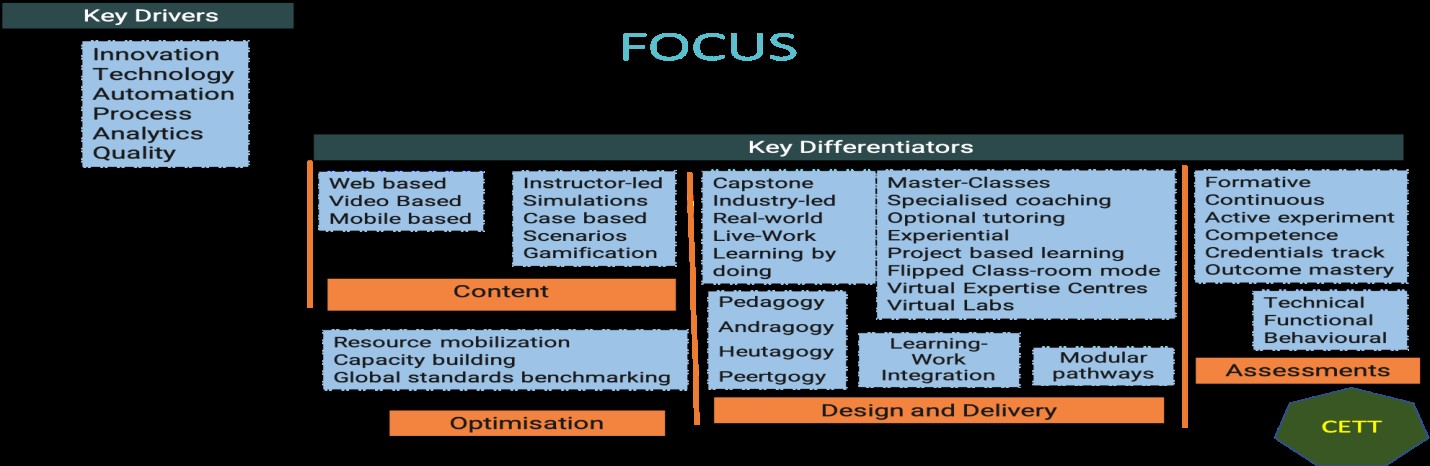
It is planned to organise appropriate FDPs incorporating the prescriptions of NEP-2020, UN SDGs 2030, and UNESCO HE transformation and Subject-related capacity building of teachers.
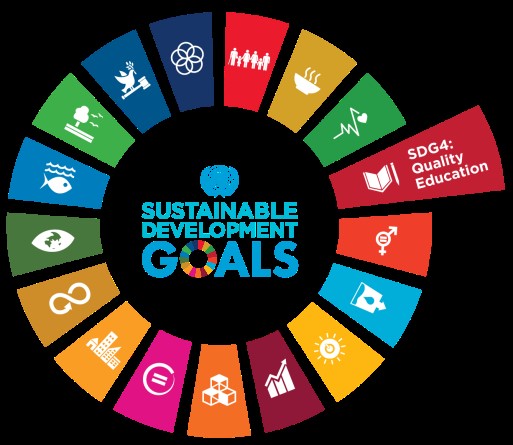
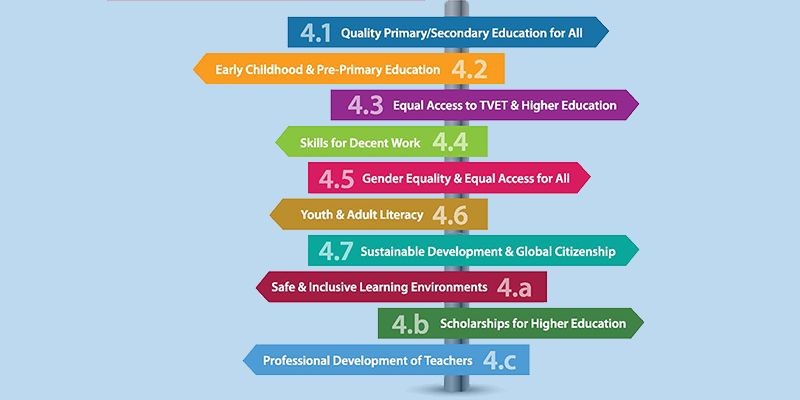

Intensive in-house Faculty capacity building programmes are planned through the JAIN 4E iterative model
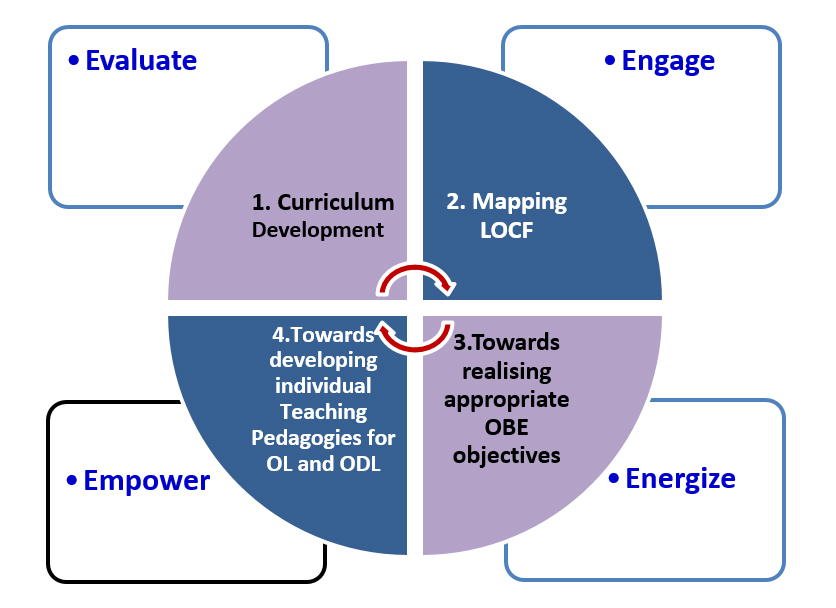
Faculty members have already been trained for adopting the CBCS system and the LOCF, as per the recommendations of the UGC.Teaching-Learning and Evaluation Plans (TLEPs) as per LOCF & CBCS have been implemented, including evaluation of co-curricular and extra-curricular activities in programme matrix.
The University has made concrete plans to generate e-content which can be uploaded on SWAYAM portal.